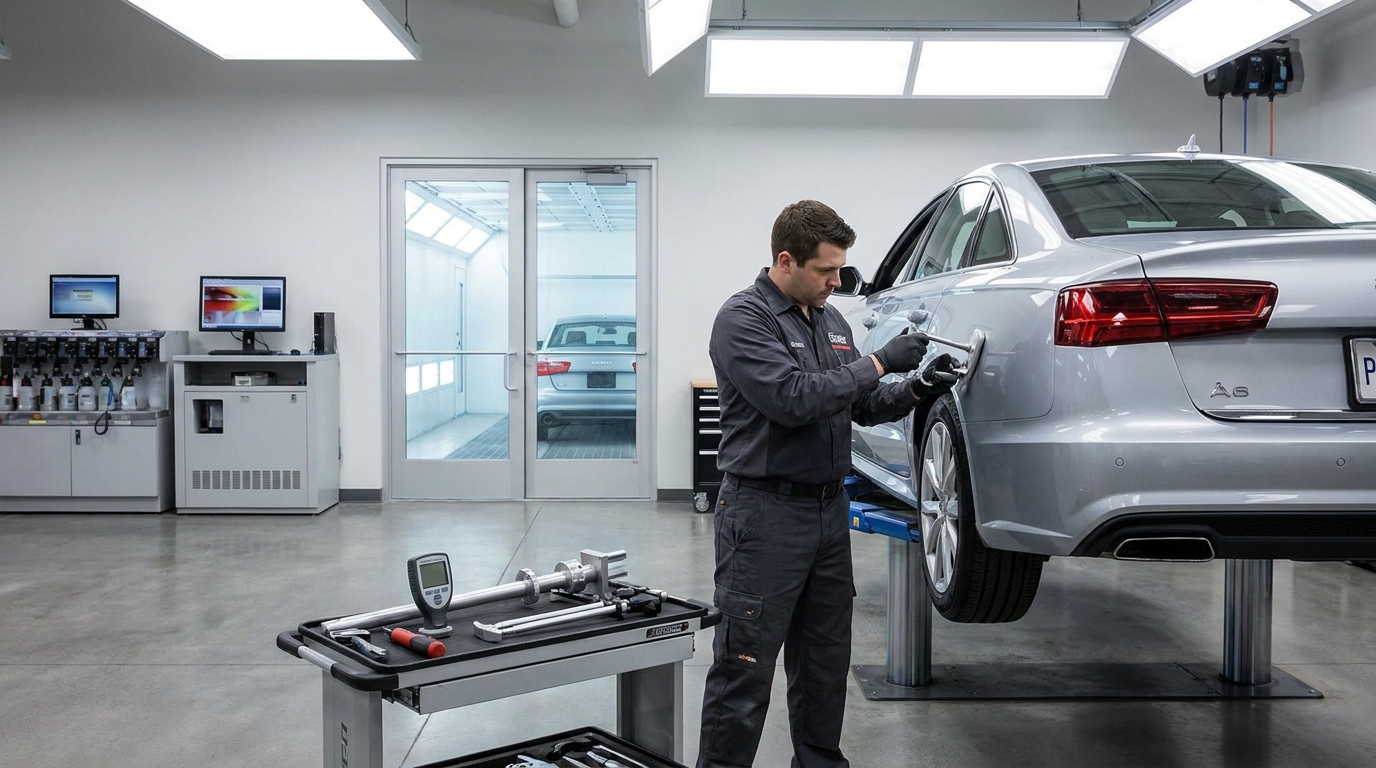
Audi Body Repair: Premium Materials and Techniques in Cape Town

Collision Coachworks Team
Expert Panel Beaters
When an Audi is involved in a collision, the stakes are higher than with most other vehicles. Audi body repair in Cape Town demands a level of expertise, tooling, and material knowledge that goes well beyond standard panel beating. At Collision Coachworks, located at 9 Assegaai Road, Parow Industria, we understand what it takes to restore an Audi to its pre-accident condition — structurally, mechanically, and cosmetically.
This guide walks through what makes Audi collision repair a specialist discipline, the premium materials and techniques involved, and what owners of Audi A3, A4, A6, Q5, and Q7 models should expect when bringing their vehicle in for repairs.
Why Audi Body Repair Requires Specialist Knowledge
Audi is part of the Volkswagen Group and sits firmly in the premium segment alongside BMW and Mercedes-Benz. Since the early 2000s, Audi has increasingly moved toward multi-material construction — combining high-strength steel, aluminium, and in some models, carbon fibre reinforced polymer (CFRP). The Audi A8 flagship, for example, uses an aluminium space frame called the Audi Space Frame (ASF), while the A4 and Q5 use aluminium-intensive hybrid structures.
This mix of materials creates challenges that a generalist panel beater may not be equipped to handle:
- Aluminium cannot be repaired the same way as steel. It work-hardens differently, requires different welding techniques (MIG-MAG aluminium wire or TIG welding), and must never be mixed with steel tools to prevent galvanic corrosion.
- High-strength steel (HSS) and ultra-high-strength steel (UHSS) components cannot simply be heated and straightened — doing so compromises their engineered yield strength and crash protection characteristics.
- Structural adhesives and rivets are used alongside welding in modern Audi bodies. Repairing these sections requires manufacturer-approved adhesive systems and rivet guns, not just a welder.
- ADAS calibration — Audi vehicles are loaded with sensors: radar for adaptive cruise control, camera systems for lane keeping, and ultrasonic sensors in bumpers. After any body repair that affects these components, recalibration using Audi diagnostic equipment (ODIS — Offboard Diagnostic Information System) is mandatory.
The Audi Repair Process at Collision Coachworks
Bringing an Audi into Collision Coachworks for audi body repair in Cape Town follows a structured, methodical process designed to restore the vehicle to OEM (Original Equipment Manufacturer) specification.
Step 1: Digital Damage Assessment
Before any work begins, the vehicle undergoes a thorough inspection. This includes a visual assessment of all visible damage as well as diagnostic scanning of the vehicle's electronic systems. Modern Audis log fault codes following an impact — even minor collisions can trigger codes in the airbag control unit, suspension modules, and body control modules.
For insurance-related repairs, a formal written estimate is prepared and submitted to the insurer's assessor. Collision Coachworks works with all major South African insurers including Santam, Discovery Insure, OUTsurance, MiWay, and Hollard.
Step 2: Body Structure Measurement
Using a vehicle measuring system, technicians verify the body geometry against Audi's published datum points. Even a seemingly minor rear-end collision on a Q5 or A6 can result in sub-frame displacement or strut tower misalignment that isn't visible to the naked eye. Computer-aided measurement catches these deviations before they become safety hazards.
Step 3: Panel Removal and Structural Repair
Damaged panels are carefully removed, and structural components are assessed. If the vehicle has aluminium structural components — common on A8, TT, and certain A4/A6 variants — these are repaired using dedicated aluminium repair stations. Aluminium tools must be kept strictly separate from steel tools to prevent cross-contamination and subsequent corrosion.
Structural repairs on high-strength steel sections follow Audi's approved repair methods, which specify whether a section should be cut and replaced rather than straightened. Attempting to straighten UHSS components with heat can create dangerous invisible weaknesses in crash structures.
Step 4: Panel Replacement and Fitting
Where panels require replacement, genuine Audi parts or OEM-equivalent parts are used. In South Africa, genuine Audi parts are available through authorised Audi dealers. For cost-effective repairs, OEM-equivalent parts (manufactured by the same suppliers that produce for Audi) offer quality comparable to dealer parts at a lower price point.
Panel fitting on Audi vehicles requires attention to extremely tight tolerances. Audi is known for its precise panel gaps and flush body lines — one of the hallmarks of the brand's build quality. A poor repair that leaves uneven gaps or misaligned body lines is immediately visible and reduces the vehicle's resale value significantly.
Step 5: Paint Preparation and Application
Audi's paint systems are multi-layer: electrocoat primer, filler primer, basecoat (often two layers for metallic and pearl finishes), and clearcoat. Matching Audi's factory paint requires sophisticated computerised spectrophotometer colour matching, particularly for complex finishes like Nardo Grey, Mythos Black, Ibis White, and the Audi Exclusive range of special-order colours.
At Collision Coachworks, paint mixing and application takes place in a climate-controlled, temperature-regulated spray booth that ensures optimal curing conditions. Dust contamination — the enemy of a flawless automotive finish — is eliminated through positive air pressure and multi-stage filtration.
Blending techniques are applied to adjacent panels where necessary to ensure seamless colour transition. This is particularly important with metallic flake and tri-coat pearl finishes, which can show visible differences between new and old paint if blending is not executed correctly.
Step 6: Reassembly and Quality Control
Following paint and clear coat application and curing, panels are refitted and all interior and exterior trim reinstalled. A final quality control inspection checks panel gaps, paint finish, operation of all electrical components, and any ADAS systems that require recalibration.
Common Audi Models We Repair in Cape Town
Cape Town's Northern Suburbs, including Bellville, Goodwood, Brackenfell, and Durbanville, have a high concentration of Audi ownership. The vehicles we most commonly repair at Collision Coachworks include:
- Audi A3 and S3 — frequently involved in parking lot scrapes and low-speed urban collisions. The A3's MQB platform uses high-strength steel extensively.
- Audi A4 and A4 Avant — a flagship executive saloon commonly used for business travel in the Cape Town area. The MLB platform (Modularer Längsbaukasten) uses aluminium in the front structure.
- Audi Q5 and SQ5 — popular family SUV. Rear-end damage is common on Q5s, and the vehicle's sophisticated air suspension and sensor array require careful post-repair assessment.
- Audi Q7 and Q8 — full-size luxury SUVs with complex body structures and extensive aluminium content.
- Audi TT and R8 — sports variants with aluminium-intensive ASF construction. These require the highest level of specialist knowledge and tooling.
Insurance Claims for Audi Repairs in South Africa
Comprehensive vehicle insurance is strongly recommended for any Audi, given the premium cost of parts and the specialist labour required for quality repairs. When submitting an insurance claim for Audi body repair in Cape Town, keep the following in mind:
- You have the right to choose your panel beater. Despite what some insurers may suggest, South African law does not require you to use an insurer's preferred repairer. You can specify Collision Coachworks and the insurer must accommodate a reasonable choice.
- Insist on OEM or OEM-equivalent parts. Check your policy wording — some policies default to aftermarket or reconditioned parts. For a vehicle like an Audi, this can significantly affect the quality of the repair and the vehicle's resale value.
- Request post-repair ADAS calibration. Ensure this is included in the scope of repair agreed with the insurer. Skipping calibration after sensor-affecting damage is both a safety risk and a liability issue.
- Repair vs write-off threshold: Audi parts are expensive. Insurers may be quicker to write off an older Audi if repair costs approach or exceed a percentage of the vehicle's market value (typically 70-80%). If you'd prefer a repair over a write-off, discuss this early in the claims process.
What Does Audi Body Repair Cost in South Africa?
Costs vary significantly based on the extent of damage, the model, and the parts required. As general guidance for Cape Town in 2026:
- Minor cosmetic damage (single panel scuff or dent): R3,500 – R8,000
- Single panel replacement and respray (e.g., a bumper or door): R8,000 – R18,000
- Moderate front or rear collision (multiple panels, structural assessment): R25,000 – R65,000
- Serious structural damage (chassis, strut towers, multiple panels): R70,000+
Aluminium-intensive models (TT, A8, R8) carry a labour premium due to the specialist tooling and training required. Always obtain a written, itemised estimate before authorising repairs.
Choosing the Right Audi Body Repair Shop in Cape Town
Not every panel beater in Cape Town has the equipment or training to work on premium German vehicles properly. When evaluating a repair shop for your Audi, ask the following:
- Do they have dedicated aluminium repair equipment, kept separate from steel tools?
- Do they have computerised vehicle measuring capability?
- Do they have a climate-controlled spray booth with spectrophotometer colour matching?
- Do they have access to ADAS calibration equipment or a partnership with a specialist calibration centre?
- Can they provide a written, itemised repair estimate?
- Do they offer a workmanship guarantee?
At Collision Coachworks in Parow Industria, the answer to all of the above is yes. Our team has extensive experience with Audi, BMW, Mercedes-Benz, and Volkswagen Group vehicles, and we treat every vehicle — regardless of age or model — with the same standard of care.
Conclusion: Audi Body Repair in Cape Town Done Right
Audi body repair in Cape Town is a specialist discipline that rewards careful choice of repairer. The combination of multi-material construction, tight tolerances, complex paint systems, and ADAS technology means that cutting corners — whether on materials, technique, or calibration — can have lasting consequences for the vehicle's safety, resale value, and driving quality.
Collision Coachworks, located at 9 Assegaai Road, Parow Industria, is conveniently accessible from Bellville, Goodwood, Brackenfell, Durbanville, and the broader Cape Town Northern Suburbs. Whether you're dealing with an insurance claim or a private repair, our team is ready to provide an honest, professional assessment and a repair that meets or exceeds factory standards.
Contact Collision Coachworks today to book your Audi for a damage assessment. Call us or visit our workshop at 9 Assegaai Road, Parow Industria, Cape Town — and get your Audi back to the condition it deserves.
Share Article
Need Expert Advice?
Get personalized consultation from our master technicians.
Related Articles
Hyundai and Kia Collision Repair in Cape Town: 2026 Specialist Guide
From i20 and Rio hatchbacks to Sportage and Tucson SUVs, here is what Cape Town owners need to know about Hyundai and Kia body repairs, parts availability, colour matching, insurance work, and 2026 cost ranges in ZAR.
BMW 3 Series Body Repair Cost in Cape Town: 2026 Guide
What BMW 3 Series body repair really costs in Cape Town in 2026 - from bumper scuffs to structural work, plus ADAS recalibration, genuine parts and how to keep quality high.
VW Polo Panel Beating Cost in Cape Town: 2026 Repair Price Guide
What does it really cost to repair a VW Polo in Cape Town? A 2026 breakdown of panel beating and spray painting prices for South Africa's best-selling hatchback, from bumper scuffs to full collision repair.