Car Accident Repair Timeline: From Assessment to Collection in Cape Town

Collision Coachworks Team
Expert Panel Beaters
After a collision, one of the first questions most car owners ask is: how long will my car take to fix? The car accident repair timeline in Cape Town can vary significantly depending on the severity of damage, insurance involvement, parts availability, and workshop capacity. At Collision Coachworks in Parow Industria, we believe in transparent communication at every stage, so our clients always know where their vehicle stands in the repair process.
This guide walks you through the typical timeline from the moment you drop off a damaged vehicle to the day you drive away — and explains what happens at each phase.
Phase 1: Initial Drop-Off and Damage Assessment (Day 1–2)
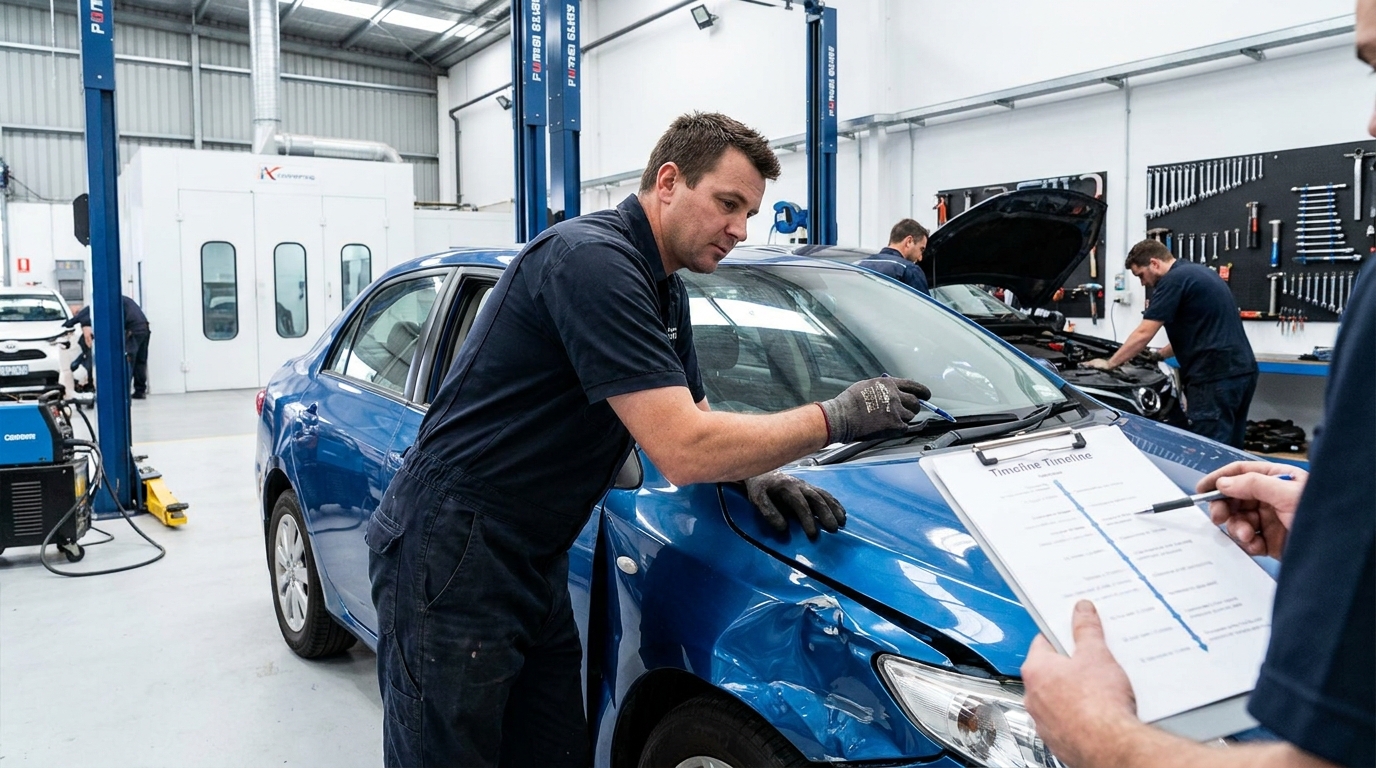
The repair journey begins with a formal vehicle assessment. When you bring your car in, our technicians carry out a thorough visual and structural inspection to document all damage — both visible and hidden. This is critical because what appears to be a minor bumper scuff can sometimes conceal cracked mounting brackets, misaligned chassis rails, or damaged cooling components underneath.
At Collision Coachworks, we use a combination of visual inspection and hands-on assessment to produce a detailed repair estimate. This estimate is then submitted to your insurer (if you're claiming) or shared directly with you for cash repairs. The assessment phase typically takes one to two business days.
Key documents produced at this stage include: the repair quotation, a photographic record of all damage, and an authorisation request to your insurance provider if applicable.
Phase 2: Insurance Authorisation (Day 2–7)
For insured repairs, this is often the phase that introduces the most waiting time in the overall car accident repair timeline. Once your panel beater submits the quote, your insurer appoints an assessor to inspect the vehicle and verify the damage against the claim. This assessor visit usually happens within two to five business days of submission.
After the assessor's visit, the insurer reviews the report and either approves the full quote, disputes certain line items, or requests additional information. In straightforward cases, authorisation comes through within three to seven business days from the date of submission. Complex structural repairs or disputes can take longer.
Pro tip: You can speed this phase up by submitting all required documentation promptly — including your accident report, driver's licence copy, ID, and policy number — when you first drop off the vehicle.
For cash repairs without insurance involvement, this phase is skipped entirely, and work can begin as soon as you approve the quotation — often the same day.
Phase 3: Parts Ordering and Procurement (Day 3–10)
Once authorisation is received, parts are ordered. Parts availability is one of the most variable factors in the repair timeline, and it depends heavily on your vehicle make and model.
Common vehicles in the Western Cape — such as the VW Polo, Toyota Hilux, Ford Ranger, and Hyundai i20 — generally have parts readily available from local distributors in Cape Town, often arriving within one to three business days. However, specialist or imported vehicles (certain European luxury brands, newer model variants, or discontinued models) may require parts to be ordered from Johannesburg or even internationally, which can add five to ten business days to the timeline.
At Collision Coachworks, we work with established parts suppliers in the Northern Suburbs and greater Cape Town area to source quality parts quickly and at competitive prices. We always use manufacturer-approved parts where possible, particularly for structural components that affect safety.
Phase 4: Panel Beating and Structural Repair (Day 5–14)
With authorisation in hand and parts on order or received, the physical repair work begins. The duration of this phase depends on the extent of damage:
- Minor damage (small dents, single-panel damage, minor scratches): typically 1–3 days
- Moderate damage (multiple panels, bumper replacement, bonnet or boot lid repair): typically 3–5 days
- Severe collision damage (chassis or structural damage, multiple panel replacements, airbag deployment): typically 5–10 days or more
Panel beating work involves reshaping damaged metal using specialist tools, replacing panels that cannot be economically restored, and realigning structural components to manufacturer tolerances. For vehicles with significant structural damage, chassis straightening on a dedicated jig is required to ensure the vehicle is safe to drive and handles correctly after repair.
Throughout this phase at Collision Coachworks, we document progress and flag any additional damage discovered once panels are removed — such as hidden rust, cracked support brackets, or damaged electrical harnesses. If additional work is required, we contact you and your insurer immediately rather than proceeding without authorisation.
Phase 5: Spray Painting and Paint Finishing (Day 8–16)
Once all metalwork is completed and approved, the vehicle moves to the spray painting phase. This is a multi-step process that takes longer than most people expect:
- Surface preparation: stripping old paint from repaired areas, applying filler where needed, sanding to a smooth finish
- Priming: applying primer to repaired and new panels to create the foundation for topcoat adhesion
- Colour matching: using computerised spectrophotometer technology to match your vehicle's exact colour code — critical for a seamless, undetectable repair
- Basecoat application: applying the colour layers in a controlled spray booth environment
- Clearcoat application: sealing the paint with protective clearcoat for gloss and durability
- Curing and drying: modern waterbased paints require controlled baking at elevated temperatures in the spray booth
- Polishing and buffing: blending the new paint into surrounding panels for a factory finish
This full process typically takes two to four days per vehicle, though it may be longer for full resprays or multi-panel repairs. At Collision Coachworks, we use a climate-controlled spray booth to ensure consistent paint quality regardless of Cape Town's variable weather conditions.
Phase 6: Reassembly and Final Quality Check (Day 12–18)
After painting, the vehicle is reassembled — all trim, lights, bumpers, glass, and mechanical components removed during the repair are refitted and tested. This is followed by a thorough quality control inspection covering paint finish, panel alignment, gap consistency, and mechanical function (lights, wipers, safety systems).
At Collision Coachworks, no vehicle leaves our workshop in Parow Industria without passing a final walk-around inspection by a senior technician. We check every repaired area against the original repair quotation to confirm all work has been completed to the required standard.
Phase 7: Final Billing and Vehicle Collection
For insurance repairs, the final invoice is submitted to your insurer, and you pay only your agreed excess (the portion you are responsible for) when collecting the vehicle. For cash repairs, the full invoice amount is settled at collection.
Collection is straightforward: you review the repairs with our team, confirm your satisfaction, complete the paperwork, and drive away. We recommend doing a thorough walk-around with a staff member before signing off — check panel alignment, paint colour match, and test any functions that were affected by the accident.
Typical Total Timelines at a Glance
Based on our experience at Collision Coachworks serving clients across Cape Town, Bellville, Goodwood, Brackenfell, and Durbanville, here are realistic end-to-end timeframes:
- Minor cash repair (no insurance): 2–5 business days from drop-off to collection
- Minor insured repair: 5–10 business days (including insurance authorisation)
- Moderate collision repair (insured): 10–15 business days
- Severe structural damage (insured): 15–25 business days or more
These timelines assume no delays in insurance authorisation and no parts supply issues. Extended timelines are typically the result of back-ordered parts, insurer delays, or discovery of additional hidden damage during the repair process.
How to Keep Your Repair Moving
There are several things you can do as a vehicle owner to avoid unnecessary delays:
- Submit all insurance documentation on the day of drop-off
- Respond promptly to any queries from your insurer or panel beater
- Confirm your excess payment method in advance so there are no delays at collection
- Keep your contact details current with both your insurer and Collision Coachworks so we can reach you immediately if we discover additional damage
- Avoid requesting unnecessary add-on repairs during the process, as these require fresh authorisation and can delay the primary repair
Why Choose Collision Coachworks for Your Cape Town Repair
Located at 9 Assegaai Road, Parow Industria, Collision Coachworks is centrally positioned to serve car owners across the Northern Suburbs, Bellville, Goodwood, Ravensmead, Brackenfell, and surrounding areas. We work with all major South African insurers and maintain direct lines of communication with assessors to keep authorisation delays to a minimum.
Our commitment is to keep you informed at every stage of the repair process — no surprises, no unexplained delays. From the initial assessment to the moment you collect your vehicle, our team is available to answer your questions and give you accurate timeline updates.
Ready to book your vehicle in or need a repair timeline estimate? Contact Collision Coachworks today at 9 Assegaai Road, Parow Industria, Cape Town. We'll give you a clear picture of what's involved and how long you can expect your repair to take.
Share Article
Need Expert Advice?
Get personalized consultation from our master technicians.
Related Articles
How Long Does Panel Beating Take? Repair Timeline Guide
Find out how long panel beating takes in Cape Town, from minor dents to major collision repair, with realistic timelines, process stages, and local factors that affect turnaround.
Hyundai and Kia Collision Repair in Cape Town: 2026 Specialist Guide
From i20 and Rio hatchbacks to Sportage and Tucson SUVs, here is what Cape Town owners need to know about Hyundai and Kia body repairs, parts availability, colour matching, insurance work, and 2026 cost ranges in ZAR.
Panel Beaters Bellville: Trusted Repairs in Your Neighbourhood
Looking for panel beaters in Bellville? Compare turnaround times, insurance support, spray-paint quality, and why Northern Suburbs drivers choose a workshop in Parow Industria for trusted collision repairs.