Chassis Straightening: When Your Car Needs Structural Repair

Collision Coachworks Team
Expert Panel Beaters
When a vehicle is involved in a serious collision, the damage goes far deeper than crumpled panels and scratched paint. The chassis — the structural skeleton of your car — can bend, twist, or compress in ways that are invisible to the naked eye but profoundly dangerous. Chassis straightening repair is one of the most technically demanding services in modern automotive repair, and it is essential for restoring both the safety and drivability of your vehicle after a significant accident.
At Collision Coachworks, located at 9 Assegaai Road, Parow Industria, Cape Town, we use computerised measuring systems and dedicated straightening benches to return collision-damaged vehicles to their original manufacturer specifications. In this guide, we explain what chassis straightening involves, how to know if your car needs it, and what to expect from the repair process.
What Is Chassis Straightening?
The chassis or body structure of a modern car is engineered to absorb and redirect collision energy — protecting the occupants inside a protective crumple zone. When that energy exceeds the design parameters, the structure itself deforms. Chassis straightening (also called frame straightening or structural realignment) is the process of using hydraulic equipment, anchoring systems, and precision measuring tools to pull the deformed metal back to its original dimensions.
There are two broad categories of vehicle construction that affect how this work is done:
- Body-on-frame vehicles: Older bakkies like the Toyota Hilux and Ford Ranger use a separate chassis frame beneath the body. Damage can be isolated to either the frame or the body shell.
- Unibody vehicles: Most modern passenger cars — including the VW Polo, BMW 3 Series, and Hyundai i20 — use a unibody design where the body and frame are a single welded structure. Any significant collision can distort this entire shell.
In both cases, professional chassis straightening repair requires specialised equipment and trained technicians who understand the geometry specifications of each individual vehicle model.
Signs Your Vehicle Needs Chassis Straightening
Not every accident requires chassis work — a minor fender bender may only affect outer panels. However, the following warning signs indicate that structural damage may be present:
- Uneven gaps around doors, boot lid, or bonnet — if panel gaps have shifted asymmetrically, the underlying structure has likely moved.
- Doors that won't open or close properly — door hinge pillars are key structural elements and even small distortions can cause binding.
- Vehicle pulling to one side — if your car drifts left or right on a straight road after a collision, the chassis may be twisted, throwing wheel alignment out of specification.
- Unusual tyre wear patterns — diagonal wear or rapid inner/outer edge wear can indicate that the axles are no longer tracking correctly.
- Visible creasing or buckling — crease lines that cut across the floorpan, sill sections, or firewall are a strong indicator of structural deformation.
- Cracks in glass or windscreen — if glass cracks without obvious stone chips, the vehicle body may be flexing due to frame misalignment.
- Vibration at highway speed — sustained vibration that cannot be resolved by wheel balancing can point to chassis or sub-frame damage.
If you notice any of these symptoms after an accident — whether in Bellville, Goodwood, Brackenfell, or anywhere in the Northern Suburbs — bring your vehicle in for a structural assessment immediately. Driving on a compromised chassis is both dangerous and likely to cause accelerating secondary damage to suspension, tyres, and driveline components.
The Chassis Straightening Process Explained
Modern chassis repair is a precise, data-driven process. Here is what happens when your vehicle arrives at Collision Coachworks for structural repair:
1. Initial Damage Assessment
The vehicle is inspected visually and placed on a flat datum surface. Technicians document all visible damage, and the information forms the basis of the repair estimate — which is forwarded to your insurer if you are claiming. At this stage, all airbags are noted, deployed units are flagged for replacement, and safety systems are checked for damage.
2. Computerised Measurement
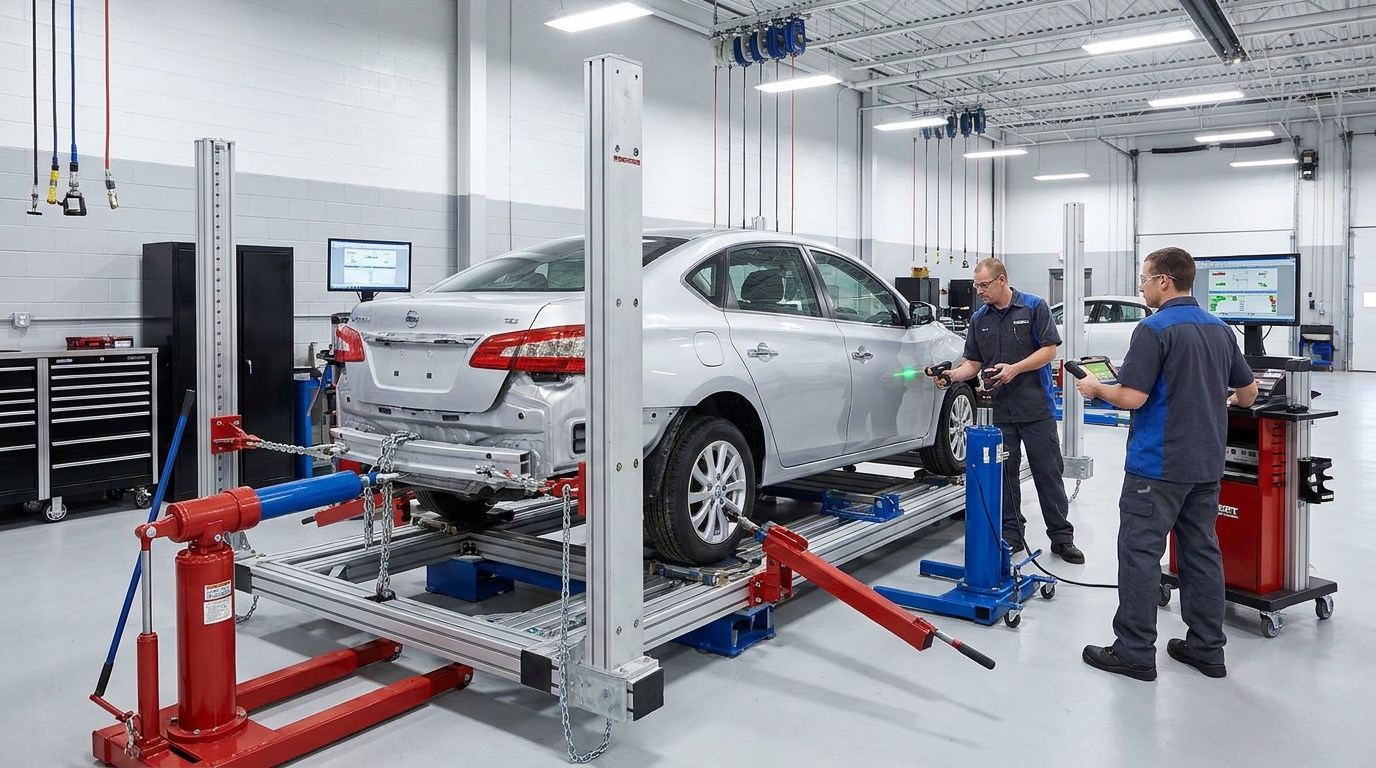
The car is secured on the straightening bench and connected to an electronic measuring system. Dozens of reference points across the vehicle — door sills, wheel arches, suspension mounting points, firewall, and rocker panels — are measured and compared against the original manufacturer data stored in the system's database.
This step is critical. Without computerised measurement, it is impossible to know the true extent of structural damage or to confirm that repairs have been completed correctly. The measurement system produces a detailed report showing which areas have moved, by how much, and in which direction.
3. Anchoring and Pulling
Once the measurement data has been analysed, the repair plan is established. The vehicle is anchored firmly to the bench at multiple points using high-strength clamps and pinchweld holders. Hydraulic pulling towers and rams are then positioned to apply controlled, calibrated force to the deformed sections.
Straightening is done incrementally — applying force, re-measuring, adjusting, and repeating — until the chassis returns to within manufacturer tolerances. This is skilled work that requires experience and patience. Moving metal too aggressively can introduce new stresses or cause cracking.
4. Sectional Replacement Where Necessary
Sometimes, deformed sections cannot be fully recovered through straightening alone — particularly if the metal has been compressed beyond its elastic recovery limit, or if structural components such as the firewall, A-pillar, or sill reinforcement have cracked. In these cases, the damaged section is cut out and replaced with new genuine or OEM-equivalent structural steel, then MIG welded into position using manufacturer-specified joining methods.
5. Final Measurement and Sign-Off
After all structural work is complete, a full final measurement is taken. The report must show that all reference points are within the specified tolerances before the vehicle can proceed to panel, paint, and mechanical reassembly. This measurement report is documented and retained as part of the repair record — important for insurance purposes and for future resale value.
Why Chassis Repair Must Never Be Skipped or Shortcut
In South Africa, some smaller panel shops may attempt to mask chassis damage by repairing only the outer panels — filling, priming, and painting over a vehicle that is still structurally compromised. This is not only poor workmanship; it is genuinely dangerous.
A vehicle with an unrepaired or improperly repaired chassis:
- Will not absorb a subsequent collision as designed — increasing the risk of serious injury or death to occupants.
- May fail a roadworthy certificate inspection.
- Will have degraded resale value and can expose the previous owner to liability if the structural history comes to light during a pre-purchase inspection.
- Can cause progressive damage to suspension geometry, tyres, and drivetrain — leading to ongoing repair costs.
Insurance assessors at reputable insurers increasingly require documented measurement reports before approving structural repair sign-off. Choosing an insurance-preferred or SAMBRA-aware panel shop that performs computerised measurement protects both you and your insurer.
What Does Chassis Straightening Cost in South Africa?
Chassis straightening is priced based on the severity and complexity of the damage. In South Africa, straightening work on a moderately damaged unibody vehicle typically ranges from R4,000 to R15,000 for labour and bench time alone, excluding any panel replacement, structural section replacement, or mechanical repairs.
Factors that influence cost include:
- The number of damaged zones (front, rear, and side structural damage each add complexity)
- Whether sectional replacement is required
- The vehicle's make and model (luxury vehicles and SUVs often have more complex structural designs)
- Access to factory measurement data (imported or rare vehicles sometimes require additional sourcing)
If you are claiming from insurance, the chassis repair cost is included in the overall claim estimate. If you are paying privately, Collision Coachworks will provide a detailed written quotation before any work begins.
Chassis Straightening and Your Insurance Claim
When a vehicle sustains structural damage in a collision, the insurance assessor's report will typically include a line item for "chassis/structural straightening" if warranted. It is important to understand the following:
- You have the right to choose your panel beater — your insurer cannot force you to use a specific repairer. However, some insurers have preferred repairer networks that offer guaranteed workmanship and faster claims processing.
- Request the measurement report — after structural repairs, always ask for a copy of the before-and-after computerised measurement report. This is your proof that the chassis was properly repaired.
- Understand the write-off threshold — in South Africa, if the cost to repair a vehicle exceeds a certain percentage of its market value (typically 70–80%, depending on the insurer), it may be declared a write-off. Structural damage can push repair costs over this threshold on older or lower-value vehicles.
How Cape Town's Roads Contribute to Chassis Stress
Cape Town's roads present a unique set of challenges for vehicle structures. Notorious potholes on roads throughout Parow, Goodwood, Bellville, and the Northern Suburbs create repeated impact loading on suspension components and sub-frames. While a single pothole strike rarely causes major chassis deformation, chronic pothole impacts can fatigue structural welds, loosen sub-frame mounting points, and accelerate corrosion at panel joints — making the chassis more vulnerable when a collision does occur.
Regular vehicle inspections are worthwhile, especially if you drive high-mileage routes through the Northern Suburbs industrial areas. A qualified panel shop can often spot early signs of structural fatigue or corrosion before they become serious safety concerns.
Chassis Straightening at Collision Coachworks
Collision Coachworks has been providing expert structural and collision repair in Parow Industria for years. Our workshop is equipped with a dedicated vehicle anchoring bench and computerised measurement systems capable of servicing most makes and models — from VW Polos and Toyota Hiluxes to BMW 3 Series and Ford Rangers.
Our technicians are experienced in both unibody and body-on-frame structural repairs. We work closely with all major South African insurers and can assist with the claims process from initial assessment through to final sign-off. Every structural repair at Collision Coachworks is completed to manufacturer specifications and documented with a full measurement report.
If you've been in an accident and suspect structural damage — or if your vehicle is pulling, handling oddly, or showing any of the warning signs listed above — don't wait. Early assessment and repair is always preferable to driving on a compromised structure.
Contact Collision Coachworks for a Structural Assessment
Chassis straightening repair is not a job for a general mechanic or an under-equipped panel shop. It requires specialist equipment, factory measurement data, and technicians who understand automotive structures. At Collision Coachworks, we have all three.
Visit us at 9 Assegaai Road, Parow Industria, Cape Town, or call us to book your vehicle assessment. We serve clients from across the Northern Suburbs — including Durbanville, Brackenfell, Bellville, Goodwood, Ravensmead, and beyond. If your car has been in a collision, let our team assess the full extent of the damage and provide you with an honest, transparent quotation for repair.
Share Article
Need Expert Advice?
Get personalized consultation from our master technicians.
Related Articles
Electric Vehicle Body Repair: New Challenges for Panel Beaters (2026 Update)
Electric vehicle body repair panel beating brings high-voltage safety, aluminium structures, and specialised adhesives that traditional workshops must master. Here is what Cape Town EV owners should know in 2026.
How Long Does Panel Beating Take? Repair Timeline Guide
Find out how long panel beating takes in Cape Town, from minor dents to major collision repair, with realistic timelines, process stages, and local factors that affect turnaround.
Hyundai and Kia Collision Repair in Cape Town: 2026 Specialist Guide
From i20 and Rio hatchbacks to Sportage and Tucson SUVs, here is what Cape Town owners need to know about Hyundai and Kia body repairs, parts availability, colour matching, insurance work, and 2026 cost ranges in ZAR.