How Climate-Controlled Spray Booths Improve Paint Quality

Collision Coachworks Team
Expert Panel Beaters
When it comes to achieving a flawless automotive paint finish, spray booth paint quality is directly linked to the environment in which the work is performed. At Collision Coachworks in Parow Industria, Cape Town, our climate-controlled spray booth represents one of the most significant investments we make in delivering premium results for every vehicle that comes through our doors. Whether we are respraying a VW Polo after a hailstorm, touching up a Toyota Hilux that caught a guard rail, or completing a full restoration on a BMW 3 Series, the controlled environment of a professional spray booth makes a measurable difference in the outcome.
What Is a Climate-Controlled Spray Booth?
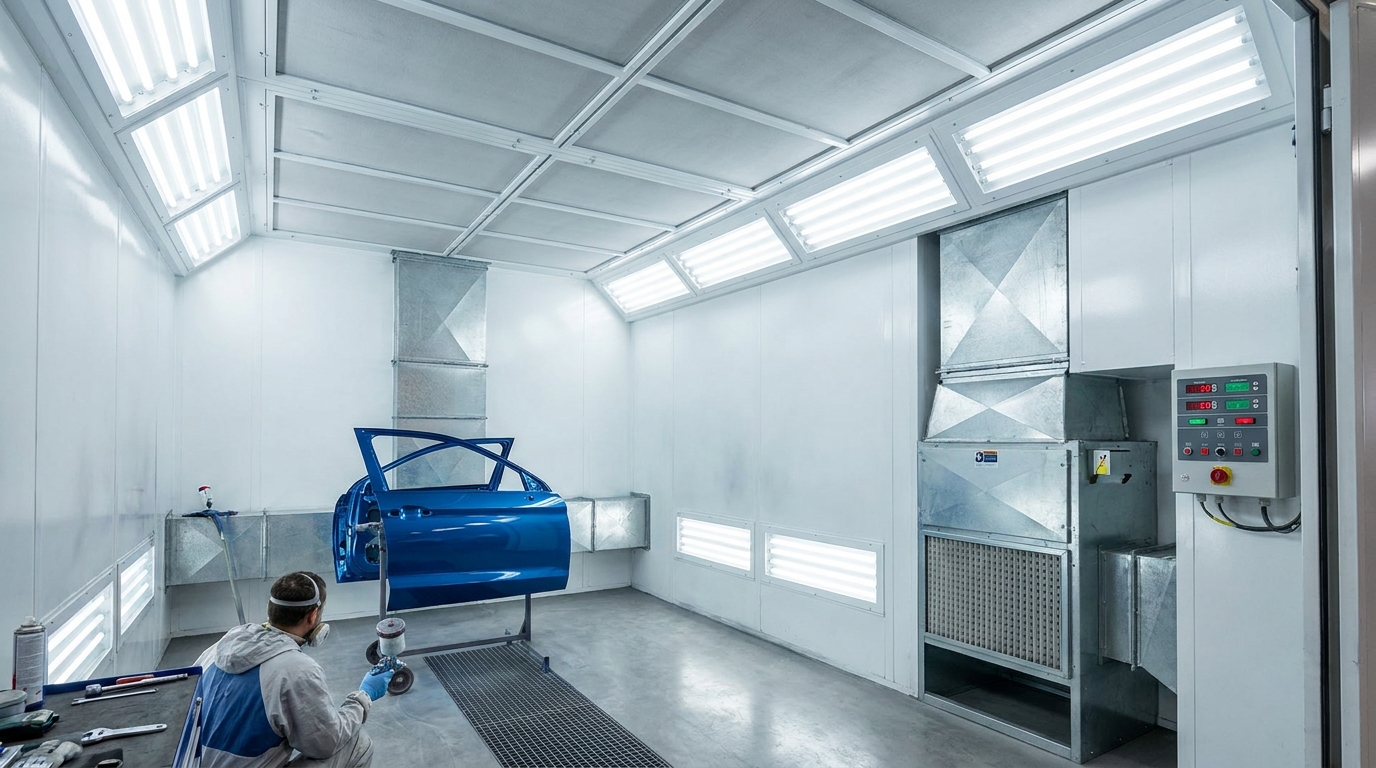
A climate-controlled spray booth is an enclosed, purpose-built chamber where automotive painting takes place under rigorously managed conditions. Unlike painting in an open workshop or garage, a spray booth regulates temperature, humidity, airflow, and particulate levels throughout the painting and curing process. These booths are the industry standard for any serious collision repair centre, and for very good reason.
Modern spray booths feature several key components working in concert:
- Heating and cooling systems that maintain a consistent temperature — typically between 20°C and 25°C for application, and higher for baking/curing
- Humidity control that keeps moisture levels in an optimal range to prevent fish-eye defects and adhesion failures
- Positive-pressure ventilation using filtered air to prevent dust and contaminants from settling on wet paint
- Exhaust filtration to capture overspray and comply with environmental regulations
- Uniform lighting — often high-CRI LED systems — to allow painters to accurately assess colour and coverage during application
Why Temperature Control Is Critical for Spray Painting Quality
Temperature is perhaps the single most important variable in automotive spray painting. When ambient temperatures are too low, paint products — whether waterborne or solvent-based — do not atomise properly from the spray gun. This leads to orange-peel texture, poor flow-out, and uneven coverage. Conversely, excessively high temperatures cause paint to dry before it levels, resulting in dry-spray effects and a rough, chalky finish that requires extensive correction work.
In Cape Town's climate, this is a real operational challenge. Our summers bring scorching temperatures in Parow Industria that can easily push a standard workshop above 35°C, while our winter months — particularly in June and July — regularly see temperatures drop below 10°C in the early morning. Without a climate-controlled booth, the seasonal extremes in the Western Cape would either force us to limit our painting hours or accept compromised quality. Neither is acceptable at Collision Coachworks.
Our spray booth maintains a stable working temperature year-round, ensuring that every job — whether on a Ford Ranger or a compact city car — receives the same ideal conditions regardless of what is happening outside.
The Role of Humidity in Automotive Paint Application
Humidity is the silent enemy of a good paint job. High moisture content in the air causes a range of defects including:
- Blushing — a milky, cloudy appearance in lacquer topcoats caused by moisture becoming trapped in the film as it dries
- Fish-eyes — small circular craters in the paint surface caused by silicone contamination, which is exacerbated by high humidity
- Poor adhesion — moisture on the substrate or in the primer layers weakens the bond between coats, leading to peeling and flaking over time
- Extended cure times — paint that should cure in two hours can take four or more when humidity is high, disrupting scheduling and potentially causing damage when the vehicle is moved prematurely
Cape Town's coastal location means that relative humidity can spike dramatically, particularly in autumn and during the berg wind conditions common in the Northern Suburbs. A climate-controlled booth strips this variable from the equation entirely, maintaining optimal relative humidity for the specific paint system being used.
Airflow and Contamination Control
One of the most underappreciated aspects of spray booth technology is positive-pressure airflow. Professional spray booths draw in outside air, pass it through multi-stage filtration systems, and push this clean air into the booth at a controlled velocity. This continuous air exchange serves two crucial purposes.
First, it removes overspray and solvent vapour from the working environment, protecting the painter and the freshly applied coatings from contamination. Second, and critically for paint quality, the positive pressure inside the booth means that no unfiltered air — carrying dust, pollen, insects, workshop particulates, or any other contaminants — can enter the booth from outside. This is why panel beaters who paint outside a booth often struggle with dust nibs and debris inclusion in their finish, requiring hours of wet-sanding and polishing to achieve an acceptable result.
In a workshop environment like ours at 9 Assegaai Road, Parow Industria, there is constant activity: grinding, sanding, cutting — all of which generate fine airborne particles. Without proper booth isolation and airflow management, these particles would inevitably contaminate fresh paintwork. Our booth's filtration system ensures this never happens.
Bake Cycles: How Controlled Heat Accelerates and Improves Curing
Modern automotive paint systems — particularly waterborne paints, which are now the industry standard for basecoat application — benefit enormously from a controlled bake cycle after application. Once the paint has been sprayed and given time to flash off, the booth temperature is raised — typically to between 60°C and 80°C — and maintained for a set period, usually 20 to 40 minutes depending on the paint system manufacturer's specification.
This bake process does several important things:
- Crosslinks the clearcoat — creating a harder, more durable surface that resists scratches, UV damage, and chemical attack better than air-dried paint
- Fully evaporates residual solvents — eliminating the risk of solvent entrapment, which can cause long-term lifting and cracking
- Ensures colour consistency — waterborne basecoats in particular need to be fully dry before clearcoat application; a controlled bake eliminates any guesswork
- Reduces turnaround time — a 30-minute bake cycle replaces several hours of air drying, allowing us to complete more repairs without compromising quality
Vehicles across Cape Town and the Northern Suburbs that have been painted in a booth with a proper bake cycle will consistently demonstrate better gloss retention and durability over years of service compared to repairs completed without these controlled conditions.
Colour Matching: Why Environment Matters
Achieving an invisible repair requires not only the right paint formula but also the right application environment. Colour matching is a complex process that involves spectrophotometry, formula adjustment, and test spraying — and every step is influenced by environmental conditions.
Temperature affects the viscosity of paint as it leaves the spray gun, which in turn affects how the metallic flakes in silver, gold, and multi-tone finishes orient themselves in the paint film. A slight temperature variation can cause metallic flakes to lie flat or stand upright at different angles, which changes how the colour appears in different lighting conditions. This is why a colour that looks like a perfect match in one light can appear noticeably different in another — a phenomenon called metamerism.
By controlling the temperature precisely throughout the spraying process, our painters at Collision Coachworks can ensure that the metallic orientation in the repair panel matches the orientation in the surrounding factory panels, resulting in a blend that is invisible in all lighting conditions.
Environmental and Regulatory Compliance
Beyond quality, climate-controlled spray booths play an important role in environmental compliance. Modern automotive paints — particularly the waterborne systems now required by many OEM manufacturers — produce significant volumes of overspray and VOC (volatile organic compound) emissions during application. A properly designed booth captures this overspray through its exhaust filtration system, preventing these chemicals from entering the surrounding environment.
For a workshop located in an industrial area like Parow Industria, surrounded by residential neighbourhoods including Ravensmead, Elsies River, and the broader Bellville area, responsible management of paint emissions is not just a regulatory requirement but a matter of being a good neighbour. Our investment in compliant spray booth infrastructure reflects our commitment to operating responsibly within our community.
What to Look for When Choosing a Spray Painter in Cape Town
If you are getting quotes for a respray or collision repair in Cape Town — whether in Brackenfell, Durbanville, Goodwood, or anywhere in the Northern Suburbs — it is worth asking specifically about the spray booth facilities. Key questions include:
- Is the painting done in a purpose-built, enclosed spray booth?
- Does the booth have temperature and humidity control?
- Is a bake cycle used after painting?
- What filtration system does the booth use?
- Are waterborne or solvent-based paints used, and is the booth appropriate for the paint system?
A reputable panel beater will be proud to show you their spray booth and explain how it contributes to quality. If the painter works from an open bay or an improvised enclosure without climate control, the risk of quality issues — however skilled the painter — is significantly elevated.
Conclusion: Climate Control Is Not a Luxury — It Is a Standard
In professional automotive refinishing, spray booth paint quality is inseparable from the controlled environment in which the work is performed. Temperature, humidity, airflow, and contamination control are not optional extras — they are the foundation of a finish that will last and look exceptional for years to come.
At Collision Coachworks in Parow Industria, our climate-controlled spray booth is central to every paint job we undertake. From minor scratch repairs to full panel resprays after major collisions, every vehicle benefits from the same consistent, controlled environment that makes professional results repeatable and reliable.
If your vehicle needs spray painting or collision repair in Cape Town, contact Collision Coachworks at 9 Assegaai Road, Parow Industria. Our team will assess your vehicle, explain the repair process, and deliver a result that meets OEM standards — in an environment built to make that possible.
Share Article
Need Expert Advice?
Get personalized consultation from our master technicians.
Related Articles
Electric Vehicle Body Repair: New Challenges for Panel Beaters (2026 Update)
Electric vehicle body repair panel beating brings high-voltage safety, aluminium structures, and specialised adhesives that traditional workshops must master. Here is what Cape Town EV owners should know in 2026.
How Long Does Panel Beating Take? Repair Timeline Guide
Find out how long panel beating takes in Cape Town, from minor dents to major collision repair, with realistic timelines, process stages, and local factors that affect turnaround.
Hyundai and Kia Collision Repair in Cape Town: 2026 Specialist Guide
From i20 and Rio hatchbacks to Sportage and Tucson SUVs, here is what Cape Town owners need to know about Hyundai and Kia body repairs, parts availability, colour matching, insurance work, and 2026 cost ranges in ZAR.