Ford Ranger Collision Repair: Bakkie Specialist Guide

Collision Coachworks Team
Expert Panel Beaters
The Ford Ranger has become one of South Africa's most popular vehicles — and for good reason. It's tough, versatile, and handles Cape Town's notoriously rough roads with ease. But even the most capable bakkie isn't immune to collision damage. Whether you've been involved in a fender bender in Bellville, a more serious front-end collision on the N1, or a parking lot scrape in Brackenfell, ford ranger collision repair requires specialist knowledge. Not every panel beater has the experience or equipment to handle a double-cab pickup correctly.
At Collision Coachworks, located at 9 Assegaai Road, Parow Industria, we've repaired hundreds of Ford Rangers over the years. This guide covers everything you need to know — from the type of damage Ranger owners typically face, to what a professional repair process looks like, to how to manage your insurance claim without hassle.
Why Ford Ranger Repairs Are More Complex Than a Regular Car
The Ford Ranger is a body-on-frame vehicle, which means the cab and cargo bed sit on a separate steel chassis. This construction is fundamentally different from a monocoque (unibody) passenger car like a VW Polo or Toyota Corolla — and it changes how collision damage is assessed and repaired.
Here's what makes Ranger repairs more involved:
- Ladder-frame chassis: If the Ranger takes a significant front or rear impact, the chassis itself can twist or bend. Straightening a chassis frame requires specialist equipment — a vehicle alignment and straightening jig that can apply controlled hydraulic force to bring the frame back to manufacturer specifications.
- High-strength steel panels: Modern Rangers use advanced high-strength steel (AHSS) in certain body panels. This material can't be reworked with heat the same way older mild steel can — incorrect repairs can compromise the structural integrity of the vehicle.
- Complex front-end assembly: The Ranger's front end houses the bull bar mounting points, winch mounts, recovery hooks, and an elaborate grille/bumper assembly. Replacing these components correctly requires sourcing the right OEM or compatible parts and fitting them precisely.
- Load box damage: The cargo bed is a common casualty in rear-end collisions. Straightening or replacing a load box is a specialised job — a poorly repaired load box affects water ingress, tailgate alignment, and resale value.
Common Types of Ford Ranger Collision Damage
In our experience repairing bakkies for customers across Cape Town's Northern Suburbs — Parow, Goodwood, Durbanville, Milnerton, and beyond — these are the most common accident scenarios we see with Rangers:
Front-End Collisions
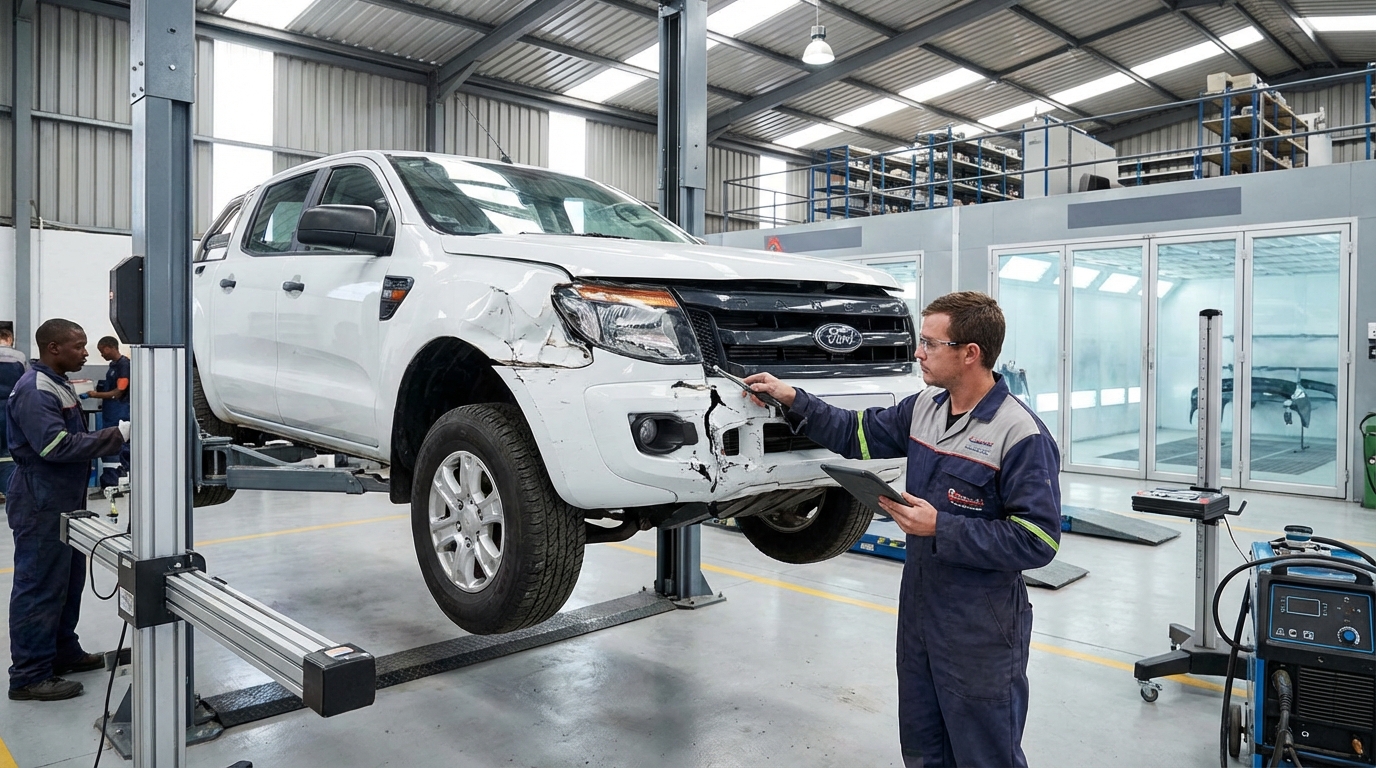
Whether from a low-speed parking shunt or a higher-speed highway impact, front-end damage on a Ranger typically involves the bumper assembly, front grille, bonnet, headlights, front fenders, and potentially the radiator support and cooling system. In more severe cases, the chassis rails that run forward from the firewall can crumple — this is by design (crumple zones), but it means more extensive structural repair is needed.
Side Impact Damage
T-bone accidents or sideswipes often damage doors, sills, and the B-pillar. On double-cab Rangers with rear passenger doors, the repair can be substantial. Doors need to be perfectly aligned for proper sealing and safety — a poorly repaired door will leak water and may not close correctly.
Rear-End Collisions
Rear impacts on the Ranger often damage the load box, tailgate, rear bumper, and tow hitch. If the collision was severe enough, the chassis rails at the rear can also bend. Load box damage, in particular, is worth repairing properly — a misaligned load box affects the tailgate, creates water ingress points, and flags on a pre-purchase inspection.
Rollover Damage
While Rangers are stable vehicles, rollovers do happen — especially on gravel roads and farms. Rollover damage is typically extensive, affecting the roof, pillars, all four doors, and potentially the chassis. These are complex insurance claims that require a thorough structural assessment before any repair work begins.
Hail Damage
Cape Town does get hail, and the Ranger's large flat bonnet and roof panels are susceptible. Hail damage repair on a bakkie can be handled with paintless dent removal (PDR) when the damage is minor, but more severe hail may require panel replacement or conventional panel beating and repainting.
The Ford Ranger Repair Process at Collision Coachworks
When your Ranger arrives at our workshop in Parow Industria, we follow a structured process to ensure the repair is done correctly and to manufacturer standards:
Step 1: Comprehensive Damage Assessment
Before any parts are ordered or hammers come out, we conduct a thorough assessment. This involves a visual inspection of all visible damage, a check of panel gaps and alignment, and — for any significant collision — a chassis measurement check using our jig equipment. Hidden damage is common in collisions; what looks like a bent bumper can sometimes indicate frame damage underneath. We document everything photographically for the insurance assessor.
Step 2: Insurance Authorisation
Most Ranger repairs go through insurance. We work with all major South African insurers — Discovery, Hollard, Old Mutual Insure, King Price, Budget, and others. We submit the repair estimate directly to the insurer and handle the back-and-forth with assessors, so you don't have to. We can also advise you on whether a repair is worth claiming — sometimes a minor repair is cheaper to pay privately than to lose your no-claims bonus.
Step 3: Panel Beating and Structural Repair
Once authorised, our panel beaters get to work. Damaged panels are straightened using dedicated bench equipment and specialised dollies and hammers. Where panels are too damaged to be reworked, we replace them with new components. Any chassis or structural work is done on our frame-straightening equipment, with before-and-after measurements to verify the chassis is back within Ford's specified tolerances.
Step 4: Parts Sourcing
We source parts from reputable suppliers. For Rangers, OEM Ford parts are available through Ford dealers in Cape Town, but we also work with trusted aftermarket suppliers for components like bumpers, grilles, and lights — which can significantly reduce repair costs without compromising quality. We'll always discuss parts options with you transparently.
Step 5: Spray Painting and Colour Matching
The Ford Ranger comes in a wide range of colours — Wildtrak Orange, Conquer Grey, Arctic White, Diffused Silver, and more. Colour matching is a critical step. We use computerised colour mixing systems and our climate-controlled spray booths ensure the paint is applied in optimal conditions for a flawless finish. The painted panels are matched to your vehicle's existing paintwork so the repair is invisible.
Step 6: Reassembly and Quality Control
After paint, the vehicle is reassembled — all trim, lights, badges, and mechanical components are refitted. We then do a final quality check: panel gaps, paint finish, door alignment, light operation, and a road test if required. You only take your Ranger back when we're satisfied it's right.
How Much Does Ford Ranger Collision Repair Cost in Cape Town?
Repair costs vary significantly depending on the extent of the damage. As a general guide for 2026:
- Minor dents and scratches (no structural damage): R2,000 – R8,000
- Front bumper replacement and repainting: R5,000 – R15,000
- Front-end collision repair (bonnet, fenders, bumper, lights): R15,000 – R45,000+
- Rear-end repair including load box damage: R8,000 – R30,000+
- Side impact (door replacement, sill, B-pillar): R12,000 – R35,000
- Major structural/chassis repair: R20,000 – R60,000+
These are approximate figures and will depend on the model year, trim level, parts availability, and paint complexity. An accurate quote requires a physical inspection — contact us at Collision Coachworks for a no-obligation assessment.
Insurance Claims for Ford Ranger Repairs
The Ford Ranger is typically insured under comprehensive motor insurance, and most collision damage will be covered subject to your excess. Here's what to know about the claims process:
Choosing Your Own Repairer
South African law gives you the right to choose your own panel beater, regardless of which insurer you're with. Some insurers will try to direct you to their preferred repairer network — which is convenient but doesn't always guarantee the best quality repair. You are entitled to use a repairer of your choice, and the insurer must pay for reasonable repair costs at that repairer.
Excess Payments
Your policy excess is payable when you collect your vehicle. Excess amounts vary — basic excesses typically range from R2,500 to R7,500 for bakkie policies, and there may be additional excesses for young drivers, high-performance models, or certain incidents. Check your policy schedule.
Write-Off Assessment
If the damage is severe, the insurer's assessor may decide to write off the vehicle — meaning the cost to repair exceeds a certain percentage of the vehicle's market value (typically 70-80%). For a high-value Ranger Wildtrak or Raptor, this threshold is higher, so write-offs are less common. If your vehicle is written off, you'll receive the market value of the Ranger at the time of the accident, less your excess.
Aftermarket Accessories and Collision Repairs
Many Ranger owners have invested in accessories — bull bars, nudge bars, side steps, canopies, and tonneau covers. These complicate collision repairs in a few ways:
- Insurance may not cover aftermarket accessories unless specifically listed on your policy.
- A bull bar that absorbed the impact of a front collision may need to be replaced — but if it's not covered, you'll pay out of pocket.
- Canopies damaged in a rear-end collision are often excluded from standard motor policies.
- Always check your policy schedule for what accessories are covered and at what value.
At Collision Coachworks, we can repair or replace most common aftermarket accessories and can advise on sourcing replacement parts at competitive prices.
Maintaining Your Ranger's Value After a Repair
A professionally repaired Ranger will retain its value far better than one with poorly done repair work. Here's how to protect your investment:
- Use a reputable panel beater: A poorly repaired vehicle will show obvious signs on a pre-purchase inspection — uneven panel gaps, mismatched paint, poor finish quality.
- Keep your repair documentation: A service history that includes professional repair invoices and insurance documentation adds to buyer confidence.
- Address rust promptly: Any collision repair that exposes bare metal must be treated with appropriate primer and sealant to prevent rust. Insist on proper rust-proofing during repairs.
- Follow paint care advice: After a respray, avoid machine polishing or harsh chemicals for at least 30 days to allow the paint to fully cure.
Why Choose Collision Coachworks for Your Ranger Repair?
At our workshop in Parow Industria, we have the equipment, experience, and expertise to handle Ford Ranger collision repairs to the highest standard. We've been servicing bakkie owners from across the Northern Suburbs — Parow, Goodwood, Bellville, Brackenfell, Durbanville, and Milnerton — for years, and we understand that your Ranger is more than just a car: it's a working vehicle and a significant investment.
We use computerised frame alignment equipment, climate-controlled spray booths, and professional-grade paint systems. We work with all major insurers and handle the paperwork so you don't have to. And we don't rush repairs — we do them right.
If your Ford Ranger has been in an accident, contact Collision Coachworks at 9 Assegaai Road, Parow Industria, Cape Town. Get a professional assessment, a clear quote, and the confidence that your bakkie will come back looking and driving the way it should.
Share Article
Need Expert Advice?
Get personalized consultation from our master technicians.
Related Articles
How Long Does Panel Beating Take? Repair Timeline Guide
Find out how long panel beating takes in Cape Town, from minor dents to major collision repair, with realistic timelines, process stages, and local factors that affect turnaround.
Hyundai and Kia Collision Repair in Cape Town: 2026 Specialist Guide
From i20 and Rio hatchbacks to Sportage and Tucson SUVs, here is what Cape Town owners need to know about Hyundai and Kia body repairs, parts availability, colour matching, insurance work, and 2026 cost ranges in ZAR.
Panel Beaters Bellville: Trusted Repairs in Your Neighbourhood
Looking for panel beaters in Bellville? Compare turnaround times, insurance support, spray-paint quality, and why Northern Suburbs drivers choose a workshop in Parow Industria for trusted collision repairs.