How to Spot a Quality Spray Paint Job vs a Poor One

Collision Coachworks Team
Expert Panel Beaters
How to Spot a Quality Spray Paint Job vs a Poor One
Whether you have just collected your car from a panel beater or you are inspecting a second-hand vehicle before purchase, knowing how to evaluate a spray paint job is one of the most valuable skills a car owner can have. In Cape Town, where harsh UV exposure and coastal salt air test every paint finish, the difference between a quality spray paint job and a rushed one becomes obvious within months. At Collision Coachworks in Parow Industria, we see the aftermath of poor paintwork regularly — vehicles that come in for corrective resprays after bargain-basement jobs have failed.
This guide walks you through the key signs of professional-grade spray painting, the red flags of shoddy work, and what questions to ask your panel beater before handing over your keys.
Why Paint Quality Matters More Than You Think
A spray paint job is not just cosmetic. Your vehicle's paint system — primer, basecoat, and clearcoat — serves as the primary barrier against rust, stone chips, and environmental damage. A poorly applied finish can lead to premature peeling, bubbling, and corrosion that eats into the metalwork beneath. For Cape Town drivers navigating everything from the N1 highway to pothole-riddled suburban roads in Bellville and Goodwood, that protective layer needs to be applied correctly the first time.
Beyond protection, paint quality directly affects your car's resale value. Dealers and private buyers in the Northern Suburbs know what to look for, and a dodgy respray can knock thousands of rands off an asking price.
1. Check for Orange Peel Texture
One of the most common quality spray paint job signs — or rather, signs of a poor one — is orange peel. This refers to a bumpy, dimpled texture on the paint surface that resembles the skin of an orange. While a slight amount of orange peel exists even on factory finishes, excessive texture indicates that the paint was applied at the wrong pressure, temperature, or distance from the panel.
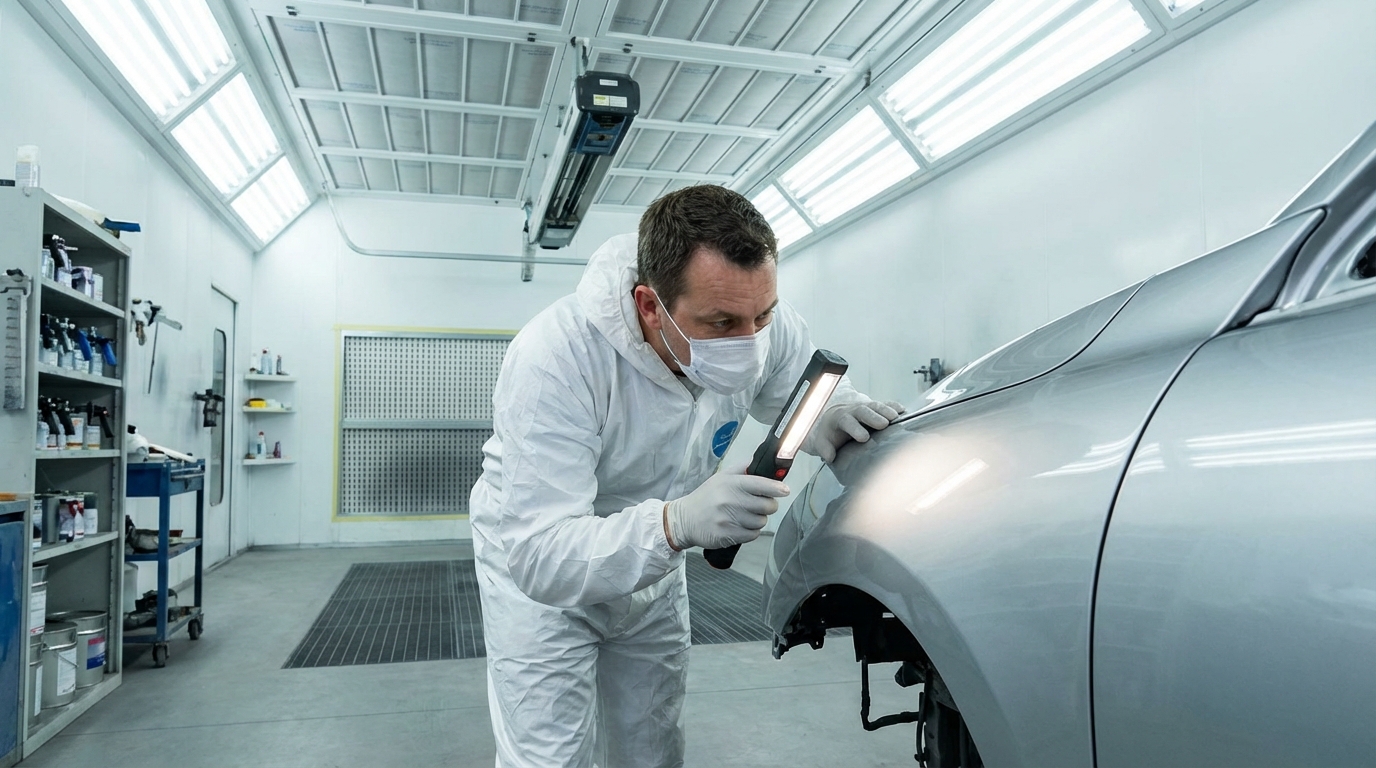
To check, stand at eye level with the panel and look along the surface at a shallow angle. Under direct sunlight or workshop lighting, a quality finish will appear smooth and reflective, almost like glass. A poor job will show an uneven, textured surface that distorts reflections.
2. Inspect the Colour Match
Colour matching is where professional panel beaters separate themselves from amateurs. Modern vehicles use complex multi-stage paints — metallics, pearls, and tri-coats — that require computerised colour-matching systems to replicate accurately. At Collision Coachworks, we use spectrophotometer technology to analyse your vehicle's exact colour formula, accounting for UV fade and age.
To spot a poor colour match, compare the repaired panel with adjacent panels. Step back about three metres and look at the car from different angles. Metallic and pearl finishes shift colour depending on viewing angle, so a mismatch will be especially obvious on sunny days. Pay close attention to the boundary between repainted and original panels — a skilled painter blends the colour into adjacent panels to create an invisible transition.
3. Look for Overspray
Overspray is paint mist that lands on areas it should not — rubber trims, glass edges, wheel arches, engine bays, or interior door jambs. It is one of the clearest indicators of careless masking and preparation. A professional workshop will meticulously mask every surface that is not being painted, including adjacent panels, lights, windows, and trim pieces.
Run your fingers along rubber door seals, check the edges of windows, and inspect under the bonnet near the inner guards. If you find a fine dusty layer of paint where there should not be any, the job was done without proper care.
4. Examine Panel Gaps and Alignment
While not strictly a paint issue, panel alignment tells you a lot about the quality of the overall repair. After collision work, panels should sit perfectly flush with consistent gaps between them. Stand at the front of the car and look along each side — the body lines should flow smoothly without steps or uneven spacing.
Doors should open and close with the same resistance as before the repair. A boot lid or bonnet that does not sit quite right suggests the structural repair underneath was not completed properly, which often correlates with a paint job that was rushed to match.
5. Feel for Imperfections Under the Clearcoat
Gently run your hand across the repainted surface. A quality finish feels perfectly smooth — almost silky. If you detect bumps, gritty spots, or rough patches, there may be dust or debris trapped under the clearcoat. This happens when painting is done in a dusty environment rather than a proper downdraft spray booth.
Professional workshops like ours in Parow Industria use climate-controlled spray booths that filter the air and maintain optimal temperature and humidity. This virtually eliminates contaminant inclusion, which is one of the most common problems with backyard spray jobs.
6. Check for Runs and Sags
Paint runs — visible drips or sags in the finish — occur when too much paint is applied in a single pass. They typically appear on vertical surfaces like doors, fenders, and pillars. A run is unmistakable: you will see a thickened trail of paint, sometimes with a teardrop shape at the bottom.
Even small runs indicate poor technique. A professional painter applies multiple thin, even coats rather than one heavy coat. Each layer is allowed to flash off before the next is applied. This patience and technique is what produces a deep, flawless finish.
7. Assess the Clearcoat Quality
The clearcoat is the transparent top layer that gives your car its gloss and UV protection. A quality clearcoat application should be even across the entire panel, with a deep, wet-look shine. Poor clearcoat work shows up as hazy patches, a flat or milky appearance, or areas where the gloss varies noticeably.
Over time, a poorly applied clearcoat will peel — you have probably seen vehicles around Brackenfell and Durbanville with white, flaking patches on the bonnet or roof. This is clearcoat failure, and it means the entire panel needs to be stripped and resprayed.
Questions to Ask Your Panel Beater Before the Job
Prevention is better than a corrective respray. Here are the key questions to ask any panel beater in Cape Town before committing to the work:
- Do you use a downdraft spray booth? This is non-negotiable for a quality finish. Any shop spraying in an open workshop is cutting corners.
- What paint system do you use? Reputable shops use branded paint systems from manufacturers like Glasurit, Standox, or Sikkens. Ask for the brand name.
- How do you colour match? The answer should involve a spectrophotometer or computerised mixing system — not just a colour code from the door plate.
- Do you blend into adjacent panels? Blending is standard practice for metallic and pearl finishes. If they say they only paint the damaged panel, expect a visible colour difference.
- What warranty do you offer on the paintwork? A confident panel beater will offer a written warranty. At Collision Coachworks, we stand behind our work because we trust our process.
- Are you SAMBRA registered? The South African Motor Body Repairers Association sets industry standards. Registration signals commitment to quality and accountability.
Common Cars We See with Paint Issues in Cape Town
Certain vehicles seem to arrive at our Parow Industria workshop more frequently for corrective paintwork. The VW Polo is by far the most common — it is the best-selling car in South Africa, and many owners opt for the cheapest repair quote after a fender bender, only to regret it later. We also see a high volume of Toyota Hilux bakkies and Ford Rangers with poor panel work on their load bins and fenders, often from overloaded cargo damage repaired on the cheap.
BMW 3 Series and Mercedes C-Class owners sometimes bring in vehicles purchased second-hand, only to discover previous accident damage hidden under a hasty respray. A pre-purchase inspection that includes paint depth readings can save you from an expensive surprise.
The Cost Difference Between Good and Bad Paintwork
In Cape Town, a single-panel respray from a reputable panel beater typically costs between R3,500 and R8,000 depending on the vehicle and paint type. A full respray can range from R25,000 to R60,000 or more for premium finishes. Budget operators might quote significantly less — sometimes 30 to 50 percent below market rate.
The problem is that a cheap spray job almost always costs more in the long run. Corrective resprays involve stripping the failed paint back to bare metal, re-preparing the surface, and starting from scratch. That correction often costs double what a proper job would have cost in the first place. It is a false economy that Cape Town drivers fall into more often than they should.
How Collision Coachworks Ensures Quality
At our workshop on 9 Assegaai Road in Parow Industria, every spray paint job follows a strict process. We start with thorough surface preparation — sanding, priming, and sealing — before any colour goes on. Our climate-controlled spray booth maintains the correct temperature and airflow throughout the process, and we use premium paint systems with computerised colour matching.
Every vehicle undergoes a multi-point quality inspection under dedicated inspection lighting before it leaves the booth. We check for orange peel, runs, dust inclusions, colour consistency, and clearcoat depth. If anything does not meet our standard, it goes back into the booth. This process takes longer, but it is why our customers across the Northern Suburbs — from Goodwood and Bellville to Brackenfell and Durbanville — keep coming back.
Final Thoughts
Knowing the signs of a quality spray paint job empowers you to make better decisions — whether you are choosing a panel beater, inspecting a completed repair, or evaluating a used car. The details matter: smooth texture, accurate colour matching, clean edges, and an even clearcoat are the hallmarks of professional workmanship.
If you need a spray paint job done right the first time, or if you are dealing with a previous repair that has not held up, contact Collision Coachworks. We are located at 9 Assegaai Road, Parow Industria, and we serve drivers across Cape Town's Northern Suburbs. Get in touch for an honest assessment and a quote you can trust.
Share Article
Need Expert Advice?
Get personalized consultation from our master technicians.
Related Articles
How Long Does Panel Beating Take? Repair Timeline Guide
Find out how long panel beating takes in Cape Town, from minor dents to major collision repair, with realistic timelines, process stages, and local factors that affect turnaround.
Waterborne vs Solvent Paint: Cape Town Respray Costs and Quality in 2026
Compare waterborne vs solvent paint cars systems used in Cape Town resprays: finish quality, environmental rules, drying times, and typical ZAR costs at a Parow Industria panel beater.
How to Spot a Quality Spray Paint Job: A 10-Point Inspection Checklist
Learn the quality spray paint job signs that separate a professional respray from a rushed job. A practical 10-point checklist Cape Town car owners can use before accepting any panel or respray work.