Toyota Hilux Panel Beating and Collision Repair Guide

Collision Coachworks Team
Expert Panel Beaters
The Toyota Hilux is more than just a vehicle in South Africa — it is a national institution. From the construction sites of Bellville to the dirt roads of the Boland, the Hilux is everywhere. Its legendary toughness means it often stays on the road long after lesser vehicles would have been scrapped. But even the toughest bakkie isn't immune to collision damage, and when your Hilux takes a hit, you need a panel beater who understands exactly what they are working with. This guide covers everything you need to know about Toyota Hilux panel beating, from common damage types to repair timelines and what to expect in terms of cost.
Why the Hilux Presents Unique Repair Challenges
At first glance, the Hilux looks like a straightforward repair job — it is a body-on-frame truck, after all, not a unibody city car. But that simplicity is somewhat deceptive. Modern Hilux models (particularly the GR Sport, Legend, and Raider variants) use high-strength steel in key structural areas, advanced driver assistance systems (ADAS) that must be recalibrated after any front-end work, and multi-coat paint finishes that require precise colour matching.
Compared to a VW Polo or Toyota Corolla, the Hilux also has a far larger surface area to work with — bonnet, double cab roof, full cargo area, and substantial front and rear bumper assemblies. All of this adds complexity to what might otherwise seem like a simple panel beating job.
High-Strength Steel and Chassis Considerations
Toyota has progressively introduced high-tensile and ultra-high-tensile steel into Hilux construction from the eighth generation onwards. This steel cannot be straightened using conventional heat and hammer techniques — it must be replaced rather than repaired. An inexperienced panel beater who tries to reshape high-strength steel risks weakening the structural integrity of the vehicle permanently. At Collision Coachworks in Parow Industria, our technicians are trained to identify which panels and structural members require replacement versus those that can be safely restored.
Common Types of Toyota Hilux Collision Damage
The way a Hilux gets damaged tends to follow fairly predictable patterns based on how the vehicle is used. Here is what we see most frequently at our workshop at 9 Assegaai Road, Parow Industria:
Front-End Impact Damage
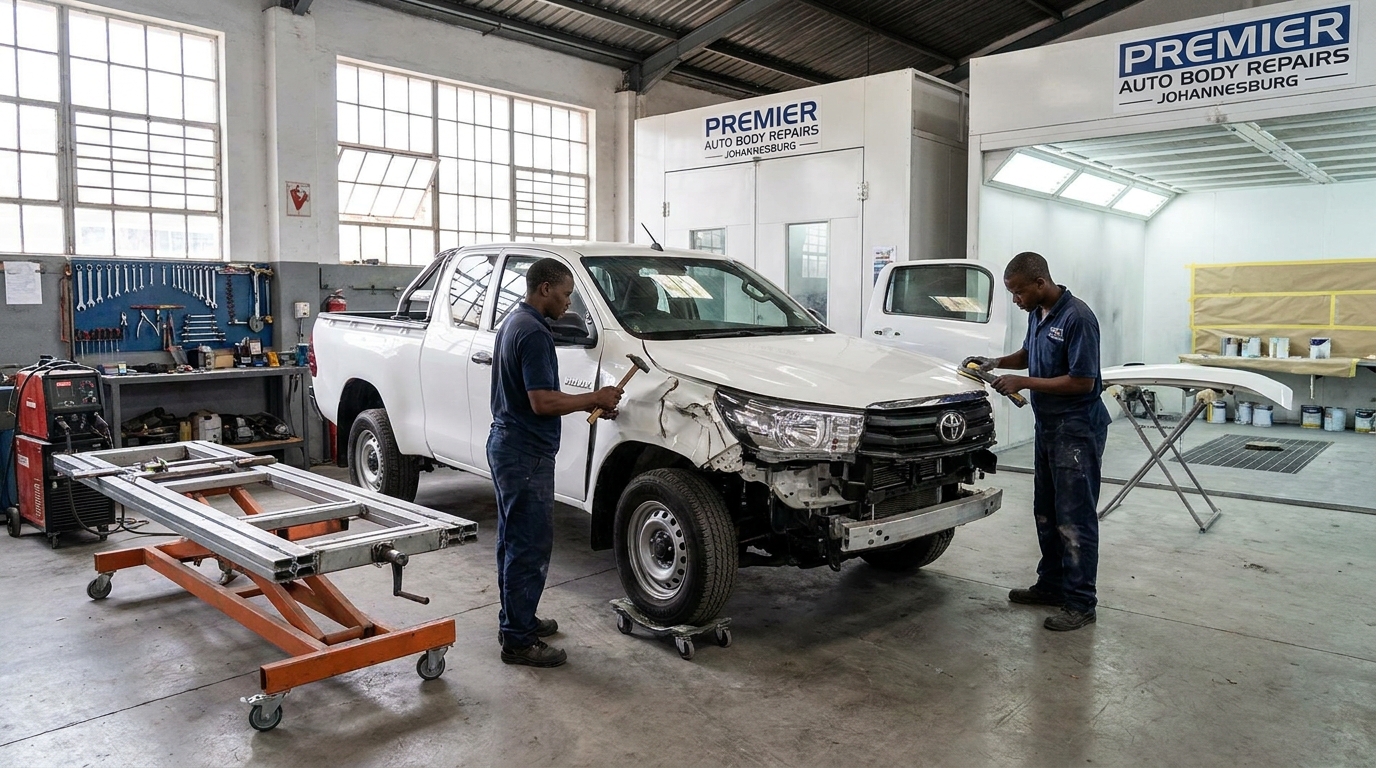
Rear-end collisions and head-on impacts are the most common cause of significant Hilux damage. The front of the Hilux houses the radiator support, front crossmember, and a substantial bumper assembly — all of which absorb tremendous energy in a crash. A low-speed impact (under 30 km/h) may only damage the bumper skin, front fog light surrounds, and bonnet leading edge. A higher-speed collision can push damage into the radiator support, compress the front rails, and in severe cases, affect the chassis itself.
Diagnosing the true extent of front-end damage requires a proper structural inspection on a measuring system. What looks like a simple bonnet replacement can sometimes hide significant frame damage underneath.
Side Panel and Door Damage
Cape Town's congested Northern Suburbs roads — particularly around Goodwood, Brackenfell, and Bellville — are notorious for low-speed parking scrapes, door dings, and side-swipe collisions. For the Hilux double cab, this typically means damage to the front and rear doors, the B-pillar area, and the rear quarter panels. The rear quarter panel on a Hilux is a large, complex pressing that is expensive to source and time-consuming to replace correctly, which makes professional assessment essential before deciding on repair vs replacement.
Load Bed and Rear Bumper Damage
Hilux load beds take an enormous amount of abuse. Beyond collision damage, they accumulate dents, scrapes, and structural deformation from heavy loads and rough terrain. Significant load bed dents can usually be addressed through panel beating, though severe damage may require full load bed replacement. The rear bumper, being a solid steel assembly on most Hilux variants, is highly repairable even after moderate impacts.
Rollover and Roof Damage
Sadly, rollovers are not uncommon in South Africa given our road conditions and the prevalence of Hilux vehicles on gravel and rural roads. Roof damage from rollovers involves complex structural repair — the A, B, and C pillars must be carefully assessed, and the roof panel itself usually requires replacement. This is high-skill work that demands proper structural measuring and approved repair procedures.
The Toyota Hilux Panel Beating Process at Collision Coachworks
When your Hilux arrives at our workshop, we follow a structured process to ensure the repair is done right the first time:
- Initial assessment: A senior technician performs a thorough visual and structural inspection to document all damage — both obvious and hidden.
- Insurance liaison: If you are claiming from your insurer (whether Outsurance, Discovery, Santam, Hollard, or another provider), we compile a detailed repair estimate and handle the assessor communication on your behalf.
- Disassembly: Damaged panels, bumper assemblies, lights, and grille components are carefully removed. This stage often reveals secondary damage not visible during the initial assessment.
- Structural repair: Where necessary, chassis and body frame measurements are taken and any misalignment corrected using our straightening equipment.
- Panel replacement or repair: Damaged panels are either straightened using panel beating techniques or replaced with new OEM or quality aftermarket panels, depending on the severity of damage and your preference.
- Body preparation: All repaired and new panels are properly prepared — primed, blocked, and feathered — before entering the paint booth.
- Spray painting: Your Hilux is sprayed in our climate-controlled booth using a computer-matched paint system to ensure a seamless colour match, whether your vehicle is in Attitude Black, Emotional Red, or any other Toyota colour code.
- Reassembly and quality check: Everything is refitted, panel gaps and alignments are checked, and the vehicle is cleaned before collection.
Toyota Hilux Panel Beating Costs in Cape Town (2026)
Repair costs vary enormously depending on the extent of damage, the parts required, and whether the repair is going through insurance. As a general guide for Cape Town in 2026:
- Minor dent and scratch repair (single panel): R1 500 – R4 500
- Front bumper replacement and spray: R5 000 – R12 000 depending on the Hilux spec and whether sensors/cameras are involved
- Bonnet replacement and spray: R6 000 – R14 000
- Full front-end repair (moderate collision): R18 000 – R45 000+
- Door replacement and spray: R8 000 – R18 000 per door
- Load bed replacement: R15 000 – R30 000+
These are indicative ranges only — your actual quote will depend on specific damage, the Hilux variant (SR, SR5, GR Sport, Legend, etc.), and parts availability. GR Sport models with unique body styling and sportier bumper designs can be more expensive to source parts for.
If you are not claiming from insurance and are paying cash, it is worth getting a detailed written quote before authorising repairs. At Collision Coachworks, we provide transparent, itemised quotes so you know exactly what you are paying for.
Insurance Claims for Hilux Repairs
Most comprehensive vehicle insurance policies will cover collision damage to your Hilux, subject to your excess. If you drive a bakkie for business purposes, check whether your policy covers business use — some policies have restrictions that could affect your claim. For third-party-only policies, the other driver's insurer is liable if they were at fault, but pursuing that claim is more complex and often requires legal assistance.
When dealing with insurers, it is important to use a reputable, SAMBRA-registered panel beater. Collision Coachworks works with all major insurers and can guide you through the assessment and authorisation process to minimise delays in getting your Hilux back on the road.
ADAS Recalibration After Hilux Collision Repair
Newer Hilux models (2018 and onwards) are increasingly equipped with advanced driver assistance systems including:
- Pre-collision warning systems
- Lane departure alert
- Automatic high-beam
- Radar-based adaptive cruise control
- Reversing cameras and parking sensors
Any front-end repair, windscreen replacement, or significant suspension work that alters the vehicle's geometry can affect the calibration of these systems. If they are not correctly recalibrated post-repair, they may provide false warnings or — more dangerously — fail to activate when needed. We take ADAS recalibration seriously at Collision Coachworks and factor this into the repair scope where applicable.
Choosing the Right Panel Beater for Your Hilux in Cape Town
Not every panel beater in the Northern Suburbs has the equipment, training, and experience to handle a modern Hilux repair correctly. When evaluating your options, look for:
- Structural measuring capability: Essential for anything beyond purely cosmetic damage. Without measuring equipment, hidden frame damage can be missed.
- Dedicated spray booth: A proper climate-controlled booth is necessary for a factory-quality finish. A booth-less spray environment leads to dust contamination and uneven paint.
- Computerised colour matching: The Hilux comes in a wide range of colours and finishes. Accurate colour matching requires spectrophotometry, not just a visual guess.
- Experience with bakkies: Panel beaters who primarily work on passenger cars may not be familiar with the specific repair procedures for body-on-frame vehicles.
- Transparent communication: You should always receive a written quote, a realistic timeline, and regular updates on your repair progress.
At Collision Coachworks, located at 9 Assegaai Road, Parow Industria, Cape Town, we have been repairing bakkies — Hilux, Ford Ranger, Nissan NP200, and more — for many years. Our team combines hands-on expertise with modern equipment to deliver repairs that look and perform as they should.
Repair Timelines: How Long Will Your Hilux Be Off the Road?
This is one of the most common questions we receive, and the honest answer is: it depends. Here is a realistic guide:
- Minor cosmetic repairs (single dent, small scratch): 1 – 3 days
- Moderate front or rear damage (bumper, bonnet, grille): 3 – 7 working days
- Significant collision repair (multiple panels, structural work): 2 – 4 weeks
- Insurance-authorised repairs: Add 3 – 10 working days for assessor and insurer authorisation before repair work begins
Parts availability is one of the biggest variables. Toyota Hilux parts are generally well-stocked through Toyota dealers and reputable parts suppliers in the Northern Suburbs, but GR Sport-specific components and certain advanced electronics can take longer to source.
Keeping Your Hilux in Top Condition After Repairs
Once your Hilux has been repaired and resprayed, a little care will protect the investment:
- Avoid washing the vehicle for at least two weeks after a full respray — fresh paint needs time to cure fully.
- Park in shade where possible to protect the new paint from UV degradation.
- Apply a quality carnauba wax or paint sealant once the paint has fully cured (typically 4 – 6 weeks post-spray).
- Have any stone chips touched up promptly before they develop into rust.
- If you use the load bed heavily, consider a quality load bed liner to protect the bare metal.
Conclusion
The Toyota Hilux is built to last, but toyota hilux panel beating requires skill, the right equipment, and a genuine understanding of how these vehicles are constructed. Whether you have a minor parking lot scrape or significant collision damage from an accident on the N1 near Brackenfell, the quality of the repair will determine how your Hilux looks and performs for years to come. At Collision Coachworks, we treat every Hilux with the respect it deserves — because we know how much these vehicles mean to their owners.
Contact us at 9 Assegaai Road, Parow Industria, Cape Town to book an assessment or get a free quote on your Hilux repair. We work with all major insurers and provide honest, professional advice with no obligation.
Share Article
Need Expert Advice?
Get personalized consultation from our master technicians.
Related Articles
Electric Vehicle Body Repair: New Challenges for Panel Beaters (2026 Update)
Electric vehicle body repair panel beating brings high-voltage safety, aluminium structures, and specialised adhesives that traditional workshops must master. Here is what Cape Town EV owners should know in 2026.
How Long Does Panel Beating Take? Repair Timeline Guide
Find out how long panel beating takes in Cape Town, from minor dents to major collision repair, with realistic timelines, process stages, and local factors that affect turnaround.
Third-Party vs Comprehensive Insurance for Panel Beating: A Cape Town Driver's 2026 Guide
Third-party or comprehensive cover? We break down exactly what each policy pays for when your car needs panel beating, using real Cape Town repair scenarios and 2026 ZAR figures.