Vehicle Damage Assessment: What Panel Beaters Actually Check

Collision Coachworks Team
Expert Panel Beaters
When you drop a damaged car at a workshop, the first real work that happens is not panel beating at all. It is a vehicle damage assessment, and a panel beater who does it properly is doing something closer to diagnostics than bodywork. The visible dent is usually the smallest part of the story. What the assessment finds underneath that dent decides your repair cost, your turnaround time, and whether your insurer pays out the way you expect.
At Collision Coachworks in Parow Industria, we assess vehicles from across the Northern Suburbs every week, from Bellville commuters with parking-lot scuffs to Ford Rangers that met a pothole on the N1 at speed. The pattern is consistent: owners are surprised by what the assessment turns up, and the surprise is almost always structural rather than cosmetic.
Why a Vehicle Damage Assessment Is Not Just a Look-Over
Modern vehicles are designed to absorb impact energy and channel it away from the cabin. That is excellent engineering and it saves lives, but it means the panel that took the hit is deliberately sacrificial. The energy does not stop at the bumper. It travels through crumple zones, crash boxes, chassis rails, and mounting points, deforming things you cannot see with the bonnet closed.
A VW Polo that hits a wall at 25 km/h might show a creased front wing and a cracked bumper cover. Under the skin, the crash box behind the bumper bar may be compressed, the bonnet slam panel pushed back a few millimetres, and the headlight mounting tabs snapped clean off. Repair the wing alone and the car looks fixed. It is not fixed. The panel gaps will never sit right, the bonnet will not close evenly, and the headlight aim will be off.
This is why a real assessment is a measured process with a written output, not a walk-around and a number scribbled on a pad.
The Seven Things We Check in Every Assessment
1. Panel Gaps and Alignment
Before anything is disassembled, we measure the gaps between panels: bonnet to wing, door to door, boot to quarter panel. Factory gaps are consistent to within a millimetre or two. Uneven gaps on a car that has not been touched tell us the shell has moved, which points to structural involvement rather than a surface knock.
We also check the gaps on the undamaged side. Comparing left to right is the fastest way to establish what the car looked like before the incident, especially on older vehicles that may already carry unrelated damage.
2. Paint Depth Readings
A paint depth gauge measures coating thickness in microns. Factory paint on most vehicles sold in South Africa sits somewhere between 90 and 140 microns depending on the manufacturer and the panel. Readings well above that indicate filler or a previous respray. Readings that jump around across a single panel usually mean body filler underneath.
This matters for two reasons. It tells us whether a panel has been repaired before, which affects how it will behave when we work it again. And it protects you: if we find evidence of prior undisclosed repairs on a car you bought recently, that is worth knowing.
3. Structural Measurement
Where the impact was significant, we measure the chassis and body against manufacturer specifications. This is done on a jig or with an electronic measuring system that compares reference points on the vehicle to factory data. Deviations of more than a few millimetres at key points mean the shell needs pulling before any panel work begins.
Skipping this step is the single most common failure in cheap repairs. A car straightened by eye may look correct and still tramline on the road, wear tyres unevenly, or fail to protect occupants properly in a second accident.
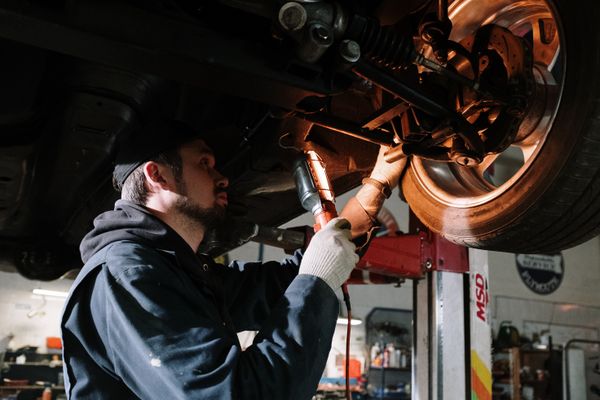
4. Suspension and Steering Geometry
Cape Town roads punish suspension even without a collision. After an impact, particularly a front or side hit, we inspect control arms, struts, steering rack mountings, and subframe alignment. Bent components are often not visible; a control arm can be deformed by a few millimetres and throw the wheel alignment out entirely.
Pothole damage deserves specific mention here. A hard pothole strike commonly bends a rim, deforms a control arm, and damages the tyre sidewall in one event. Owners often only notice the tyre.
5. Mechanical and Cooling Components
Front-end damage frequently reaches the radiator, condenser, intercooler pipework, and cooling fans. On bakkies such as the Toyota Hilux and Ford Ranger, we check the radiator support and intercooler mountings closely because they sit forward and take impact early. A cracked condenser that goes unnoticed becomes an aircon failure two weeks after you collect the car.
6. Electronic Systems, Sensors, and Calibration
This is the area that has changed most in the last decade. Parking sensors, blind spot monitors, forward collision cameras, and radar units are mounted in bumpers, mirrors, and windscreens, which is to say exactly where collision damage happens. Replacing a bumper on a modern BMW 3 Series is not a paint job. The sensors behind it need recalibration to manufacturer specification afterwards, or the driver assistance systems will read the road incorrectly.
We run a diagnostic scan as part of the assessment on any vehicle carrying these systems, and again after repair. Fault codes stored during the impact often reveal damage that is otherwise invisible.
7. Corrosion and Pre-Existing Condition
Cape Town is coastal, and salt air is unforgiving. When we open up a repair area we frequently find rust in seams and door bottoms that has nothing to do with the accident. We document it separately, because insurers do not pay for pre-existing corrosion, and you should not be surprised by that distinction when the quote arrives.
What the Assessment Report Should Tell You
A proper vehicle damage assessment produces a document, not a verbal estimate. When a panel beater hands you an assessment, it should clearly separate several things:
- Parts to be replaced, with part numbers and whether they are genuine, aftermarket, or used
- Parts to be repaired, with the labour hours allocated to each
- Paint and materials, usually costed by panel count and paint type
- Structural work, listed separately with setup and pulling time
- Calibration and diagnostic work where electronic systems are involved
- Pre-existing damage noted and excluded, so there is no argument later
If a quote arrives as a single figure with no breakdown, you have no way to compare it against another workshop and no way to query anything. Ask for the itemised version. Any reputable panel beater will provide it without hesitation.
Assessment Costs and Timelines in Cape Town
Most established workshops in the Northern Suburbs, including Goodwood, Bellville, Brackenfell, and Durbanville, do not charge for a standard assessment on a repairable vehicle. The assessment is part of quoting for the work.
Where a fee applies, it is usually for a detailed structural measurement report, a pre-purchase inspection, or an independent assessment requested for a dispute. Expect roughly R850 to R2 500 in ZAR for that kind of formal report, depending on how much measurement and documentation is involved.
Timing is worth understanding. A visual assessment takes 30 to 45 minutes. A full assessment that involves partial disassembly to see behind damaged panels usually takes half a day, and it is the more accurate of the two by a wide margin. Where the damage looks moderate to severe, disassembly is worth the delay. It is far better to discover a bent chassis rail on day one than on day nine.
Where the Insurer Fits In
If you are claiming, there are two assessments in play and they are not the same thing. The panel beater assesses the damage and quotes the repair. The insurer then sends its own assessor to review that quote and authorise it, adjust it, or dispute individual line items.
The insurer's assessor is not inspecting your car to help you. They are verifying that the claimed work matches the incident and is priced reasonably. This is normal and it usually resolves quickly, provided the workshop's assessment is thorough and well documented. Vague quotes get queried; itemised ones with photographs and measurement data get authorised.
Two practical points. First, additional damage found once the car is stripped is common and must be submitted as a supplementary claim before that work proceeds, which can add a few days. Second, you are entitled to choose your own panel beater in South Africa, whether or not the workshop is on your insurer's preferred list. Being on the list affects the administrative path, not your right to choose.
Preparing Your Car for Assessment
You can make the assessment faster and more accurate with very little effort:
- Remove personal belongings from the cabin and boot so panels and mounting points are accessible
- Bring photographs from the accident scene if you took any, including the other vehicle and the road position
- Bring the accident report or case number if the police attended
- Write down anything that changed after the impact: new noises, warning lights, pulling to one side, aircon that stopped working
- Mention any damage that predates the accident, honestly, so it can be documented as excluded
That last point saves more disputes than anything else on the list. Pre-existing damage that surfaces late looks like an attempted claim inflation, even when it was an honest oversight.
Signs of an Assessment Done Badly
Not every quote you receive reflects a genuine assessment. Be cautious when a workshop quotes without lifting the bonnet, quotes from photographs alone on anything beyond a light scuff, refuses to itemise, or gives a figure dramatically lower than everyone else. That last one is rarely a bargain. It usually means structural work, calibration, or blend panels have been left out and will reappear as an additional charge later, or worse, will simply not be done.
A quote that is thorough and slightly higher is generally the honest one. The workshop has looked properly and priced what the repair actually requires.
Getting a Straight Answer About Your Vehicle
A careful vehicle damage assessment by a panel beater is what separates a repair that restores the car from one that merely hides the damage. It establishes what was hit, what moved, what needs replacing, and what it will honestly cost, and it gives you a document you can take to your insurer with confidence.
If your vehicle has been in an accident anywhere around Parow, Goodwood, Bellville, Elsies River, or the wider Northern Suburbs, bring it to Collision Coachworks at 9 Assegaai Road, Parow Industria. We will assess it properly, show you what we find, explain the report line by line, and give you an itemised quote you can actually compare. No obligation, and no pressure to book the work with us.
Contact Collision Coachworks to arrange an assessment, and get a clear picture of what your car really needs.
Share Article
Need Expert Advice?
Get personalized consultation from our master technicians.
Related Articles
Electric Vehicle Body Repair: New Challenges for Panel Beaters (2026 Update)
Electric vehicle body repair panel beating brings high-voltage safety, aluminium structures, and specialised adhesives that traditional workshops must master. Here is what Cape Town EV owners should know in 2026.
How Long Does Panel Beating Take? Repair Timeline Guide
Find out how long panel beating takes in Cape Town, from minor dents to major collision repair, with realistic timelines, process stages, and local factors that affect turnaround.
Third-Party vs Comprehensive Insurance for Panel Beating: A Cape Town Driver's 2026 Guide
Third-party or comprehensive cover? We break down exactly what each policy pays for when your car needs panel beating, using real Cape Town repair scenarios and 2026 ZAR figures.