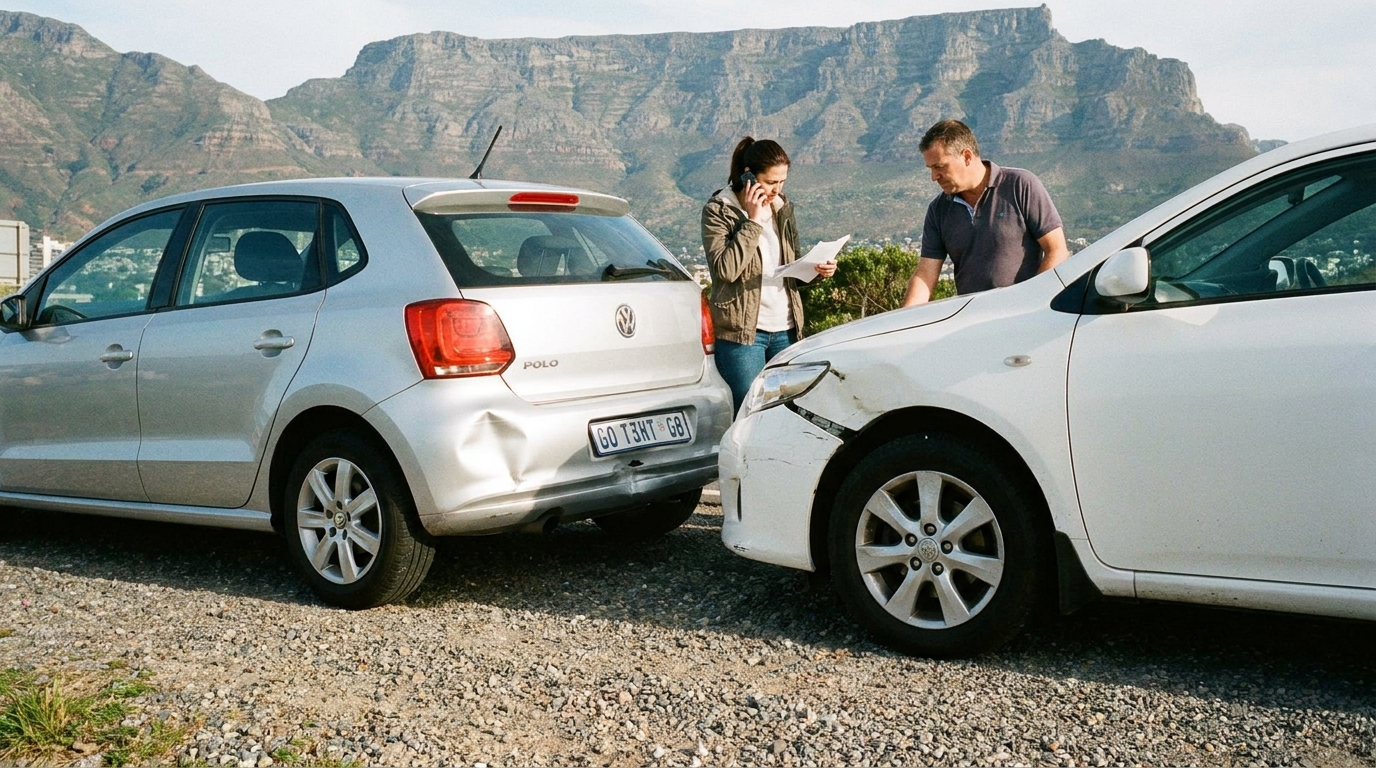
What to Do Immediately After a Car Accident in Cape Town

Collision Coachworks Team
Expert Panel Beaters
A car accident is stressful, disorienting, and — if you don't know what to do — potentially costly. Whether you've experienced a minor fender bender on the N1 near Bellville or a more serious collision on the R300 near Parow Industria, knowing exactly what to do after a car accident in Cape Town can protect your safety, your legal rights, and your insurance claim.
This guide walks you through every step — from the moment of impact to dropping your vehicle off at a trusted panel beater like Collision Coachworks for professional repairs.
Step 1: Prioritise Safety First
The moments immediately after a collision are chaotic. Your first instinct should be personal safety — yours and everyone else involved.
- Stay calm. Take a breath before you act. Panicked decisions lead to mistakes.
- Check for injuries. Check yourself, your passengers, and the occupants of other vehicles. Do not attempt to move anyone who appears seriously injured unless they are in immediate danger (e.g., fire risk).
- Move to safety. If the vehicles are driveable and it is safe to do so, move them off the roadway to avoid secondary collisions. Cape Town's roads — including the N2, N1, and M5 — carry high traffic volumes, and a stationary vehicle in a lane is an extreme hazard.
- Switch on your hazard lights and place warning triangles (which are legally required to be carried in your vehicle) at least 45 metres behind your car.
Step 2: Call Emergency Services if Needed
If anyone is injured — even if the injuries seem minor — call emergency services immediately:
- 10111 — South African Police Service (SAPS)
- 10177 — National ambulance/emergency services
- 112 — Emergency from a mobile phone (works on all networks)
- 0860 999 911 — Western Cape Government Emergency Medical Services
In South Africa, if an accident results in injury or death, you are legally required to report it to the police within 24 hours. Even if there are no injuries, it is good practice to report the accident — particularly in Cape Town where traffic authorities have dedicated accident reporting points in areas like Bellville and the Northern Suburbs.
Step 3: Do Not Admit Fault
This is one of the most important rules after any road accident in South Africa. Even if you believe you may be at fault, do not admit liability at the scene. Insurance companies and courts determine liability based on evidence, witness accounts, and traffic law — not roadside statements made in shock.
A simple apology, while well-intentioned, can be used against you. Keep communication factual and limited until you've spoken to your insurer.
Step 4: Exchange Information
Before leaving the scene, collect the following information from all other parties involved:
- Full name and identity number
- Contact number and address
- Vehicle registration number
- Vehicle make, model, and colour
- Insurance company name and policy number
- Driver's licence number
If the other driver is uninsured or refuses to share details, note the registration plate, take photos, and report immediately to SAPS. Uninsured accidents are unfortunately common in the Western Cape, and your insurer will need a police case number to process claims in these situations.
Step 5: Document the Scene Thoroughly
Your smartphone is your most valuable tool after an accident. Use it to document everything:
- Take wide-angle photos of both vehicles and their positions on the road
- Photograph all visible damage to every vehicle involved
- Capture road conditions, traffic signs, markings, and any contributing factors (e.g., a pothole — notoriously common on Cape Town's roads)
- Take photos of the other driver's licence, registration papers, and insurance documents
- Note the time, date, and exact location (intersection, road name, GPS coordinates if possible)
- If there are witnesses, ask for their contact details and whether they'd be willing to provide a statement
This photographic evidence is invaluable when your insurer's assessor or a panel beater like Collision Coachworks conducts a formal damage assessment.
Step 6: Contact Your Insurance Company
Call your insurer as soon as possible — ideally while still at the scene or immediately after. South African insurers like Outsurance, Santam, Discovery Insure, and King Price all have 24-hour emergency lines.
When you call, have ready:
- Your policy number
- A clear description of what happened
- The other party's details you collected
- The location of the accident
- Whether anyone was injured
Your insurer will guide you through the claims process and may appoint a preferred panel beater — or allow you to choose your own. You have the right to select a repairer you trust, such as Collision Coachworks at 9 Assegaai Road, Parow Industria.
Step 7: Understand the Insurance Assessment Process
After filing your claim, your insurer will arrange for an assessor to inspect the damaged vehicle. This assessment determines:
- The extent of damage
- Whether the vehicle is repairable or a write-off
- The authorised repair cost
- Whether the damage is consistent with the accident circumstances reported
In many cases, Cape Town insurers will send an assessor directly to an approved panel beating workshop. At Collision Coachworks, we liaise directly with insurance assessors to streamline this process and minimise delays for our customers.
Your excess: Remember that you'll need to pay your policy excess before or when collecting your repaired vehicle. This is the agreed portion of repair costs that you carry regardless of who was at fault.
Step 8: Choose the Right Panel Beater
Selecting a panel beater is a critical decision that affects the quality and longevity of your vehicle's repairs. Here's what to look for:
- SAMBRA registration: The South African Motor Body Repairers' Association sets quality standards for the industry. Choosing a SAMBRA-registered panel beater gives you recourse if repairs don't meet standard.
- Insurance approval: While you're not legally required to use an insurer's preferred repairer, working with an insurance-approved workshop simplifies the claims process and guarantees that costs are agreed upfront.
- Warranty on repairs: A reputable panel beater like Collision Coachworks stands behind their work with a workmanship guarantee.
- Genuine parts: Ensure the workshop uses original or OEM-equivalent parts, particularly for structural repairs that affect your vehicle's safety in future collisions.
- Spray painting quality: Modern colour-matching technology means a quality respray should be invisible to the eye. Beware of workshops that offer suspiciously low prices — poor paint jobs fade, peel, and devalue your vehicle.
Collision Coachworks, located at 9 Assegaai Road, Parow Industria, Cape Town, serves the entire Northern Suburbs — including Bellville, Goodwood, Brackenfell, Durbanville, and Elsies River. We work with all major South African insurers and provide professional panel beating, spray painting, and structural repair services.
Step 9: What Happens During the Repair Process?
Understanding the repair process helps you set realistic expectations on timelines and outcomes:
- Drop-off and initial assessment: The workshop conducts a detailed inspection and documents all damage.
- Insurance authorisation: The repairer submits a quote and images to the insurer. Approval can take 24–72 hours or longer for complex claims.
- Parts ordering: Structural panels, bumpers, headlights, and other parts are sourced. Lead times vary depending on vehicle model and parts availability — common cars like the VW Polo or Toyota Hilux are usually faster to source than specialist or imported vehicles.
- Panel beating and structural repair: Damaged panels are straightened, replaced, or bonded as required. Structural components are carefully aligned using computerised measuring systems.
- Surface preparation and spray painting: Surfaces are sanded, primed, and prepared before paint is applied in a climate-controlled spray booth. Multiple coats are applied and cured.
- Finishing and quality check: The vehicle is polished, mechanically inspected, and checked against the original condition report before handover.
Repair timelines at Collision Coachworks range from a single day for minor scratch and dent repairs to 2–3 weeks for extensive collision damage requiring structural work and a full respray. We keep customers informed throughout the process and provide detailed updates on insurance authorisation and parts delivery.
What if the Other Driver Was Uninsured?
Unfortunately, uninsured driving is widespread in South Africa. If the other driver had no insurance:
- File a case with SAPS and obtain the case number — this is essential for your own insurance claim
- Claim through your own comprehensive policy (you'll pay your excess but your insurer may pursue the other party)
- If you only have third-party cover, your options are limited to civil legal action against the other driver, which can be costly and time-consuming
- The Road Accident Fund (RAF) covers personal injury — but not vehicle damage — caused by uninsured drivers
Common Mistakes Cape Town Drivers Make After an Accident
- Leaving the scene too quickly without documenting damage or exchanging information
- Admitting fault at the roadside, which can complicate insurance claims
- Delaying the insurance notification — most policies require prompt reporting, and delays can reduce claim validity
- Choosing a panel beater based on price alone — the cheapest quote rarely delivers the quality needed for structural and cosmetic repairs
- Driving a damaged vehicle that may have compromised structural integrity, braking, or visibility
- Not following up on the repair authorisation — if your insurer is slow to approve, check in regularly to keep things moving
Ready to Get Your Vehicle Repaired?
If you've been in an accident in Cape Town or the surrounding Northern Suburbs, Collision Coachworks is ready to help. Our experienced team at 9 Assegaai Road, Parow Industria handles everything from minor dent and scratch repairs to major collision restoration — working directly with your insurer to make the process as smooth as possible.
Don't leave your vehicle's repair to chance. Contact Collision Coachworks today for a professional assessment and peace of mind that your car will be restored to its pre-accident condition.
Share Article
Need Expert Advice?
Get personalized consultation from our master technicians.
Related Articles
Third-Party vs Comprehensive Insurance for Panel Beating: A Cape Town Driver's 2026 Guide
Third-party or comprehensive cover? We break down exactly what each policy pays for when your car needs panel beating, using real Cape Town repair scenarios and 2026 ZAR figures.
Car Insurance Excess in South Africa: What You'll Actually Pay for Panel Beating in 2026
Confused about car insurance excess in South Africa? Here is exactly how excess works, what it costs you when you claim for panel beating, and how to keep your out-of-pocket spend down in 2026.
Cash vs Insurance Claim for Panel Beating: When Paying Out of Pocket Makes Sense
A Cape Town driver's guide to deciding whether to pay cash or claim from insurance after a minor bump, weighing your excess, no-claim bonus, and future premiums before you decide.