The Role of 3D Scanning in Modern Collision Repair

Collision Coachworks Team
Expert Panel Beaters
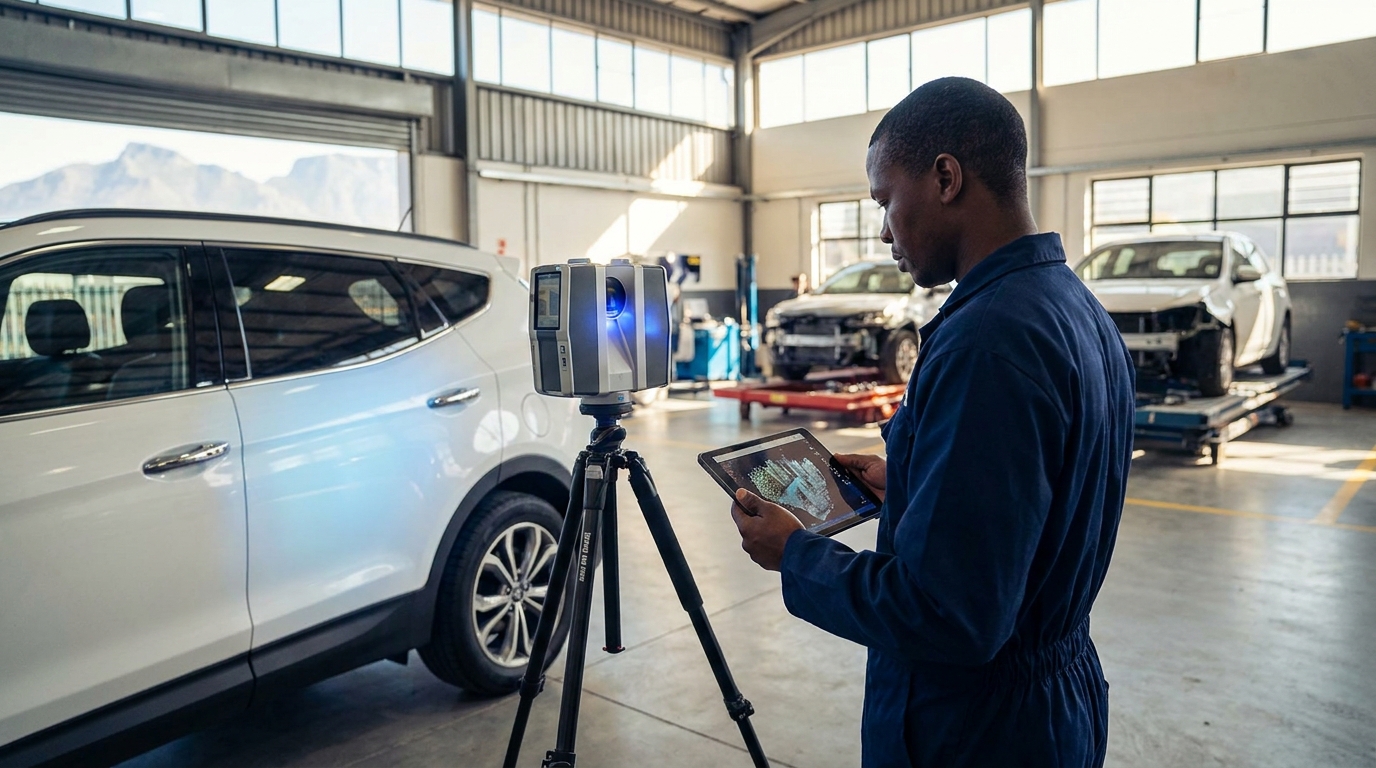
Walk into a modern collision repair facility in Cape Town today and you will notice something very different from the panel beating shops of twenty years ago. Yes, the hammers, dollies and welders are still there, but sitting next to them you will find laser scanners, tablet-mounted measuring arms and computer terminals streaming live point-cloud data onto large screens. This is the world of 3D scanning collision repair, and it has quietly become one of the most important quality-control tools in the industry.
At Collision Coachworks in Parow Industria, we have watched 3D scanning evolve from a niche technology used only by exotic brands to an everyday requirement for almost any vehicle built in the last decade. Whether you drive a VW Polo, a Toyota Hilux, a BMW 3 Series or a Ford Ranger, modern safety systems and advanced body structures simply cannot be returned to their original condition without digital measurement. In this guide we explain what 3D scanning actually does, why it matters for your insurance claim, and how it changes the repair timeline.
What Is 3D Scanning in Collision Repair?
3D scanning is the process of capturing millions of precise measurement points from a damaged vehicle and comparing them to the manufacturer's original factory specifications. Instead of a technician eyeballing a dent or stretching a tape measure across a bent chassis rail, the scanner records the exact geometry of every panel, mounting point and structural member in three dimensions.
The technology typically uses one of three methods:
- Laser scanning — a laser beam sweeps across the vehicle and a camera records where each beam lands, building a digital map accurate to fractions of a millimetre.
- Structured light scanning — a pattern of light is projected onto the panel and any distortion in the pattern reveals the surface shape.
- Photogrammetry — multiple high-resolution photographs are stitched together by software into a 3D model.
The end result is the same in every case: a dense point cloud, essentially a digital twin of your damaged car, that can be overlaid on the manufacturer's CAD data to show exactly where the body has moved, twisted or crumpled.
Why Modern Cars Demand Digital Measurement
Cars built before roughly 2010 were forgiving. If a panel was a few millimetres out of alignment, the gaps might look slightly off but the vehicle would still drive safely. That is no longer true. Modern vehicles sold in South Africa, from entry-level hatchbacks to luxury SUVs, rely on a combination of engineered crumple zones, ultra-high-strength steels, aluminium castings and a network of Advanced Driver Assistance Systems (ADAS) that all assume the body is within factory tolerance.
Crumple Zones and High-Strength Steel
Front and rear crash structures are designed to absorb energy in a very specific way. If a longitudinal rail is even a few millimetres out of position, the entire energy-absorption behaviour of the car changes. In a second collision, the vehicle may no longer protect occupants the way it did when it left the factory. 3D scanning confirms that every structural member is back within the tolerance the engineer designed for, often within 2mm or less.
ADAS Sensors and Camera Calibration
Adaptive cruise control, lane-keep assist, blind-spot monitoring and automatic emergency braking all rely on radar, lidar and camera sensors mounted behind bumpers, grilles and windscreens. A bumper replaced even slightly out of position can point a radar 1 or 2 degrees off its correct axis. At highway speeds on the N1 between Cape Town and Paarl, that small angular error translates to the system looking several lanes off to the side. Digital scanning provides the measurement confidence needed before sensors can be calibrated back to specification.
Electric Vehicles and Battery Trays
With electric vehicles arriving in South Africa in growing numbers, 3D scanning has become even more critical. EV battery trays form part of the structural floor of the vehicle. Any deformation must be measured with precision because a twisted battery enclosure is not just a structural problem — it can be a fire risk.
How 3D Scanning Fits into the Repair Process
At Collision Coachworks we use digital measurement at four distinct stages of a collision repair. Understanding these stages helps owners and insurers see exactly what they are paying for.
1. Initial Damage Assessment
When a vehicle arrives at our workshop at 9 Assegaai Road, Parow Industria, the first task is a full scan of the body, regardless of what the visible damage suggests. Collision energy travels through a vehicle in unpredictable ways. A seemingly minor front bumper impact can push a subframe backwards, twist a firewall and shift the suspension geometry. Without scanning, these hidden shifts are easily missed and only emerge months later as uneven tyre wear, pulling under braking or doors that stop closing flush.
2. Insurance Quoting and Approval
Scan data supports a more accurate and defensible quote to the insurance assessor. Instead of writing "front-end realignment required" as a line item, the technician can attach a printout showing exactly which measurement points are out of tolerance and by how much. This is especially valuable on more complex vehicles where insurers want documented proof before approving structural work.
3. Live Monitoring During Straightening
On a vehicle with chassis damage, the straightening bench is fitted with real-time measurement systems. As hydraulic rams pull the structure back towards its original shape, the technician watches the point cloud move on screen until it overlays the factory CAD within tolerance. This replaces the old method of repeatedly measuring with mechanical jigs and gauges and drastically reduces the time a car spends on the bench.
4. Final Quality Verification
Before the vehicle goes back to spray, a final scan confirms every measurement is within specification. The report is saved to the job file and, where appropriate, shared with the insurer and the owner. This documentation is valuable evidence of repair quality if the vehicle is sold or later assessed for a future claim.
Benefits for Cape Town Vehicle Owners
For owners across the Northern Suburbs — Parow, Bellville, Goodwood, Brackenfell, Durbanville, Milnerton and Ravensmead — the shift to 3D scanning collision repair delivers several real-world benefits.
- Safer vehicles after repair. Structural integrity is verified, not assumed. Your car will behave in the next accident the way the manufacturer intended.
- Better resale value. A documented scan report proves the vehicle was returned to factory tolerance. This is increasingly requested by buyers and dealer-trade-in appraisers.
- Fewer comebacks. Hidden damage caught early means fewer return visits for problems like uneven tyre wear, wind noise or misaligned tailgates.
- Properly functioning ADAS. Safety systems are only safe if they are aligned correctly. Scan-based repair is the foundation for accurate sensor calibration.
- Faster insurance approvals. Objective digital data shortens back-and-forth with assessors.
What Does 3D Scanning Cost?
Scanning is usually not a separate line item on a private quote — it is built into the labour time for assessment and quality control. On an insurance claim, the scanning and measurement time is typically absorbed under structural assessment hours agreed between the panel beater and the insurer. For context, a full scan and analysis typically adds around R1,500 to R4,500 of workshop time on a complex repair, but it routinely saves far more than that by catching hidden damage before paint is applied.
If your car has suffered any impact that affected a wheel, a chassis rail, a suspension mounting or an airbag-related structure, insisting on a scan-based repair is one of the smartest decisions you can make as an owner.
Common Myths About Digital Measurement
"My car is old, it doesn't need scanning."
Even older vehicles benefit from digital measurement when structural work is involved. Bent subframes and twisted body shells on a 10-year-old Toyota Hilux are just as dangerous as on a new one. Scanning ensures the repair is done once, done correctly, and not revisited six months later.
"The assessor didn't ask for a scan."
Insurance assessors in South Africa increasingly expect scan data on any moderate-to-severe repair. SAMBRA-accredited workshops are raising standards across the country. Rather than waiting to be asked, a reputable panel beater will simply scan as part of the standard process.
"Visual inspection is good enough."
An experienced technician can spot many issues by eye, but the human eye cannot reliably detect 2mm of displacement on a chassis rail. Modern unibody vehicles are far too precise for visual assessment alone.
How to Choose a Panel Beater Using 3D Scanning
Not every workshop in Cape Town has invested in measurement technology. When choosing where to have your vehicle repaired, ask these direct questions:
- Do you scan every vehicle as part of the assessment process, or only on request?
- Is your scanning system updated with current manufacturer CAD data?
- Will I receive a copy of the pre- and post-repair scan reports?
- Do you perform ADAS calibration in-house after structural work?
- Are your technicians trained and certified on the scanning platform?
A quality workshop will answer each of these clearly and be happy to demonstrate the equipment. Hesitation or vague answers are a sign to keep looking.
The Future: Scanning, AI and the Digital Workshop
The next step in 3D scanning collision repair is already arriving in South African workshops. Artificial intelligence is being trained to read scan data automatically, flag likely hidden damage and even suggest the repair sequence. Cloud-connected scanners share updates with insurers in real time. Some systems now produce augmented-reality overlays that a technician can see through a headset as they work on the vehicle.
For vehicle owners, the direction of travel is clear. Repairs will become more accurate, more transparent and easier to verify. At Collision Coachworks we continue to invest in the tools and training that keep us at the front of this change, because our customers in Parow Industria and across the Cape deserve repairs that are measurably correct — not just visually acceptable.
Repair Your Vehicle at Collision Coachworks
If your car has been in an accident, do not settle for a workshop that relies on guesswork. Our team at Collision Coachworks uses 3D scanning on every structural repair, backed by a climate-controlled spray booth and over two decades of panel beating expertise. We work with every major South African insurer and can handle your claim from first assessment through to final handover.
Visit us at 9 Assegaai Road, Parow Industria, Cape Town, or contact the team today to book an assessment. Whether you need a minor bumper repair or full collision restoration, we will make sure your vehicle returns to factory specification — measurably, verifiably and safely.
Share Article
Need Expert Advice?
Get personalized consultation from our master technicians.
Related Articles
Electric Vehicle Body Repair: New Challenges for Panel Beaters (2026 Update)
Electric vehicle body repair panel beating brings high-voltage safety, aluminium structures, and specialised adhesives that traditional workshops must master. Here is what Cape Town EV owners should know in 2026.
How Long Does Panel Beating Take? Repair Timeline Guide
Find out how long panel beating takes in Cape Town, from minor dents to major collision repair, with realistic timelines, process stages, and local factors that affect turnaround.
Third-Party vs Comprehensive Insurance for Panel Beating: A Cape Town Driver's 2026 Guide
Third-party or comprehensive cover? We break down exactly what each policy pays for when your car needs panel beating, using real Cape Town repair scenarios and 2026 ZAR figures.