Car Body Filler: When It's Used and How to Ensure Quality

Collision Coachworks Team
Expert Panel Beaters
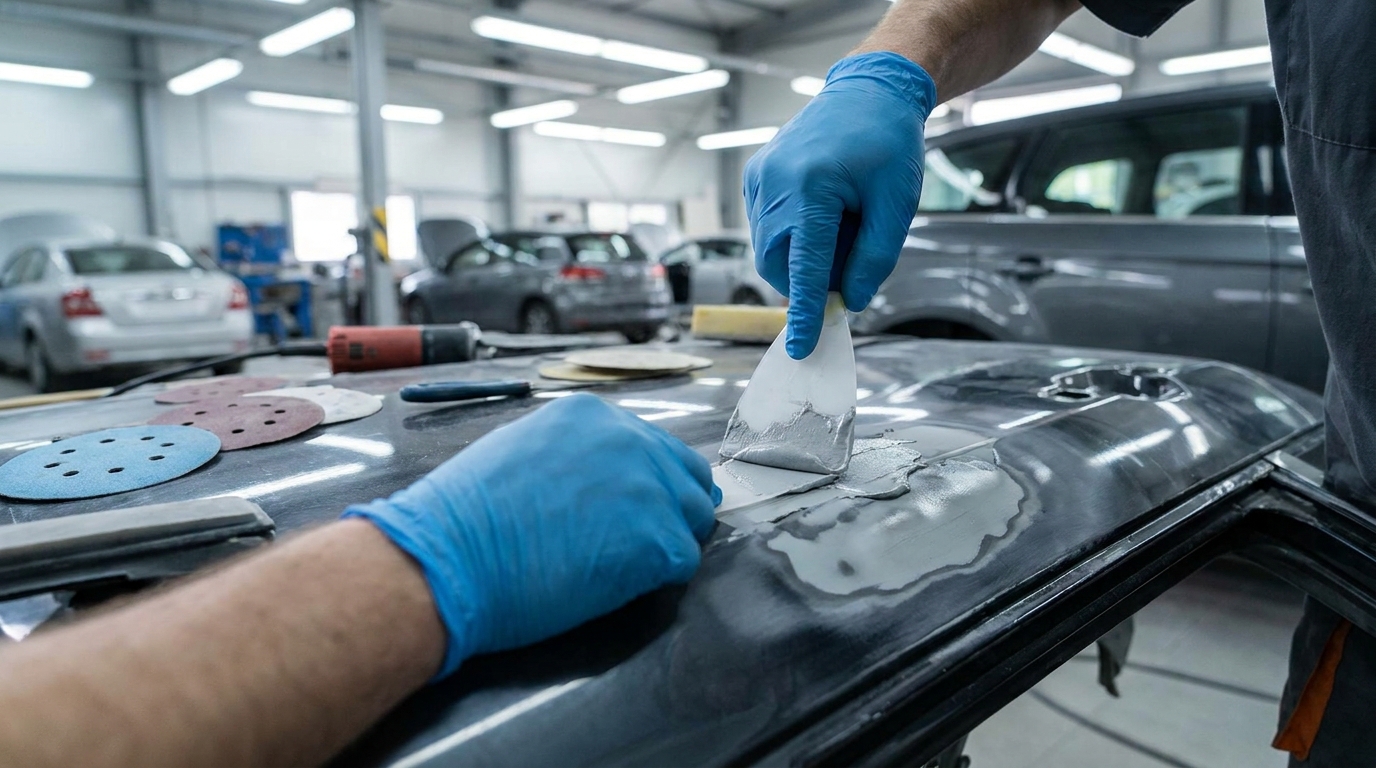
Car body filler — commonly known by the brand name Bondo or simply as stopper in South African workshops — is one of the most misunderstood materials in automotive repair. Used correctly by a skilled panel beater, it plays a legitimate and essential role in restoring a vehicle's surface to factory-smooth condition. Used incorrectly, it becomes a ticking time bomb hiding beneath layers of paint, concealing structural problems and masking shoddy workmanship. If you want to understand what happens to your car during a panel beating job, understanding car body filler is a good place to start.
What Is Car Body Filler and What Is It Actually For?
Polyester body filler is a two-part compound — a paste and a hardener — that, when mixed correctly, cures into a rigid material that can be sanded, shaped, and painted over. It was developed specifically to bridge the gap between the repaired metal surface and a perfectly smooth finish ready for primer and paint.
Here is the critical point that separates a quality repair from a poor one: body filler is a finishing material, not a structural one. It is designed to fill minor surface imperfections — small low spots, tiny pin holes, and shallow scratches in metal that has already been correctly reshaped. When a panel beater properly hammers and dolly-works a dented panel back to near-original contour, the filler only needs to bridge the last millimetre or two of imperfection. That is its legitimate role.
At Collision Coachworks in Parow Industria, our technicians follow this principle on every job. The metal work comes first, always. Filler is the finishing touch, not the foundation of the repair.
When Is Car Body Filler Legitimately Used?
Understanding when filler is appropriate helps you evaluate whether a repair shop is doing things correctly. Here are the scenarios where applying body filler is standard, accepted practice:
- Post panel beating surface preparation: After a dent has been worked back to near-original shape using hammers, dollies, and spoons, filler smooths out the remaining shallow surface irregularities before primer is applied.
- Weld seam finishing: When replacement panels are welded in, the weld seam is ground down and filler is used to blend the area seamlessly with the surrounding surface.
- Minor scrapes and scratches in metal: Surface scratches that have cut into the metal but have not deformed it structurally can be filled before repainting without any metalwork required.
- Factory seam sealing: Some vehicles leave the factory with filler used to smooth body seams — this is an OEM-approved application.
- Flexible bumper filler on plastic components: Specialised flexible filler compounds are used on plastic bumpers and fascias to restore shape after minor damage.
In all these cases, the filler application is thin — typically between 1mm and 4mm at most — and applied over a correctly prepared metal surface.
When Is Car Body Filler Being Misused?
This is where the reputation of body filler gets complicated. In the hands of less scrupulous repairers across Cape Town and beyond, filler becomes a shortcut — a way to avoid the skilled, time-consuming metal work that a quality repair demands. Here is what misuse looks like:
- Thick filler over unworked dents: Instead of straightening the metal first, a filler is applied in thick layers — sometimes 10mm, 20mm, or even more — directly over the dent. This is a fundamental failure of workmanship. Thick filler is brittle, cracks over time, and will eventually fall out, revealing the original damage.
- Filler applied over rust: Body filler does not bond to rust. If filler is applied over corroded metal without proper rust treatment, the bond fails quickly, moisture gets trapped beneath, and the rust accelerates dramatically. This is particularly common on older vehicles and is a serious problem in Cape Town's coastal climate.
- Filler used to hide structural damage: If a vehicle has suffered significant structural deformation — bent chassis rails, misaligned body mounts, crumple zones that have not been properly restored — filler hides these issues without addressing them. A vehicle that looks perfect cosmetically but has unresolved structural problems is dangerous.
- Filler over paint: Filler should always be applied to bare, sanded metal or properly keyed primer. Applying it over existing paint dramatically reduces adhesion and guarantees early failure.
How Much Filler Is Too Much?
The generally accepted industry standard — and what reputable panel beaters across South Africa adhere to — is that filler should not exceed 6mm in depth at any single point, and ideally should be considerably thinner than that. When filler exceeds this thickness, several problems emerge:
- Thermal expansion and contraction of the metal substrate causes the filler to crack as temperatures cycle — this is especially relevant in the Western Cape where summer and winter temperatures vary significantly.
- Thick filler takes much longer to cure fully and can remain slightly flexible in its core, causing paint adhesion problems over time.
- Sanding thick filler back to shape generates significant heat, which can distort the repair and soften the filler itself.
- If moisture penetrates (through micro-cracks in the paint or from the underside), thick filler acts as a sponge, accelerating corrosion and causing the repair to delaminate from the metal.
If a repair ever requires more than 6mm of filler, the correct approach is to return to the panel and work the metal further — or to replace the panel entirely if it is beyond economical repair.
How to Identify Quality Filler Work
It is not always easy to spot poor filler work once a vehicle has been repainted and polished to a mirror finish. However, there are some practical checks that can help — both immediately after a repair and in the weeks and months that follow.
Immediately After Repair
- Contour consistency: Run your hand across the repaired panel compared to the adjacent unrepaired panels. The surface should feel consistent and correct — not subtly wavy or exhibiting a slight hump or hollow where the repair was done. Small contour inconsistencies can indicate filler that was not properly worked back to the panel's original shape.
- Panel alignment: Check that panel gaps — the spaces between the bonnet and fenders, doors and pillars — are consistent and even. Poor repairs sometimes affect panel alignment, a sign that the metal work was insufficient.
- Request documentation: A reputable panel beater will photograph the vehicle at various stages of repair. At Collision Coachworks in Parow, we document our work so clients have a full record of what was done.
Over Time
- Watch for paint cracking: Hairline cracks in the paint surface — particularly following the outline of where a dent was — are a classic sign that thick filler beneath is cracking as temperatures fluctuate.
- Look for paint lifting or bubbling: Blistering or bubbling paint, especially around the edges of a repair, often indicates moisture getting beneath filler that was applied incorrectly — often over rust or improperly prepared surfaces.
- Feel for depressions: As thick filler shrinks and cracks over time, the surface can develop subtle depressions. If a repaired area starts to look slightly sunken two or three years after the repair, poor filler work is the likely culprit.
Filler Types Used in Professional Panel Beating
Not all body filler is the same. A professional workshop serving clients in Cape Town and the Northern Suburbs — whether in Bellville, Goodwood, Brackenfell, or Durbanville — should be using the correct filler type for each application:
- Standard polyester body filler: The most common type, used for the bulk of surface finishing over metal. Available in various grades from coarse (for first applications) to fine (for surface finishing before primer).
- Fibreglass-reinforced filler: Contains short fibreglass strands for improved strength and reduced shrinkage. Used in areas subject to more movement or vibration.
- Spot putty / glazing putty: A very fine, thin-bodied filler used as a final step to fill tiny pin holes and small imperfections in the standard filler layer before final primer is applied. Not suitable as a stand-alone filler over bare metal.
- Flexible filler for plastic: Specially formulated to flex with plastic and rubber components. Using rigid filler on plastic bumpers will crack within weeks.
- Aluminium-reinforced filler: Contains aluminium particles for excellent adhesion to aluminium panels — increasingly important as more modern vehicles use aluminium in their body construction.
What Happens If Poor Filler Work Is Not Caught?
The consequences of thick, poorly applied, or incorrectly bonded filler work are not just cosmetic. They compound over time and ultimately cost far more to address than a quality repair would have in the first place. Here is what typically unfolds:
First, the paint develops hairline cracks — initially so fine that they are only visible in strong raking light. Over time, these cracks allow moisture to penetrate. The underlying metal begins to rust, and the rust lifts the paint from below, creating bubbles and flaking. The filler itself, now wet and unbonded from the metal, begins to separate. What was a cosmetic repair is now a rust problem that requires stripping the panel back to bare metal, treating the rust, and starting again from scratch. In severe cases, the panel may need to be replaced entirely — a cost that far exceeds what a quality repair would have cost initially.
For South African drivers, particularly those near the coast in the Cape Town area where salt air accelerates corrosion, this cycle can play out surprisingly quickly. A poor repair done in summer can be visibly deteriorating by the following winter.
Why Panel Replacement Is Sometimes Better Than Filler
There are situations where a skilled panel beater will recommend replacing a damaged panel rather than repairing it — even when repair might appear possible. This is not about creating unnecessary work. It is about giving the client the best long-term result.
If a panel has been significantly deformed, if the metal has been overstretched or thinned during the impact, or if the repair would require excessive filler to achieve a correct contour, panel replacement delivers a better and more durable outcome. Modern replacement panels are relatively affordable for common South African vehicles — a replacement VW Polo door skin or Toyota Hilux fender can often be sourced for less than the labour cost of an extensive repair on a badly damaged original panel.
At Collision Coachworks, we assess each vehicle honestly and give clients a clear recommendation based on what will deliver the best long-term result — not just what is quickest or cheapest in the short term.
Choosing a Panel Beater Who Does It Right
When choosing a panel beater in Cape Town — whether you are in Parow, Bellville, Elsies River, or anywhere across the Northern Suburbs — the question to ask is simple: how much filler will this repair need? A shop that cannot answer this question, or that is not willing to discuss their process, is a shop worth approaching with caution.
A quality panel beater will:
- Straighten the metal correctly before reaching for the filler
- Use only as much filler as necessary to achieve a smooth finish over correctly prepared metal
- Apply filler only to bare, properly sanded metal (never over paint or rust)
- Use the correct filler type for the substrate being repaired
- Achieve panel contour accuracy that passes both visual and tactile inspection
- Document their work so clients have a repair record
Car body filler panel beating is not something to fear — when it is used correctly as a finishing material by a skilled technician, it produces repairs that last decades. The key is ensuring your chosen workshop treats it as the finishing touch it is supposed to be, not the substitute for skilled metal work that it is often misused as.
Get a Professional Assessment at Collision Coachworks
If you have concerns about a previous repair on your vehicle — paint cracking, subtle panel irregularities, or unexplained bubbling — bring your car to Collision Coachworks at 9 Assegaai Road, Parow Industria, Cape Town. Our team will assess the repair and give you an honest assessment of what was done and what, if anything, needs to be addressed. We also provide free quotations on all panel beating, spray painting, and collision repair work for new clients across Cape Town and the Northern Suburbs.
Share Article
Need Expert Advice?
Get personalized consultation from our master technicians.
Related Articles
Electric Vehicle Body Repair: New Challenges for Panel Beaters (2026 Update)
Electric vehicle body repair panel beating brings high-voltage safety, aluminium structures, and specialised adhesives that traditional workshops must master. Here is what Cape Town EV owners should know in 2026.
How Long Does Panel Beating Take? Repair Timeline Guide
Find out how long panel beating takes in Cape Town, from minor dents to major collision repair, with realistic timelines, process stages, and local factors that affect turnaround.
Third-Party vs Comprehensive Insurance for Panel Beating: A Cape Town Driver's 2026 Guide
Third-party or comprehensive cover? We break down exactly what each policy pays for when your car needs panel beating, using real Cape Town repair scenarios and 2026 ZAR figures.