Colour Matching Technology in Modern Spray Painting

Collision Coachworks Team
Expert Panel Beaters
When your car returns from a panel beater after a respray, the most telling test is simple: does the repaired panel match the rest of the vehicle? For Cape Town drivers, car colour matching spray painting has become one of the most scrutinised aspects of collision repair — and for good reason. Even a millimetre of colour deviation is visible in direct sunlight. At Collision Coachworks in Parow Industria, we use modern computerised colour matching systems to ensure every respray is factory-accurate, no matter how old or faded the surrounding paintwork may be.
Why Colour Matching Is Harder Than It Looks
Every car leaves the factory with a manufacturer colour code — a reference like "Reflex Silver" (BMW) or "Candy White" (Volkswagen). But paint is not static. Sun exposure, oxidation, minor scratches, and even the type of polish used over the years cause a car's paint to shift subtly from its original formulation. A VW Polo that has spent five years in the Cape Town sun will have a slightly different shade of white than the day it left the factory.
This means a panel beater cannot simply look up the factory code, mix that exact formula, and expect a perfect match. The surrounding panels must be measured and accounted for. This is where modern colour matching technology becomes indispensable.
How Spectrophotometers Work
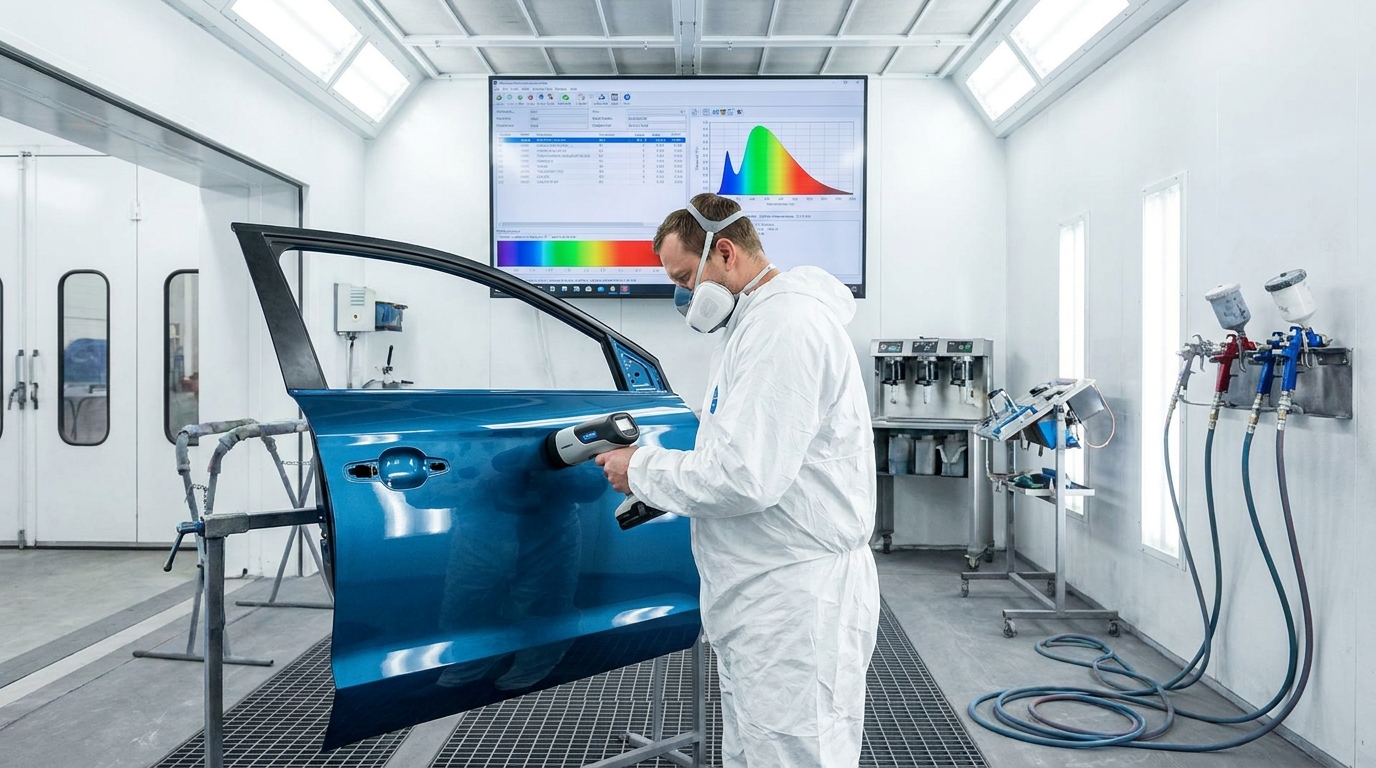
The backbone of modern car colour matching spray painting technology is the spectrophotometer — a handheld device that measures the light reflectance of a paint surface across hundreds of wavelengths simultaneously. When pressed against a car panel, the device emits controlled light and analyses precisely how the paint absorbs and reflects it.
The result is a detailed digital fingerprint of that specific panel's colour. This data is transmitted wirelessly to paint mixing software, which cross-references thousands of formulas and adjustments to produce a mix that accounts for the vehicle's exact degree of weathering, fade, and metallic flake orientation.
For solid colours like blacks and whites, the process is relatively straightforward. The real challenge lies in metallic and pearlescent finishes — common on Toyota Hilux bakkies, BMW 3 Series models, and Ford Rangers — where tiny metallic flakes in the paint change appearance depending on the viewing angle. High-end spectrophotometers measure these effect pigments at multiple angles to ensure the blend is accurate under all lighting conditions.
The Paint Mixing Process: From Data to Colour
Once the spectrophotometer reading is captured, the paint technician works with dedicated mixing software — systems like Glasurit, Spies Hecker, or SATA — to formulate the exact blend. These platforms hold databases of tens of thousands of colour variants from every major manufacturer, updated regularly as new model colours are released.
The software calculates a formula to the gram, factoring in the base coat, toners, metallic or pearl additives, and the precise ratio of each component. At professional workshops like Collision Coachworks, this mixing is done on calibrated scales that measure to fractions of a gram — because in colour work, even minor deviations in pigment ratios translate to visible differences under certain lighting.
Once mixed, a test panel spray is applied and allowed to cure before it is compared against the vehicle — both in workshop lighting and, critically, in natural daylight. The human eye is a surprisingly sensitive instrument for colour deviation, so no amount of technology replaces this final visual confirmation step.
The Role of the Spray Booth Environment
Even a perfectly formulated colour mix can look wrong if it is applied in suboptimal conditions. Temperature, humidity, and air flow all affect how paint lays down on a surface and how it cures. Modern climate-controlled spray booths maintain consistent conditions throughout the spraying process, ensuring the paint behaves predictably and cures to the correct gloss and texture.
At our Parow Industria facility, repairs on vehicles from across the Northern Suburbs — Bellville, Goodwood, Durbanville, Brackenfell — are processed in a controlled environment that eliminates the variables that cause colour variance or poor finish quality.
Tri-Stage and Special Effect Paints
Some of the most challenging colour matching jobs involve tri-stage paints — three-layer finishes that use a basecoat, a mid-coat effect layer, and a clear coat. These create deep, shifting colours that change dramatically depending on the angle of observation. Popular examples include certain Audi flip-flop finishes and pearl-effect Mercedes-Benz paints.
For these vehicles, the spectrophotometer must capture readings at multiple angles — typically 15°, 45°, and 110° from the light source — to map the full colour behaviour. The paint formula software then constructs a layered mixing strategy that replicates not just the base hue but the entire optical effect of the original paint system.
This is specialist work that not all panel beaters in Cape Town are equipped to handle. If your vehicle has a pearl, tri-coat, or chromaflair finish, it is worth asking specifically about the equipment and software your repair shop uses before committing to a booking.
Blending: The Invisible Join
Even with perfect colour matching, there is one more technique that separates professional spray painters from average ones: blending. Rather than painting only the damaged panel and stopping at its edges, skilled technicians fade the new paint into adjacent panels. This creates a gradual transition that is invisible to the human eye, even if there is a slight residual colour variance between the new mix and the aged surrounding paint.
Blending is particularly important on larger vehicles and those with prominent panel lines. A Toyota Hilux with a resprayed rear quarter panel, for example, may need blending into the door and the roof panel depending on the extent of the repair and the vehicle's colour.
This process requires additional labour and materials — which is why professional colour matching and blending adds to the overall cost of a repair. But it is the difference between a car that looks repaired and one that looks as if nothing ever happened.
Insurance and Colour Match Standards
In South Africa, most comprehensive insurance policies require that repairs restore the vehicle to pre-accident condition. For insurers like Santam, OUTsurance, and Discovery Insure, this includes ensuring colour accuracy. SAMBRA-registered panel beaters are required to maintain standards that include the use of approved paint systems and proper colour matching procedures.
If your insurer authorises a repair at a network repairer, it is worth confirming that the shop uses computerised colour matching — not a technician eyeballing a paint code from the door jamb sticker and hoping for the best. The difference in outcome is significant, especially on metallic or pearl finishes common to higher-value vehicles.
How Long Does Colour Matching Add to a Repair?
For most vehicles, the spectrophotometer reading and formula generation takes under fifteen minutes once the vehicle is in the workshop. The mixing itself takes another fifteen to thirty minutes depending on the complexity of the formula. This is a small investment of time relative to the overall repair process, and it is what makes the difference between a repair that is noticeable and one that is invisible.
On complex tri-stage or effect finishes, the colour development process may require an additional test panel and a second mixing iteration, adding a few hours to the overall timeline. At Collision Coachworks, we factor this into our job scheduling so it does not delay vehicle handover.
What to Ask Your Panel Beater About Colour Matching
If you are arranging a respray or panel repair in Cape Town, here are the key questions to ask before you approve the job:
- Do you use a spectrophotometer? If the answer is no, proceed with caution for anything other than a solid colour on a very new vehicle.
- Which paint brand and mixing system do you use? Look for recognised brands like Glasurit, Spies Hecker, Sikkens, or Standox — these are the systems used by OEM manufacturers and maintain regularly updated formula databases.
- Will you blend into adjacent panels? On metallic or pearlescent finishes, blending is not optional if you want an invisible repair.
- Will you do a test panel before applying to the vehicle? Any professional shop will do this as standard practice on complex colours.
- Is the repair covered by a paint warranty? Reputable workshops offer a paint workmanship warranty — typically two to five years on the finish.
Colour Matching at Collision Coachworks
At Collision Coachworks, 9 Assegaai Road, Parow Industria, we have invested in professional-grade spectrophotometry and computerised paint mixing as a core part of our repair process — not an optional add-on. Whether we are respraying a door panel on a Hyundai Tucson, blending a quarter panel on a BMW, or doing a full body respray on a Ford Ranger, the same colour matching precision is applied to every job.
Our technicians are trained in colour science and work with premium paint systems to ensure that your vehicle leaves our workshop looking exactly as it should. Customers from Bellville, Durbanville, Brackenfell, Goodwood, and across the Northern Suburbs trust us for colour-critical repairs precisely because we treat colour matching as a technical discipline, not guesswork.
If you have a vehicle requiring a respray or panel repair and you want the peace of mind that comes from professional colour matching technology, contact Collision Coachworks to discuss your repair. We offer free assessments and can explain exactly what the colour matching process will involve for your specific vehicle and finish.
Share Article
Need Expert Advice?
Get personalized consultation from our master technicians.
Related Articles
Electric Vehicle Body Repair: New Challenges for Panel Beaters (2026 Update)
Electric vehicle body repair panel beating brings high-voltage safety, aluminium structures, and specialised adhesives that traditional workshops must master. Here is what Cape Town EV owners should know in 2026.
How Long Does Panel Beating Take? Repair Timeline Guide
Find out how long panel beating takes in Cape Town, from minor dents to major collision repair, with realistic timelines, process stages, and local factors that affect turnaround.
Third-Party vs Comprehensive Insurance for Panel Beating: A Cape Town Driver's 2026 Guide
Third-party or comprehensive cover? We break down exactly what each policy pays for when your car needs panel beating, using real Cape Town repair scenarios and 2026 ZAR figures.