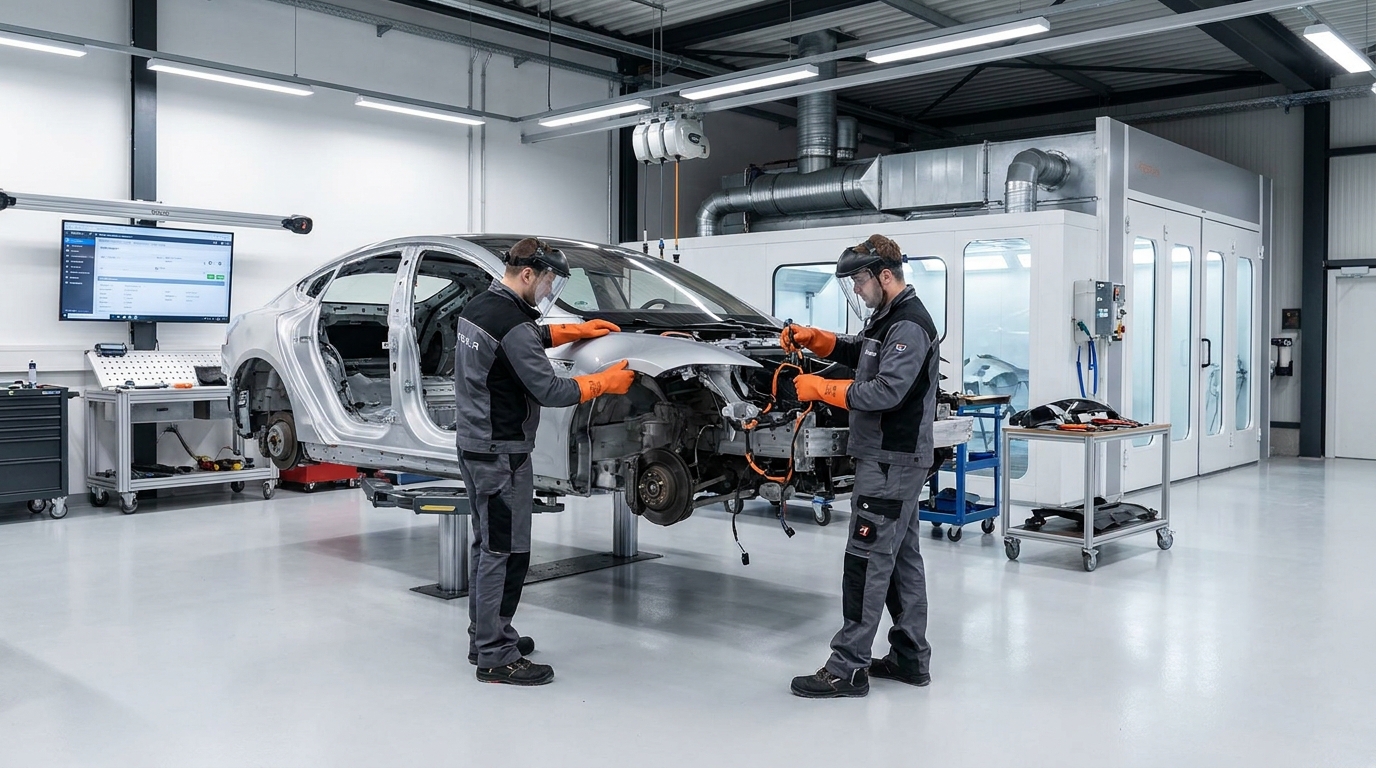
Electric Vehicle Body Repair: New Challenges for Panel Beaters

Collision Coachworks Team
Expert Panel Beaters
The rise of electric vehicles on South African roads is reshaping the automotive repair industry in ways that few drivers fully appreciate. As EVs like the Nissan Leaf, BMW i3, Volvo XC40 Recharge, and various Tesla models become increasingly common on Cape Town roads — from Blouberg to Bellville, Durbanville to the Northern Suburbs — panel beaters and collision repair specialists face a new set of technical challenges that demand specialised knowledge, equipment, and safety protocols. Understanding electric vehicle body repair and what makes it different from conventional panel beating is essential knowledge for any EV owner navigating the aftermath of an accident.
Why EV Body Repair Is Different from Conventional Panel Beating
At first glance, a dented electric vehicle looks much like any other damaged car. The bodywork is bent, the paint is scratched, and the bumper needs attention. But beneath that familiar exterior lies a fundamentally different engineering architecture that changes almost every aspect of how collision repairs must be approached.
The most critical difference is the high-voltage battery system. Most modern EVs operate at voltages between 400V and 800V — significantly higher than the 12V or 48V systems in conventional vehicles. Working around these systems without proper training and equipment creates serious risk of electrocution, arc flash, or triggering a thermal runaway event in damaged battery cells. This is not hypothetical danger: improperly handled EV batteries have caused serious injuries and fires in repair shops globally.
Before any structural repair work begins on an EV, a qualified technician must disable the high-voltage system using manufacturer-approved procedures. This typically involves removing a service disconnect plug, allowing capacitors to discharge, and verifying with a calibrated multimeter that the system is safe. Only then can conventional bodywork proceed safely.
Structural Differences: Aluminium, Carbon Fibre, and Mixed Materials
Manufacturers design EV platforms specifically to accommodate heavy battery packs — often weighing 400–600kg — while keeping overall vehicle weight manageable and maintaining structural rigidity. This engineering challenge leads to extensive use of high-strength aluminium alloys, advanced high-strength steel (AHSS), and in premium models, carbon fibre reinforced polymer (CFRP) components.
Aluminium body panels require fundamentally different repair techniques than steel. While steel can be heated and straightened relatively forgivingly, aluminium work-hardens rapidly and can crack if over-manipulated. Aluminium welding requires MIG welding with dedicated wire and gas, or more commonly, specialised pulse MIG or TIG equipment — not the standard MIG welder used on steel panels. Cross-contamination between aluminium and steel welding equipment causes porosity and weakened welds, so separate dedicated tools are a necessity, not a luxury.
For Cape Town panel beaters transitioning to EV work, this means significant investment. A proper aluminium-capable MIG welder starts at around R45,000–R80,000 for quality units. Dedicated aluminium repair hand tools, dent pulling equipment, and rivet bonding systems add further cost. Panel beaters in Parow Industria, Goodwood, and the broader Northern Suburbs are increasingly making these investments as EV volumes grow.
Battery Pack Protection and Repair Considerations
In many EVs, the battery pack sits in a flat "skateboard" configuration beneath the passenger compartment floor. This positioning provides excellent handling characteristics and low centre of gravity, but it also means the battery pack is directly exposed to road hazards and can sustain damage in side impacts, underbody scrapes over kerbs, or low-speed rear-end collisions.
Even minor underbody damage can compromise the battery enclosure's structural integrity, its cooling system, or the electrical connections between battery modules. In most cases, battery pack inspection and repair must be completed by the vehicle manufacturer's authorised service network or specialist EV repairers — a standard panel beater cannot safely open or repair a high-voltage battery pack without factory training and proprietary diagnostic tools.
This creates a common scenario where a visually minor accident — a low-speed parking lot bump that produces cosmetic panel damage — also requires battery inspection by an authorised dealer before the vehicle can be returned to service. South African EV owners should be aware that repair timelines for EVs may be longer than comparable ICE vehicles precisely because this additional assessment step is mandatory.
Adhesive Bonding: The Hidden Complexity of Modern EV Repair
Where conventional vehicles rely heavily on spot welding for body assembly, many EVs — and indeed many modern premium conventional vehicles — use structural adhesives alongside welding or riveting. These adhesives provide weight savings, improved NVH (noise, vibration, harshness) characteristics, and enhanced corrosion resistance.
Repairing adhesive-bonded structures requires the right adhesive products (typically two-component epoxy or methacrylate systems), proper surface preparation, and controlled cure conditions. Using the wrong adhesive, applying it to contaminated surfaces, or rushing the cure process compromises the structural integrity of the repair — a safety-critical failure mode that may not be visible during visual inspection.
Reputable panel beaters investing in EV capability stock manufacturer-specified adhesive systems and follow OEM repair documentation precisely. At Collision Coachworks, located at 9 Assegaai Road in Parow Industria, our team continuously trains on evolving repair standards to handle modern vehicle architectures correctly.
Recalibration of Advanced Driver Assistance Systems (ADAS)
Modern EVs are typically loaded with Advanced Driver Assistance Systems: forward collision warning, automatic emergency braking, lane keep assist, blind spot monitoring, and 360-degree camera systems. These systems rely on precisely calibrated sensors — radar units, cameras, and ultrasonic sensors — embedded throughout the vehicle's bodywork.
Any collision repair that involves replacing or realigning a panel, bumper, or body section where ADAS sensors are mounted requires recalibration of those systems after repair. This is not optional — it is a safety requirement. A forward collision warning camera that is 2 degrees out of alignment may fail to trigger emergency braking at the critical moment.
ADAS recalibration requires either a static calibration rig (a specific physical setup with targets at precise distances and angles) or a dynamic calibration drive on roads meeting specific conditions — depending on the system and manufacturer. For Cape Town panel beaters, this typically means having dedicated calibration equipment or working in partnership with an authorised dealer calibration service. Either way, it adds time and cost to repairs that EV owners need to budget for.
Insurance Implications for EV Repairs in South Africa
South African insurers are still adapting their assessment and pricing models to EVs. Several points are worth understanding:
- Parts availability: EV-specific body parts — battery enclosures, high-voltage cable conduits, specific aluminium panels — often have longer lead times than conventional parts, as local dealer stockholding is limited. Repairs can take significantly longer due to parts waiting times.
- Write-off thresholds: The high cost of EV battery packs means that even moderate collision damage can push repair costs beyond the insured value of the vehicle, resulting in write-offs. A battery pack replacement for a mid-range EV can cost R150,000–R400,000 or more.
- Specialist repair surcharges: Some insurers are beginning to recognise that EV repairs legitimately cost more due to specialist labour, equipment requirements, and mandatory safety procedures. Policyholders should check whether their policy covers EV-specific repair costs adequately.
- Approved repairer networks: Not all insurer-approved panel beaters are equipped to handle EV repairs safely and correctly. It is reasonable — and sometimes necessary — to request that your insurer direct your EV repair to a suitably equipped facility.
What to Do If Your EV Is Involved in a Collision
If your electric vehicle is involved in an accident anywhere in the Cape Town area — whether you live in Brackenfell, Durbanville, Bellville, or central Cape Town — there are important steps beyond the standard post-accident procedure:
- Do not attempt to inspect or touch the battery or high-voltage components yourself. Even if the car appears undamaged, internal battery damage is possible and not always externally visible.
- Inform your insurer and the repair facility that the vehicle is an EV before the assessment. This ensures the correct protocols are applied from the outset.
- Request confirmation that the repair facility is equipped for EV work — specifically that they have high-voltage safety training, appropriate tools, and OEM repair documentation for your vehicle model.
- Ask about ADAS recalibration — confirm it is included in the repair scope and that the facility has the necessary equipment or a confirmed calibration partner.
- Get a written repair plan that specifies what structural repairs are being made, what adhesive systems will be used, and what battery inspection has been conducted.
The Future of EV Repair in South Africa
Electric vehicle sales in South Africa are growing, albeit from a small base. Government incentives, falling battery costs, and expanding charging infrastructure are all contributing to gradual EV adoption. Industry analysts expect the proportion of EVs in the South African car parc to increase meaningfully over the next decade, with Cape Town — with its affluent market and environmental consciousness — likely to lead adoption.
For the collision repair industry, this means ongoing investment in training, tooling, and certification. Organisations like SAMBRA (South African Motor Body Repairers' Association) are working to develop training standards and certification pathways for EV repair. Panel beaters who invest in these capabilities now will be well positioned as the market grows.
At Collision Coachworks in Parow Industria, we are committed to staying at the forefront of repair technology. Our team participates in ongoing training to handle modern vehicle architectures — including EVs — to the highest safety and quality standards.
Conclusion: Choose Your EV Repairer Carefully
Electric vehicle body repair demands a higher level of technical knowledge, safety awareness, and equipment capability than conventional panel beating. The risks of choosing an unqualified repairer are not just cosmetic — they include structural compromise, ADAS malfunction, and potentially life-threatening electrical hazards.
Cape Town EV owners should take time to verify that their chosen panel beater has the training, tools, and protocols to handle electric vehicle body repair safely and correctly. Whether you drive a BMW i3 through Durbanville, a Tesla on the N1 through the Northern Suburbs, or a Volvo EV in Brackenfell, your vehicle deserves repair by specialists who understand its unique architecture.
If you have been in an accident involving an electric vehicle in the Cape Town area, contact Collision Coachworks at 9 Assegaai Road, Parow Industria. Our team will assess your vehicle safely and provide an honest, detailed repair plan — whether your car is electric, hybrid, or conventional.
Share Article
Need Expert Advice?
Get personalized consultation from our master technicians.
Related Articles
Electric Vehicle Body Repair: New Challenges for Panel Beaters (2026 Update)
Electric vehicle body repair panel beating brings high-voltage safety, aluminium structures, and specialised adhesives that traditional workshops must master. Here is what Cape Town EV owners should know in 2026.
How Long Does Panel Beating Take? Repair Timeline Guide
Find out how long panel beating takes in Cape Town, from minor dents to major collision repair, with realistic timelines, process stages, and local factors that affect turnaround.
Third-Party vs Comprehensive Insurance for Panel Beating: A Cape Town Driver's 2026 Guide
Third-party or comprehensive cover? We break down exactly what each policy pays for when your car needs panel beating, using real Cape Town repair scenarios and 2026 ZAR figures.