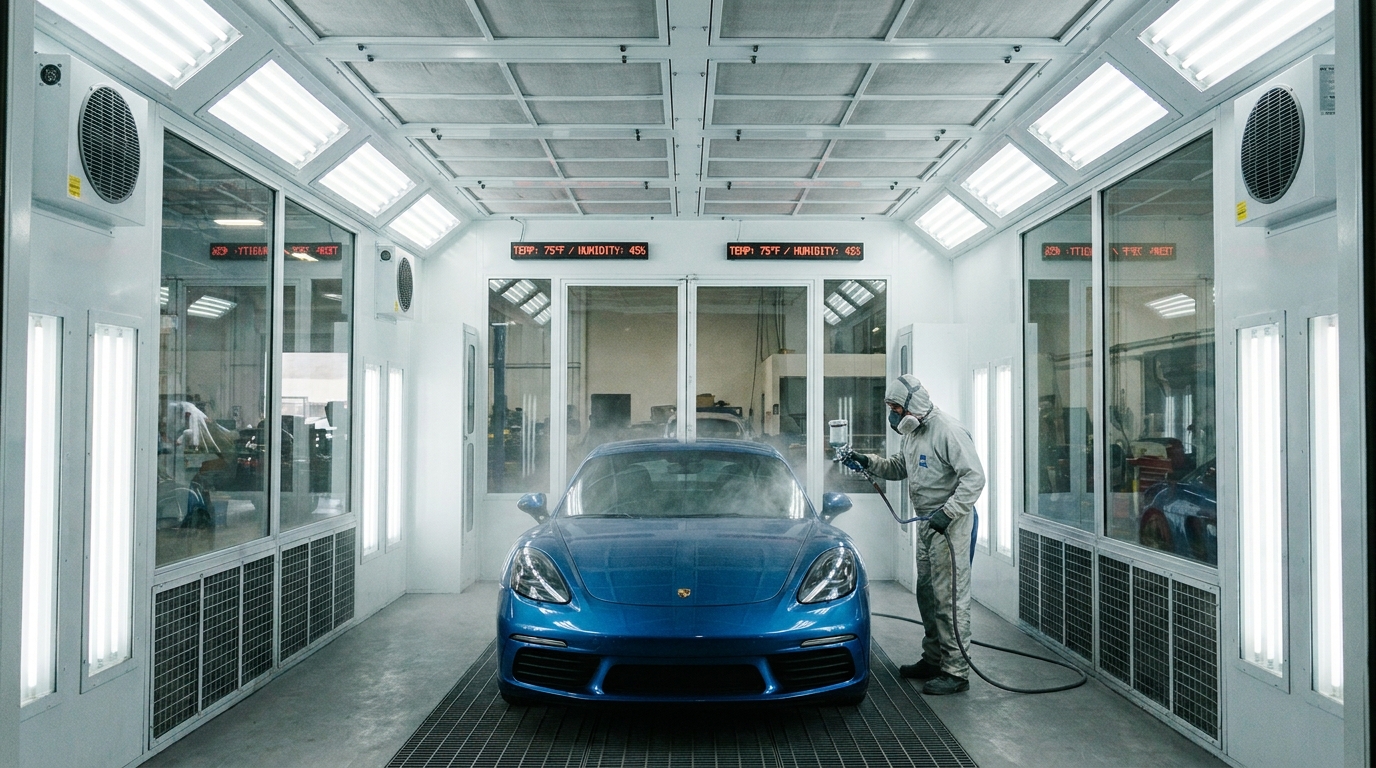
How Climate-Controlled Spray Booths Improve Paint Quality

Collision Coachworks Team
Expert Panel Beaters
When you drop your vehicle off at a panel beater for a respray, you might not think much about where the actual painting happens. But the environment in which paint is applied makes an enormous difference to the final result. Climate-controlled spray booths represent the gold standard in automotive refinishing — and understanding how they work helps you appreciate why choosing a properly equipped panel beater in Cape Town matters for the long-term quality of your car's finish.
At Collision Coachworks in Parow Industria, we operate with professional spray booth technology specifically because we understand that a flawless paint job cannot be achieved by chance — it requires controlled conditions from start to finish.
What Is a Climate-Controlled Spray Booth?
A climate-controlled spray booth is a sealed, purpose-built enclosure where automotive painting takes place under precisely regulated conditions. Unlike an open workshop bay or a basic spray area, a professional spray booth actively controls several critical environmental variables:
- Temperature: Maintained between 18°C and 25°C (or higher during the curing/baking phase)
- Humidity: Kept within an optimal range, typically 40–60% relative humidity
- Air pressure: Positive pressure is maintained inside the booth to prevent outside contaminants from entering
- Airflow: A continuous, filtered airflow carries overspray away from the vehicle and out through exhaust filters
- Lighting: High-intensity, colour-accurate lighting allows painters to identify runs, sags, and uneven coverage in real time
This level of environmental control is what separates a professional respray that lasts 10+ years from one that begins to fade, peel, or show texture problems within months.
Why Temperature Matters in Automotive Painting
Paint chemistry is sensitive to temperature at every stage — from application through to curing. In Cape Town's climate, temperatures can swing dramatically between early mornings and midday, particularly in summer. In Parow, Bellville, Goodwood, and the broader Northern Suburbs, seasonal temperatures can hit 35°C+ on hot days, which creates real challenges for paint application in uncontrolled environments.
Temperature During Application
Modern automotive paints — both waterborne and solvent-based — are formulated to be applied within specific temperature windows. If the ambient temperature is too high, the paint solvent evaporates too quickly before the paint has fully levelled, resulting in a rough, orange-peel texture. If it's too cold, the paint takes too long to flash off between coats, which can trap solvents and cause solvent popping (small craters in the finished surface).
A climate-controlled booth removes this variability entirely. The technician can set the booth to the optimal temperature for the specific paint product being used and maintain that temperature consistently throughout the application process — whether it takes 30 minutes or three hours.
The Bake Cycle
After paint application, most modern spray booths switch into a bake mode where the temperature is elevated — often to 60–80°C — to accelerate the curing process. This forced curing achieves several things:
- It dramatically shortens cycle times, allowing vehicles to be returned to customers faster
- It produces a harder, more durable paint film than air-dried paint
- It improves gloss retention and resistance to chips, scratches, and UV fading
- It helps the new paint bond more thoroughly with the primer layers below it
For owners of premium vehicles like BMW 3 Series, Audi A4, or Mercedes-Benz C-Class — where OEM paint quality is expected to be matched — the bake cycle is not optional. It's essential for achieving a factory-level result.
Humidity Control: The Hidden Factor in Paint Quality
Humidity is arguably the most underappreciated variable in automotive painting, yet it's one of the most impactful. Cape Town's coastal climate brings with it significant humidity variation — fog-heavy mornings in the winter months and dry summer heat can create conditions that are challenging to manage in an uncontrolled environment.
Too Much Humidity
When relative humidity is too high during paint application, moisture from the air can become trapped in the paint film. This causes a defect called blushing or milky haze — a cloudy, dull appearance in the finished coat that cannot be polished out. It's particularly problematic with clear coats, where any cloudiness is immediately visible.
High humidity also slows solvent evaporation, which extends flash times between coats and increases the risk of runs and sags if the painter proceeds before the previous coat is ready.
Too Little Humidity
Extremely low humidity — common on hot, windy days — causes overspray to partially dry before it lands on the vehicle surface. This produces dry spray, a sandy or gritty texture in the finish that requires additional cutting and polishing to rectify. It also means the paint atomises differently, making it harder to achieve even coverage.
In a climate-controlled spray booth, humidity is actively monitored and adjusted through the HVAC system. The result is a consistent application environment regardless of what's happening outside — whether it's a grey, foggy Cape Town winter morning or a hot southeaster-driven summer afternoon.
Airflow and Filtration: Keeping Contaminants Out
Even a single spec of dust settling into wet paint creates a visible inclusion — a tiny bump that catches light and is immediately obvious on a gloss finish. In an open workshop, dust is everywhere: from grinding work on other vehicles, from foot traffic, from the workshop floor, and from outside.
A professional spray booth addresses this through a carefully designed airflow system. Here's how it typically works:
- Intake filters: Air entering the booth passes through plenum filters (often multi-stage) that remove particles down to a very fine micron rating
- Positive pressure: The booth maintains slightly higher air pressure inside than outside, so any leakage is outward rather than inward — preventing contaminated workshop air from entering
- Downdraft airflow: The most effective booths use a downdraft design where filtered air enters through ceiling diffusers and exhausts through floor-level extraction. This carries overspray and airborne particles downward and away from the vehicle surface
- Exhaust filters: Before air exits the booth, it passes through exhaust filters that capture overspray particulates, both for air quality compliance and to protect the extraction fans
The result is an environment that is genuinely cleaner than a hospital operating theatre in terms of airborne particle counts — which is exactly what's needed for a mirror-quality paint finish.
Lighting: Seeing What You're Painting
Professional spray booth lighting is another feature that has a profound effect on paint quality. Booths use high-intensity fluorescent or LED lighting specifically engineered to reveal surface defects during and after application.
Good booth lighting allows the painter to:
- Identify runs and sags as they occur and address them before the paint sets
- Spot areas of uneven coverage — particularly important in blending work where new paint must seamlessly transition into existing paint
- Assess metallic and pearl flake orientation, which determines how the colour shifts in different lighting conditions
- Check for dirt inclusions or fish eyes while the paint is still wet enough to be corrected
This matters especially for complex colour jobs. Many modern vehicles — including popular models like the Toyota Hilux and Ford Ranger — use metallic or pearlescent paints where flake orientation is critical to matching the OEM appearance. Poor lighting leads to missed defects that only become visible once the vehicle is in daylight.
The Difference You See on Your Vehicle
So what does all of this technical infrastructure actually mean for your vehicle? The practical differences between a spray booth respray and an uncontrolled environment respray are significant and long-lasting:
Gloss and Depth
Paint applied in optimal temperature and humidity conditions levels more effectively, producing a deeper, richer gloss that is immediately noticeable. The paint film is more uniform in thickness, which contributes to better optical clarity.
Surface Texture
Controlled conditions minimise orange peel, dry spray, and other texture defects. A good spray booth respray should be smooth to the touch across the entire panel — not just in the centre where it's easiest to apply paint evenly.
Durability
Properly baked paint is significantly harder than air-dried paint. It resists minor abrasion, bird dropping etching, and UV fading far better over the long term — meaning you're less likely to need remedial work within a few years of the repair.
Colour Accuracy
Temperature and humidity affect how metallic and pearl pigments orientate in the paint film. Consistent conditions produce consistent colour throughout the panel, which is critical for spot repairs and blending work where the new paint must match the surrounding original finish.
What to Ask When Choosing a Panel Beater in Cape Town
Not all panel beaters in the Cape Town area — whether in Brackenfell, Durbanville, Milnerton, or elsewhere in the Northern Suburbs — operate with professional spray booth equipment. When evaluating a workshop for your vehicle, it's worth asking directly:
- Do you have a climate-controlled spray booth on site?
- Does your booth have a bake cycle for accelerated curing?
- What filtration system does your booth use?
- Do your painters work exclusively in the booth, or do they spray in the workshop?
A workshop that takes paint quality seriously will answer these questions with confidence and often be proud to show you their facility. A workshop that deflects or is vague about their spray environment is a warning sign.
Collision Coachworks: Professional Spray Booth Facilities in Parow Industria
At Collision Coachworks, situated at 9 Assegaai Road, Parow Industria, we invest in proper spray booth technology because we understand that paint quality is not just cosmetic — it's structural protection for your vehicle's bodywork. A quality respray seals metal panels against corrosion, UV damage, and the road environment Cape Town cars face every day.
Whether you're bringing in a VW Polo after a parking lot scrape, a Toyota Hilux after a collision repair, or a luxury vehicle requiring factory-matched colour work, the same professional process applies. Every vehicle that leaves our spray booth has been refinished under controlled conditions — the right temperature, the right humidity, clean filtered air, and professional lighting throughout.
We serve customers across the Cape Town area, including Parow, Bellville, Goodwood, Brackenfell, Durbanville, Milnerton, and surrounding communities. If you've been quoted for spray painting work elsewhere, we're happy to provide a comparison quote and walk you through our process.
Contact Collision Coachworks today at 9 Assegaai Road, Parow Industria, Cape Town, to discuss your vehicle's paint and panel beating needs. Our team is ready to answer your questions and provide a professional assessment of the work required.
Share Article
Need Expert Advice?
Get personalized consultation from our master technicians.
Related Articles
Electric Vehicle Body Repair: New Challenges for Panel Beaters (2026 Update)
Electric vehicle body repair panel beating brings high-voltage safety, aluminium structures, and specialised adhesives that traditional workshops must master. Here is what Cape Town EV owners should know in 2026.
How Long Does Panel Beating Take? Repair Timeline Guide
Find out how long panel beating takes in Cape Town, from minor dents to major collision repair, with realistic timelines, process stages, and local factors that affect turnaround.
Third-Party vs Comprehensive Insurance for Panel Beating: A Cape Town Driver's 2026 Guide
Third-party or comprehensive cover? We break down exactly what each policy pays for when your car needs panel beating, using real Cape Town repair scenarios and 2026 ZAR figures.