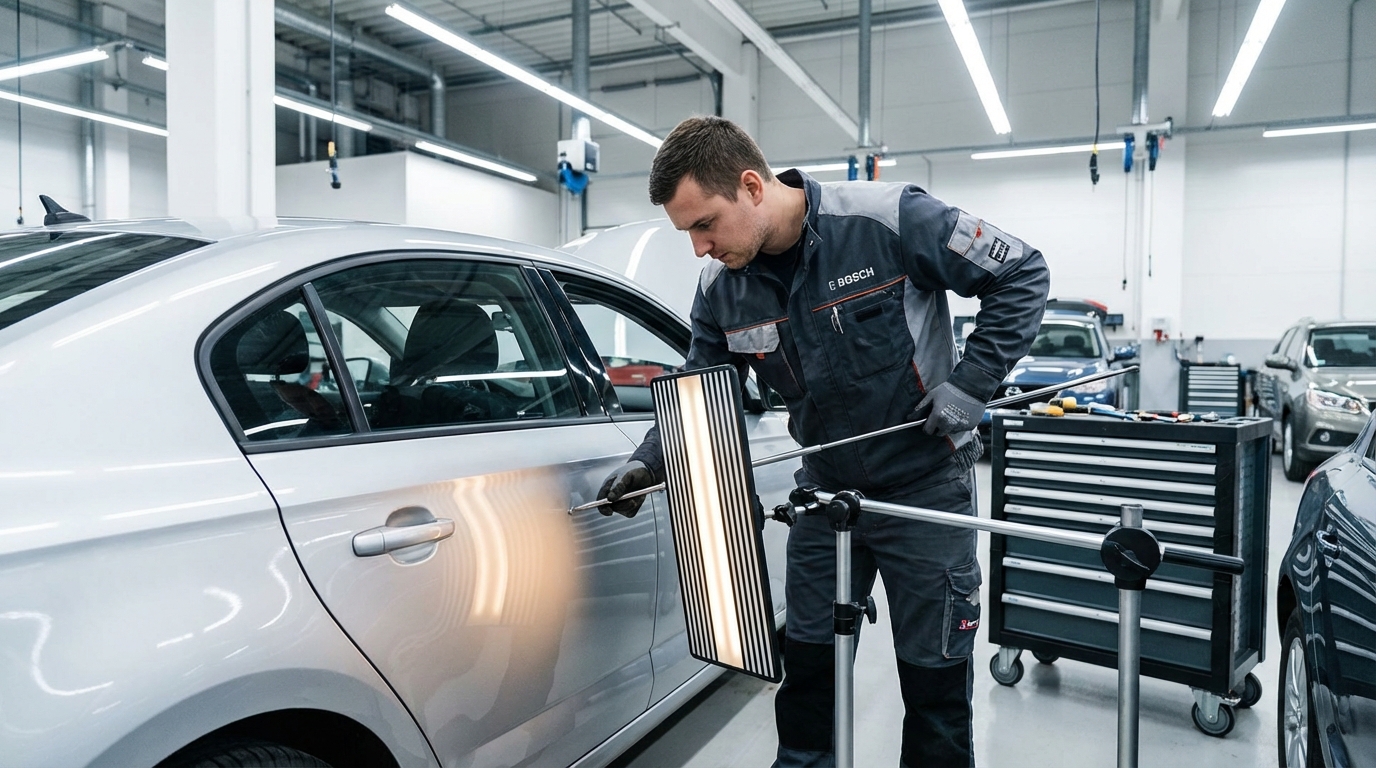
How PDR Technology Is Changing Dent Repair

Collision Coachworks Team
Expert Panel Beaters
Paintless dent repair (PDR) technology has fundamentally changed the panel beating industry over the past two decades. What once required days of bodywork, filler, and repainting can now often be resolved in hours — without a single drop of paint. At Collision Coachworks in Parow Industria, we use advanced PDR techniques alongside traditional panel beating to give our clients the most efficient, cost-effective solution for their specific damage.
What Is Paintless Dent Repair?
Paintless dent repair is a technique for removing minor dents and dings from vehicle panels without the need for body filler, sanding, or repainting. Using specially crafted metal rods, body picks, and glue-pulling systems, skilled technicians carefully massage dented panels back to their original shape from behind or directly on the surface.
The process relies on the natural elasticity of modern automotive steel and aluminium. When a panel suffers a minor impact — a car park ding, small hail dent, or minor bump — the metal deforms but the paint often remains intact. PDR exploits this by reversing the deformation without disturbing the paint layer.
For South African motorists driving VW Polos, Toyota Hiluxes, BMW 3 Series, and Ford Rangers across Cape Town's congested roads and tight parking areas in Bellville, Goodwood, and Brackenfell, small dents are an unfortunate reality. PDR technology offers a fast, affordable fix that preserves the vehicle's original factory finish.
The Core PDR Tools and Techniques
Metal Rods and Body Picks
The most traditional PDR method involves inserting long, flexible metal rods behind the damaged panel — through door jambs, window openings, or pre-existing holes — and carefully applying pressure from behind to push the dent outward. This requires exceptional feel and precision. A skilled PDR technician develops a tactile sense for the metal, applying just enough pressure in precisely the right location to coax the panel flat without over-pushing or creating new high spots.
Body picks are shorter, more rigid tools used for accessing tighter areas or applying more targeted force to stubborn dent areas. Different tip shapes allow technicians to work on curved panels, edges, and creases that straight rods cannot reach effectively.
Glue-Pulling Systems
When access from behind a panel is impossible — as is often the case with bonnet dents, roof panels, or reinforced door sections — glue-pulling technology provides an alternative. Specialised adhesive tabs are attached to the dent, and a slide hammer or pulling bridge is used to pull the dent outward from the front of the panel.
Modern glue formulations bond strongly enough to pull steel panels yet release cleanly without damaging the paint. Glue pulling is particularly effective for larger, shallower dents where the goal is to reduce the dent before final finishing with traditional rods and taps.
Reflection Boards and Lighting Systems
One of the most critical — yet least visible — aspects of PDR is the lighting. Technicians use specialised LED reflection boards or fluorescent light bars to create a uniform reflection across the panel surface. By observing the distortion in these reflected lines, the technician can map the dent precisely: seeing exactly where metal needs to be raised or lowered.
Without proper lighting, even experienced technicians cannot achieve the level of precision PDR demands. Modern PDR workshops invest significantly in quality lighting systems because it directly determines the quality of the finished repair.
Digital Dent Mapping
The cutting edge of PDR technology includes digital scanning systems that create a three-dimensional map of panel damage. Using structured light or laser scanning, these systems identify all dents across a panel — including shallow impacts invisible to the naked eye — and prioritise the repair sequence. This technology is particularly valuable for hail damage restoration where a single panel may have dozens of overlapping dents.
When PDR Works Best
PDR is not a universal solution. Its effectiveness depends on several factors:
- Paint integrity: PDR works only when the paint is undamaged. Cracked, chipped, or peeling paint means the panel needs conventional repair and repainting.
- Dent depth and size: Shallow dents up to approximately 10–12cm in diameter are ideal PDR candidates. Very deep dents that have stretched the metal significantly may not return cleanly to their original shape.
- Location: Dents on flat or gently curved panel sections are the easiest to repair. Dents on sharp body lines, panel edges, or reinforced structural areas present greater challenges.
- Metal type: High-strength steel (HSLA/UHSS) used in modern safety-critical panels can be more resistant to PDR manipulation. Aluminium panels require adapted techniques as the metal behaves differently under pressure.
- Age of the dent: Fresh dents are generally easier to repair than older ones. Over time, metal can work-harden slightly in its deformed position, making it more resistant to PDR techniques.
PDR vs Traditional Panel Beating: A Side-by-Side Comparison
Understanding the differences helps vehicle owners make an informed decision about which repair method is appropriate:
- Time: PDR repairs typically take 1–4 hours per panel. Traditional panel beating, filling, and repainting the same panel may take 1–3 days.
- Cost: PDR is generally significantly cheaper. In South Africa, a single PDR repair might cost R500–R1,500 depending on size and complexity, compared to R2,500–R6,000+ for conventional panel repair and respray.
- Paint preservation: PDR preserves the original factory paint finish, which is typically better matched and more durable than any respray. This is a major advantage for maintaining resale value.
- Insurance: Many insurers prefer PDR for appropriate repairs due to lower cost and faster turnaround. At Collision Coachworks, we work directly with insurers to determine the most appropriate — and approved — repair method.
- Limitations: PDR cannot address structural damage, cracked paint, or severe deformation. Traditional panel beating and conventional repair techniques remain essential for more significant collision damage.
Hail Damage and PDR: A Perfect Match
Cape Town and the surrounding Western Cape are no strangers to severe hail storms. When hail strikes, vehicles can sustain dozens or even hundreds of small dents across every horizontal surface — bonnet, roof, boot lid, and front guards. This is where PDR technology truly demonstrates its superiority over conventional repair methods.
A hail-damaged vehicle repaired conventionally would require repainting multiple panels, a process that introduces colour matching challenges, extended rental car costs, and the permanent replacement of original factory paint. PDR addresses hail damage more efficiently, more accurately, and at a fraction of the cost — often restoring the vehicle to pre-hail condition within a single day for moderate damage.
For Northern Suburbs residents in Durbanville, Brackenfell, and Bellville — areas that frequently experience severe summer storms — knowing that PDR is available at Collision Coachworks in nearby Parow Industria provides real peace of mind.
The Skill Behind PDR: Why Training Matters
PDR looks deceptively simple in demonstration videos. In practice, it is an exceptionally demanding craft that takes years to master. A poorly executed PDR repair can leave visible high spots, low areas, or panel distortion that is difficult or impossible to correct without removing the panel entirely and starting over with conventional methods.
At Collision Coachworks, our PDR technicians have undergone formal training and have extensive hands-on experience with the full spectrum of PDR scenarios — from single parking dents on VW Polo doors to multi-panel hail damage restoration on Toyota Hilux bakkies. This depth of experience is what separates a quality PDR repair from a rushed one.
When evaluating a PDR provider, ask about their technician's training background, the tools they use, and whether they offer a quality guarantee. A reputable workshop will always do a pre-repair assessment and be honest about whether PDR is appropriate or whether conventional repair is the better solution for your specific damage.
PDR and Vehicle Resale Value
Every South African motorist understands the importance of maintaining vehicle resale value. Whether you're planning to trade in your car or sell it privately, panel condition and paint quality are among the most scrutinised factors by potential buyers and trade-in assessors.
Because PDR preserves the original factory paint, it maintains the integrity of your vehicle's finish in a way that repainting cannot fully replicate. Factory paint is applied under controlled conditions with multi-layer primer and clear coat systems that aftermarket repaints struggle to match perfectly. A vehicle with its original paint on all panels commands a premium — and PDR helps keep it that way.
Furthermore, PDR repairs are not disclosed on vehicle history reports in the same way that accident damage and insurance claims are. Keeping your vehicle's history clean where possible is a legitimate strategy for preserving resale value.
The Future of PDR Technology
PDR technology continues to evolve rapidly. Innovations on the horizon include AI-assisted dent mapping that provides technicians with real-time guidance during the repair process, improved glue formulations for challenging panel materials, and specialised PDR techniques adapted for the increasing prevalence of aluminium and composite panels in modern vehicles.
Electric vehicles (EVs) — increasingly common even on Cape Town roads — present new PDR challenges due to their different panel construction and the presence of battery packs beneath floor panels that limit traditional access points. The industry is actively developing adapted techniques and tools to address these challenges.
Get a PDR Assessment at Collision Coachworks
If your vehicle has picked up dents from parking lot incidents, minor hail, or low-speed bumps, paintless dent repair technology may be the fastest, most cost-effective solution available. At Collision Coachworks, located at 9 Assegaai Road, Parow Industria, Cape Town, we offer honest, professional assessments to determine whether PDR or conventional repair is the right approach for your vehicle.
Our team will inspect the damage thoroughly, explain your options clearly, and give you a transparent quote before any work begins. We work with all major South African insurers and can assist with the claims process if needed. Contact us today to book your assessment or drop in during business hours — we're centrally located for customers from Bellville, Goodwood, Milnerton, Durbanville, and across the Northern Suburbs.
Share Article
Need Expert Advice?
Get personalized consultation from our master technicians.
Related Articles
Electric Vehicle Body Repair: New Challenges for Panel Beaters (2026 Update)
Electric vehicle body repair panel beating brings high-voltage safety, aluminium structures, and specialised adhesives that traditional workshops must master. Here is what Cape Town EV owners should know in 2026.
How Long Does Panel Beating Take? Repair Timeline Guide
Find out how long panel beating takes in Cape Town, from minor dents to major collision repair, with realistic timelines, process stages, and local factors that affect turnaround.
Third-Party vs Comprehensive Insurance for Panel Beating: A Cape Town Driver's 2026 Guide
Third-party or comprehensive cover? We break down exactly what each policy pays for when your car needs panel beating, using real Cape Town repair scenarios and 2026 ZAR figures.