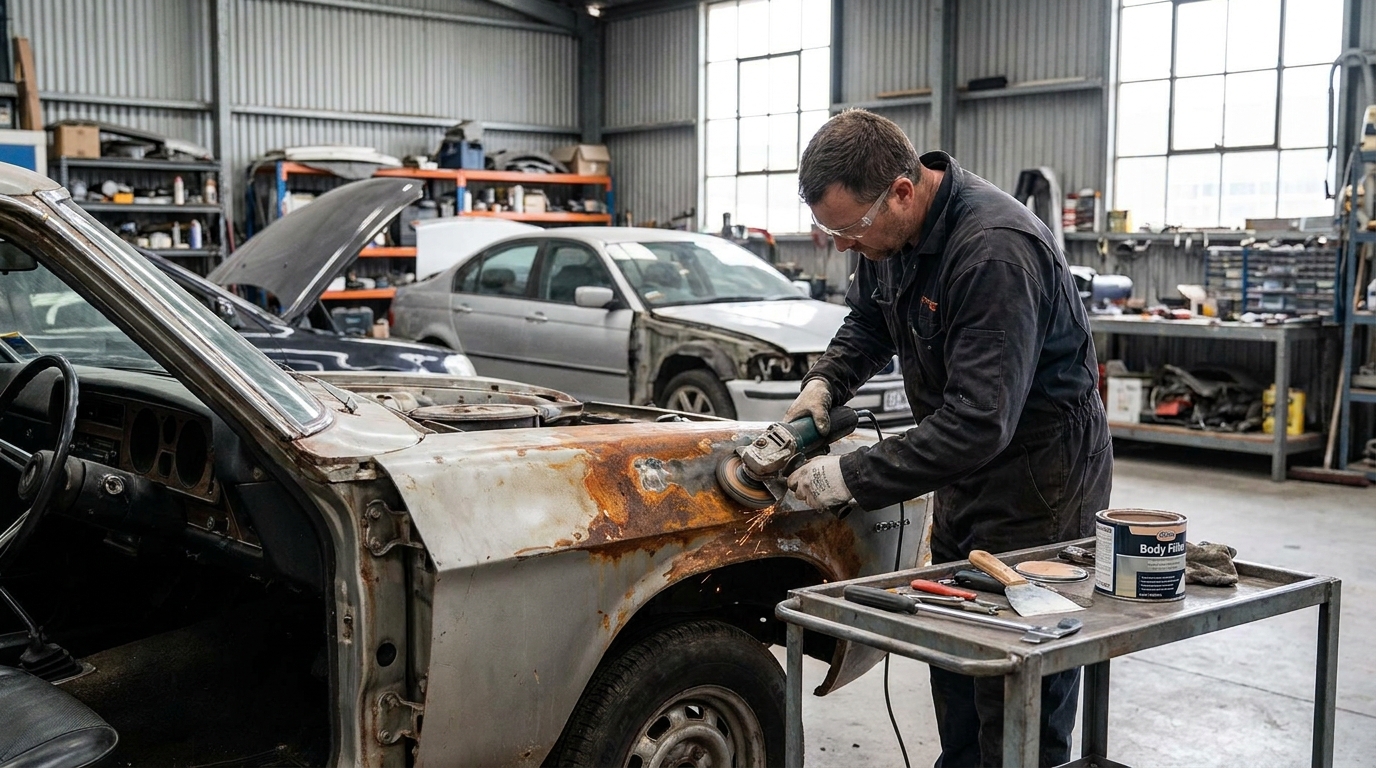
Rust Repair on Cars: Prevention and Treatment Guide

Collision Coachworks Team
Expert Panel Beaters
Rust repair on cars is one of the most common — and most urgent — issues facing South African vehicle owners. Whether you drive a Toyota Hilux that spends time on dirt roads, a VW Polo with a few stone chips on the sill, or a Ford Ranger that encountered a pothole-induced chassis scrape, rust can take hold faster than most drivers realise. Understanding how rust develops, what professional treatment involves, and how to prevent it can save you thousands of rands in long-term repairs.
Why Rust Is a Serious Problem for South African Cars
South Africa presents a uniquely challenging environment for vehicle paintwork and body panels. The Western Cape experiences a wet winter season, with Cape Town roads exposed to rain, coastal salt air, and road debris. The Northern Suburbs — from Bellville and Parow through Goodwood, Brackenfell, and Durbanville — all see vehicles dealing with stone chip damage, temperature fluctuations, and road salt spray near the coast.
Rust begins when bare metal is exposed to moisture and oxygen. Even a small scratch through the primer down to bare steel creates an entry point. Once oxidisation starts beneath the paint surface, it spreads laterally in a process called undercutting — the rust spreads under the surrounding paint, causing bubbling and flaking. By the time you notice paint bubbling on a door sill or wheel arch, the rust has usually been spreading beneath the surface for weeks or months.
Common rust-prone areas on South African vehicles include:
- Door sills and rocker panels — exposed to road spray and stones
- Wheel arches — particularly where mud and moisture accumulate behind plastic guards
- Boot floor and spare wheel well — often overlooked until significant corrosion sets in
- Windscreen channels — where old rubber seals allow water ingress
- Chassis rails and underbody — especially on bakkies and SUVs driven on gravel
- Door bottoms — water traps in the door skin drain holes can cause rot from inside out
The Professional Rust Repair Process Explained
When you bring a rust-affected vehicle to Collision Coachworks at 9 Assegaai Road, Parow Industria, the first step is a thorough assessment. This isn't just a visual check — our panel beaters inspect beneath trim panels, inside door cavities, and along the underside of the vehicle. The extent of the rust determines which repair method is appropriate.
Surface Rust Treatment (Stage 1)
Surface rust affects only the top layer of the paint system. The paint has deteriorated and rust spots are visible, but the metal beneath is still solid. Treatment involves:
- Sanding back the affected area through the paint to clean metal
- Applying a rust converter or phosphoric acid treatment to neutralise any remaining oxidisation
- Applying etch primer to promote adhesion and provide corrosion resistance
- Building up filler primer layers to restore a smooth surface
- Colour matching and refinishing with topcoat and lacquer
Surface rust repairs are the most straightforward and cost-effective, typically ranging from R800 to R2,500 per panel depending on the area affected.
Scale Rust Treatment (Stage 2)
Scale rust is more advanced — the metal surface has developed pitting and the steel has begun to weaken. The rust has progressed through multiple layers and the metal may feel rough or granular. This requires more aggressive intervention:
- Mechanical grinding with angle grinders and abrasive flap discs to remove all rust and pitting
- Chemical treatment with rust converter to halt any remaining oxidisation in pits
- Application of a suitable body filler to restore the panel contour where pitting has caused metal loss
- Multiple primer coats and careful block sanding
- Professional spray booth refinish
Scale rust repairs cost more due to labour intensity — expect R2,000 to R6,000 per panel for extensive scale rust treatment.
Penetrating Rust Treatment (Stage 3)
Penetrating rust is the most serious category, where the metal has rusted completely through, leaving holes or paper-thin sections. Panel replacement or fabrication is typically required:
- The affected section is cut out entirely using an angle grinder or plasma cutter
- A replacement panel section (new OEM panel or custom-fabricated patch panel) is welded in
- Weld seams are ground smooth and treated
- The repaired area is primed, filled as needed, and refinished
- Cavity wax or underbody sealant is applied to the inner cavity to prevent recurrence
Penetrating rust repair with panel fabrication or replacement is the most costly — from R4,000 to R15,000+ depending on the panel, vehicle, and extent of damage. On vehicles like a Toyota Hilux or Ford Ranger, chassis rust repairs can be significant in scope.
Body Filler and Rust: Understanding the Risks
A common concern amongst vehicle owners is the misuse of body filler (commonly called "bog") to cover rust rather than properly treat it. An unscrupulous repairer may grind surface rust lightly, apply thick filler directly over it, and paint the result. This is a temporary fix that will fail within months — the rust continues beneath the filler, the filler cracks and disbonds, and you're left with a worse problem than before.
At Collision Coachworks, all rust is treated at the metal level before any filler is applied. Filler is used only to restore contour on properly prepared, rust-free metal. We use quality-grade automotive polyester and lightweight fillers that are compatible with the primer systems used in our climate-controlled spray booth.
If you're buying a second-hand vehicle, one of the most important checks is to probe any suspicious paint bubbles or soft spots with a magnet — excessive filler reduces magnetic attraction and can indicate a patched rust repair. An inspection by a professional panel beater before purchase can save significant money.
Rust Prevention: What Every Car Owner Should Do
Prevention is always cheaper than cure when it comes to rust repair on cars. Here are practical steps Cape Town drivers can take:
Regular Washing — Including the Underbody
Road grime, mud, and moisture accumulate in underbody cavities, wheel arches, and drain channels. Washing your car regularly, including a directed rinse under the sills and wheel arches, removes corrosive deposits before they cause damage. This is especially important after driving on gravel roads or near the coast.
Address Stone Chips and Scratches Immediately
A stone chip on the bonnet or a door ding that breaks through to bare metal is the start of a rust problem. Touch-up paint applied promptly seals the metal and prevents oxidisation. Ignoring chips — even small ones — for months allows rust to establish itself beneath the paint surface.
Cavity Wax Treatment
Inner door cavities, sill cavities, and chassis sections are factory-treated with wax or weld-through primer, but this protection degrades over time. Professional cavity wax injection (via small access holes) provides renewed corrosion protection inside hollow body sections. This is particularly valuable for vehicles more than five years old, and for bakkies and SUVs that are used on gravel or construction sites.
Underbody Sealant
A rubberised underbody sealant (stone chip protection) applied to the underbody, wheel arches, and sills provides a physical barrier against stone impact and moisture. This is best applied when a vehicle is new or freshly repaired, but can be applied at any time to clean metal.
Keep Drain Holes Clear
Door drain holes at the bottom of door skins are designed to let water out. When these become blocked with mud or debris, water sits inside the door and accelerates rusting from the inside out. Check and clear these small holes periodically, especially after driving on muddy roads.
Covered Parking
Vehicles parked outdoors overnight — particularly near the coast or in areas with heavy morning dew — experience more surface degradation. If covered parking isn't available, a quality car cover provides meaningful protection for paintwork and trim.
Rust Repair and Insurance: What's Covered?
Insurance generally does not cover rust damage, as it is considered a maintenance issue rather than accidental damage. However, if rust damage has developed as a direct result of a collision or accident — for example, if an impact damaged underbody sealant or created a paint breach that later rusted — there may be grounds for inclusion in an insurance claim assessment.
It's worth noting that South African insurers do inspect for pre-existing rust during vehicle assessments. Visible rust at the time of a claim may lead to partial rejection of the claim if the rust is deemed to have contributed to the damage or if the vehicle was not maintained to a reasonable standard.
For rust that develops after accident repairs, a reputable panel beater like Collision Coachworks provides workmanship guarantees. If rust re-emerges on a repaired panel within the guarantee period due to inadequate rust treatment during the repair, the work should be remedied at no charge.
How Much Does Rust Repair Cost in South Africa?
Rust repair costs in South Africa vary considerably based on severity, panel accessibility, and whether panel replacement is required. As a rough guide:
- Surface rust, small area (e.g., stone chip cluster): R500 – R1,500
- Surface rust, full panel (e.g., door or bonnet): R1,500 – R3,500
- Scale rust, significant pitting: R2,500 – R7,000 per panel
- Penetrating rust, patch weld required: R4,000 – R12,000+
- Structural chassis rust (bakkies/SUVs): R6,000 – R20,000+
These are general ranges — the actual cost for your vehicle will depend on a proper assessment. Collision Coachworks provides detailed written quotations so you understand exactly what work is involved before authorising any repairs.
When to See a Professional About Rust
Many vehicle owners try DIY rust treatment with products from motor spares shops. While these can be effective for very minor surface rust on accessible areas, professional treatment is recommended when:
- The rust is on structural panels (sills, chassis rails, strut towers)
- Paint is bubbling, suggesting active undercutting rust
- The metal feels soft or has visible perforation
- The rust is in a cavity or area not accessible without panel removal
- You need the repair to be invisible and colour-matched
Attempting to cover advanced rust with filler and rattle-can paint typically results in a visible repair that fails within months — and may reduce your vehicle's resale value significantly.
Contact Collision Coachworks for a Rust Assessment
If you've noticed rust on your vehicle — whether it's a small bubble on a door sill, visible perforation on a wheel arch, or you're simply unsure about some suspicious paint on a second-hand purchase — bring it in for a professional assessment. Collision Coachworks is located at 9 Assegaai Road, Parow Industria, Cape Town, conveniently positioned for vehicle owners across Bellville, Goodwood, Brackenfell, Durbanville, and the wider Northern Suburbs.
Our team of experienced panel beaters understands the Cape Town environment and the specific rust challenges it presents. We use quality materials, proper treatment methods, and our spray booth produces factory-quality finishes. Whether you need a small rust repair or a comprehensive underbody restoration, we provide honest assessments and transparent quotations. Don't let rust repair on your car wait — the longer rust is left untreated, the more expensive the fix becomes.
Contact us today to book your rust assessment and get your vehicle protected before the next winter season.
Share Article
Need Expert Advice?
Get personalized consultation from our master technicians.
Related Articles
Electric Vehicle Body Repair: New Challenges for Panel Beaters (2026 Update)
Electric vehicle body repair panel beating brings high-voltage safety, aluminium structures, and specialised adhesives that traditional workshops must master. Here is what Cape Town EV owners should know in 2026.
How Long Does Panel Beating Take? Repair Timeline Guide
Find out how long panel beating takes in Cape Town, from minor dents to major collision repair, with realistic timelines, process stages, and local factors that affect turnaround.
Third-Party vs Comprehensive Insurance for Panel Beating: A Cape Town Driver's 2026 Guide
Third-party or comprehensive cover? We break down exactly what each policy pays for when your car needs panel beating, using real Cape Town repair scenarios and 2026 ZAR figures.