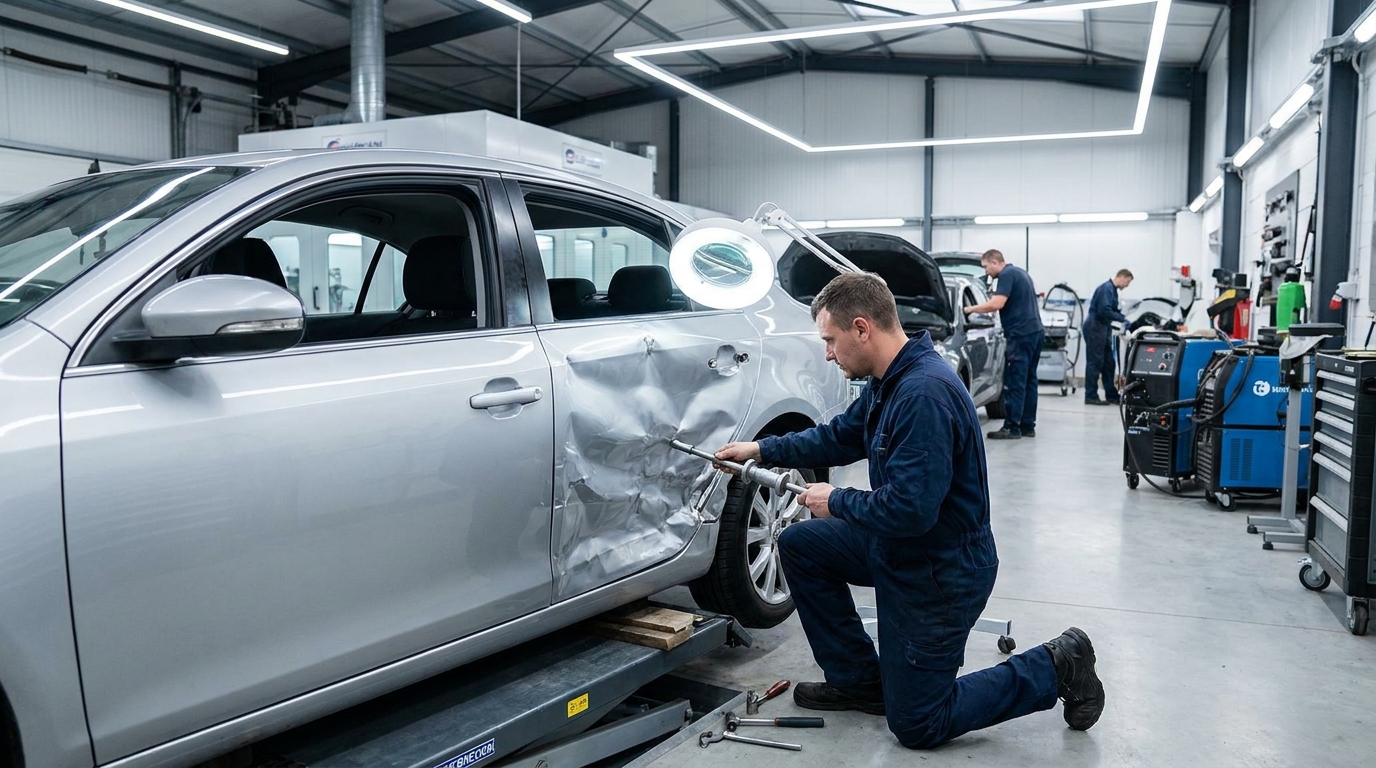
Side Impact Collision Repair: What's Involved

Collision Coachworks Team
Expert Panel Beaters
A side impact collision — whether a T-bone at an intersection, a door ding in a parking lot, or a broadside from another vehicle — is among the most serious types of vehicle damage a panel beater encounters. Unlike a rear bumper scrape or a minor bonnet dent, side impact collision repair often involves multiple interacting systems: the outer skin panels, door structures, B-pillars, side-impact airbags, window regulators, and in modern vehicles, integrated safety crumple zones. If you drive in Cape Town and have been involved in a side impact accident, here is everything you need to know about the repair process.
Why Side Impact Damage Is More Complex Than It Looks
After a side impact, drivers often look at the crumpled door or dented quarter panel and assume it is a straightforward fix. In reality, the damage visible on the surface is only part of the story. Modern vehicles — from a VW Polo to a Toyota Hilux — are engineered with side-impact protection systems (SIPS) that absorb and redirect crash energy. When these structures are activated, the repair goes far deeper than the outer skin.
Here is what can be affected in a side impact collision:
- Outer door skins and panels: The most obvious damage, requiring reshaping or replacement.
- Door beams and reinforcements: Internal door strengthening bars absorb impact energy and may be bent or fractured even when the outer skin looks repairable.
- B-pillar and A-pillar: The structural pillars running vertically through the body of the car can be twisted or compressed, affecting the vehicle's overall geometry.
- Sill and floor pan: A severe side impact can deform the sill structure and even the floor pan, requiring chassis straightening equipment.
- Side curtain airbags: These deploy from the roof lining and must be inspected and replaced if the impact triggered or stressed the system.
- Window regulators and glass: Motors, tracks, and glass are commonly damaged during side impacts.
- Seat and door seals: Misalignment after an impact can cause wind noise, water ingress, and seal failure.
The Step-by-Step Side Impact Repair Process at Collision Coachworks
At Collision Coachworks, located at 9 Assegaai Road, Parow Industria, every side impact repair follows a structured diagnostic and restoration process. Cutting corners on any step can compromise the vehicle's structural integrity and leave you with a car that is not safe for South African roads.
Step 1: Full Vehicle Assessment
Before any panel work begins, the vehicle undergoes a comprehensive inspection. This includes a visual assessment of all affected panels, a structural scan to check pillar and sill alignment, and a review of the safety systems. If your vehicle has side airbags or curtain bags that deployed, these must be flagged immediately — an uninflated bag in a subsequent accident can be life-threatening.
For vehicles driven from areas like Bellville, Goodwood, Durbanville, or Brackenfell, we often see cars that have been driven for days after a side impact because the damage appeared cosmetic. This can allow secondary stress fractures in structural components to worsen — always have a side impact assessed as soon as possible.
Step 2: Parts Procurement
Once the scope of damage is confirmed, the repair team identifies which components need replacement versus repair. Common replacements in side impact jobs include:
- Door shells or complete door assemblies
- Quarter panels (rear side panels)
- Side sill covers and structural sills
- Side curtain airbag modules
- Window regulators and motors
- Exterior mirrors and housings
For popular South African models like the Ford Ranger, Toyota Hilux, and BMW 3 Series, parts are generally available through local channels. For some European and Japanese vehicles, lead times on OEM parts can extend the repair time — your panel beater should communicate clearly about this upfront.
Step 3: Structural Straightening
If the B-pillar, sill, or floor has been deformed, the vehicle must be placed on a chassis jig and straightened using precision pulling and measuring equipment. At Collision Coachworks, we use computerised measuring systems to verify that all structural dimensions return to manufacturer specifications. This step is non-negotiable — a vehicle with even 5mm of sill deformation will have doors that do not seal properly and a compromised side-impact safety profile.
Step 4: Panel Repair and Replacement
With the structure correct, the outer panels are addressed. Depending on the severity of damage:
- Doors with moderate denting may be repaired using traditional panel beating — carefully reshaping the metal back to form using specialised dollies and hammers.
- Severely damaged panels or those with creasing across character lines are typically replaced rather than repaired, as the latter rarely achieves a result that holds up long-term.
- Quarter panels and sill covers are carefully cut and welded where necessary, using MIG welding techniques that match the factory weld specifications.
Paintless dent repair (PDR) is generally not suitable for side impact damage, as the paint and metal have usually been stressed beyond what PDR can address. Traditional panel beating combined with quality body filler for fine levelling is the correct approach.
Step 5: Paint Preparation and Respray
After metal work is complete, the affected panels go through a thorough paint preparation process. This involves:
- Applying and blocking primer to achieve a perfectly flat surface
- Colour matching using digital spectrophotometer technology — critical when repainting only one or two panels on a car with an aged or custom colour
- Spraying in a climate-controlled booth to prevent dust contamination and ensure correct paint cure
- Blending adjacent panels where required to ensure the colour transition is seamless
Cape Town's climate — with its salt air from the Atlantic coast and intense summer UV — makes paint quality especially important. The spray booths at Collision Coachworks are climate-controlled to ensure optimal conditions regardless of outside weather.
Step 6: Reassembly and Quality Check
Once paint is cured, all mechanical and electrical components are reinstalled: window regulators, glass, door handles, mirrors, seals, and trim. The vehicle then undergoes a quality check that includes door alignment, water leak testing, and a final inspection of all surfaces under controlled lighting. If airbags were deployed, the system is scanned and cleared using diagnostic equipment.
Insurance Claims for Side Impact Repairs
Most side impact repairs in South Africa are handled through comprehensive insurance. The process typically involves:
- Reporting the accident to your insurer and opening a claim
- The insurer assigning an assessor who will visit the repair shop or review photographs
- An agreed repair cost being authorised between the insurer and the panel beater
- The repair being carried out to approved scope
- You paying your policy excess upon collection
Collision Coachworks works with all major South African insurance providers and handles the paperwork and assessor liaison on your behalf. If you are unsure whether to claim, consider that side impact repairs — even for what looks like a single door — commonly range from R8,000 to R35,000+ depending on the vehicle make, model, and extent of structural damage. In most cases, claiming is the financially sensible choice.
One important note: if your vehicle was not at fault (e.g., you were hit while stationary), you may have the option to claim against the third party's insurance. South Africa's Road Accident Fund (RAF) covers personal injury but not vehicle damage, so vehicle recovery must come through either your own insurer or the at-fault party's insurer.
How to Tell If Your Side Impact Repair Was Done Correctly
After collecting your vehicle, there are several signs that indicate a quality side impact repair:
- Door gaps are even: Equal spacing between the door and surrounding body panels on all sides.
- Doors open and close smoothly without binding, sagging, or requiring extra force.
- No wind noise or water ingress through door seals when driving or washing the car.
- Paint colour match is accurate and no visible blending lines under direct sunlight.
- No warning lights related to airbag systems or seatbelt pretensioners on the dashboard.
- Sill trim and weatherstripping are seated correctly with no gaps or lifting edges.
If you notice any of these issues after a repair, return to the workshop immediately. A reputable panel beater will address any post-repair quality concerns without hesitation.
Frequently Asked Questions About Side Impact Repair
Can a side-impacted car be fully restored to factory condition?
In the majority of cases, yes — provided the structural damage is addressed correctly and quality paint matching is applied. Modern panel beating techniques, combined with computerised chassis alignment, can restore a vehicle to its pre-accident geometry. However, for vehicles with very severe side impacts that have deformed the roof, floor pan, and multiple pillars simultaneously, some insurers may assess the vehicle as uneconomical to repair (a write-off).
How long does side impact repair take?
A typical side impact repair involving one or two doors and minor structural work takes between 5 and 10 working days. More complex repairs involving quarter panel replacement, B-pillar work, or airbag system replacement can take 2–3 weeks, particularly if parts need to be sourced from overseas for less common vehicles.
Will my car be safe after a side impact repair?
Yes — provided the repair is carried out to the correct specification by a qualified panel beater with the appropriate structural straightening equipment. At Collision Coachworks, every structural repair is verified against manufacturer data before the vehicle is returned to the customer.
Conclusion
Side impact collision repair is a multi-faceted process that goes well beyond reshaping a crumpled door. From structural alignment and airbag system restoration to precision paint matching, every step matters for your safety and the long-term value of your vehicle. Whether you are in Parow, Bellville, Northern Suburbs, Goodwood, or anywhere in the Cape Town metro, Collision Coachworks at 9 Assegaai Road, Parow Industria has the expertise, equipment, and processes to restore your vehicle correctly.
Contact Collision Coachworks today to book a vehicle assessment or to get a repair estimate. We handle all insurance paperwork and assessor liaison, making the process as straightforward as possible for you.
Share Article
Need Expert Advice?
Get personalized consultation from our master technicians.
Related Articles
Electric Vehicle Body Repair: New Challenges for Panel Beaters (2026 Update)
Electric vehicle body repair panel beating brings high-voltage safety, aluminium structures, and specialised adhesives that traditional workshops must master. Here is what Cape Town EV owners should know in 2026.
How Long Does Panel Beating Take? Repair Timeline Guide
Find out how long panel beating takes in Cape Town, from minor dents to major collision repair, with realistic timelines, process stages, and local factors that affect turnaround.
Third-Party vs Comprehensive Insurance for Panel Beating: A Cape Town Driver's 2026 Guide
Third-party or comprehensive cover? We break down exactly what each policy pays for when your car needs panel beating, using real Cape Town repair scenarios and 2026 ZAR figures.