Stone Chip Repair in Cape Town: How to Protect Your Car's Paint

Collision Coachworks Team
Expert Panel Beaters
Stone chip repair in Cape Town is something every driver eventually needs to think about. Whether you commute daily on the N1, battle potholed roads through Parow and Bellville, or regularly take the Cape Winelands routes, your car's paintwork takes a beating from loose gravel, road debris, and flying stones. Left untreated, even a tiny chip can turn into a rust spot that spreads beneath the paint — eventually requiring an expensive full panel respray rather than a simple touch-up.
At Collision Coachworks, located at 9 Assegaai Road in Parow Industria, we see stone chip damage on a daily basis. This guide covers everything you need to know: what causes chips, how to spot them early, the difference between DIY and professional repair, and when a chip has gone too far for a quick fix.
What Causes Stone Chips on Cape Town Roads?
Cape Town's road network is varied — from the smooth tarmac of the N2 and N7 to poorly maintained suburban streets that scatter loose aggregate with every wet winter. Several factors make stone chips especially common in the Western Cape:
- Road construction and maintenance: Ongoing road works across the Northern Suburbs and Cape Town CBD regularly expose fresh gravel and loose chippings that get flung by passing vehicles.
- Cape Town winters: Heavy rain erodes road surfaces, dislodging stones and increasing debris on the road. The South Easter also carries dust and grit that acts as fine sandpaper on painted surfaces.
- Gravel roads and informal settlements: Many areas around Goodwood, Ravensmead, and parts of Brackenfell still have sections of unsurfaced road that contribute significantly to chip damage.
- Following distance: Driving too close to trucks, bakkies (especially Toyota Hilux and Ford Rangers with open load beds), and gravel-carrying vehicles dramatically increases chip risk.
- Highways: High-speed travel on the N1, N2, and N7 means any projectile has far more energy on impact, creating deeper chips than low-speed urban driving.
The front bumper, bonnet (hood), A-pillars, and lower door sills are the most commonly affected areas — all surfaces that face forward into the direction of travel.
Why Stone Chips Must Be Repaired Promptly
A fresh stone chip is just a cosmetic issue. It looks unsightly, but the damage is limited to the paint layers. The problem is what happens next if you leave it.
Modern car paintwork consists of several layers: the metal substrate, a primer coat, a base colour coat, and a clear lacquer topcoat. When a chip breaks through all these layers to expose bare metal, moisture enters immediately — especially during Cape Town's wet winter months. Once water reaches bare metal, oxidation (rust) begins within days, not weeks.
Rust spreads under the paint laterally, causing the paint to bubble and lift in an area much larger than the original chip. What started as a 3mm chip can become a 30mm rust patch within a single winter season. By that point, you're looking at grinding back the rust, applying filler, priming, and a localised or full panel respray — a repair costing anywhere from R800 to R3,500+ depending on the panel and extent of damage.
A simple touch-up repair, done promptly, can cost a fraction of that — often under R300 for a minor chip.
Types of Stone Chip Repair
DIY Touch-Up Paint
Most car manufacturers offer touch-up paint pens or small bottles matched to your vehicle's exact colour code (usually found on a sticker inside the door jamb or engine bay). These are widely available at motor spares stores across Cape Town, including branches in Parow, Bellville, and Goodwood.
DIY touch-up works best for:
- Very small chips (under 3mm diameter)
- Chips that haven't fully penetrated to bare metal
- Non-visible areas where a perfect colour match is less critical
The limitations are significant, however. Touch-up paint dries to a slightly different sheen than your car's original lacquer finish. On darker colours — black, dark blue, or gunmetal grey — this is especially noticeable. It's also difficult to feather touch-up paint smoothly into the surrounding area, leaving a small raised blob that catches the light. Done properly, DIY touch-up is a protective measure rather than an invisible repair.
Professional Stone Chip Repair
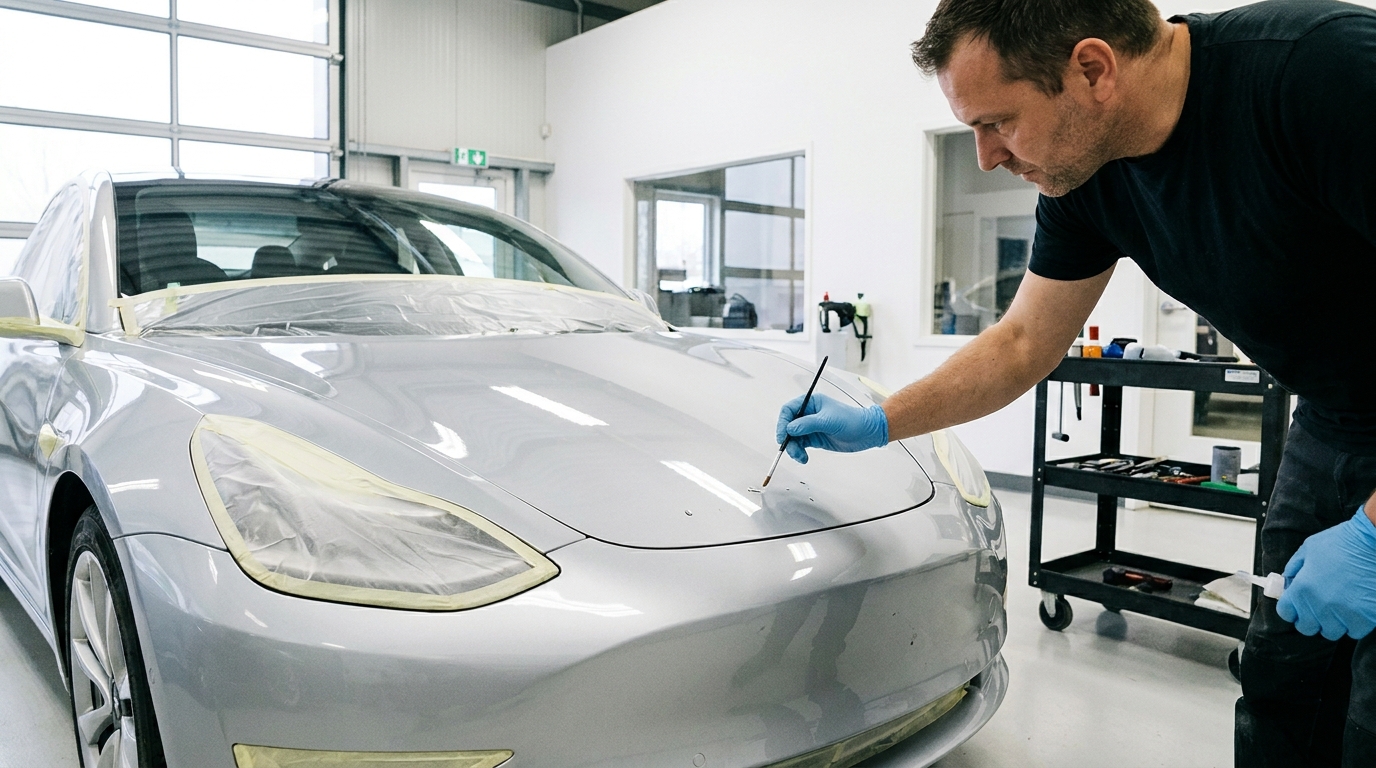
A professional panel shop like Collision Coachworks can perform stone chip repair to a standard that is either invisible or near-invisible, depending on the extent of the damage. The process varies:
- Micro-repair or spot repair: For small isolated chips, a technician will clean and degrease the chip, apply primer if needed, apply matched base coat, blend to the surrounding paint, and apply a clear lacquer topcoat. The spot is then polished to restore gloss. When done properly, this repair is essentially invisible.
- Spot respray: For a cluster of chips in one area (common on the leading edge of a bonnet), a small section of the panel may be resprayed and blended into the surrounding paint. This ensures a seamless colour match even on metallic and pearl finishes.
- Full panel respray: When chips are widespread across a panel or where rust has developed, a full panel respray is the correct solution. All previous damage is addressed before the panel receives fresh primer, colour coat, and lacquer in the spray booth.
The correct approach depends on the number of chips, their depth, whether rust has formed, and the colour and finish of the vehicle.
Colour Matching: The Critical Challenge
The biggest technical challenge with stone chip repair — and the reason many DIY attempts look worse than the original chip — is colour matching. Automotive paint fades and oxidises over time, meaning your car's paint today is rarely the same shade as the original factory colour code.
At Collision Coachworks, we use computerised spectrophotometer colour matching systems that analyse the existing paint on your vehicle and formulate a mix that accounts for weathering and fade. This means our touch-up paint is matched to your actual car, not just the original factory specification — a critical difference, especially for vehicles more than three or four years old.
Pearl, metallic, and tri-coat colours (common on German marques like BMW, Audi, and Mercedes-Benz, as well as on popular South African vehicles like the VW Polo Vivo and Toyota Fortuner) are especially difficult to match visually. Incorrect colour matching on these finishes creates a visible patch even when the application technique is perfect. Computerised mixing eliminates this problem.
Stone Chip Repair Costs in Cape Town
Pricing varies considerably based on the number of chips, depth of damage, panel location, and colour complexity. As a rough guide for Cape Town in 2026:
- Single chip touch-up (professional): R150 – R350
- Multiple chip repair on a single panel (spot repair): R400 – R900
- Spot respray (small area of panel): R700 – R1,800
- Full panel respray (chip damage + rust remediation): R1,800 – R4,500+
These are indicative ranges. A physical assessment at our Parow Industria workshop is the only accurate way to quote — stone chip repair is highly situational and depends on factors that can't be determined from a photo or description alone.
Preventing Stone Chip Damage
Repair is always possible, but prevention is far cheaper. Cape Town drivers have several effective options:
Paint Protection Film (PPF)
Paint Protection Film — sometimes called a "clear bra" — is a thick, optically clear polyurethane film applied to high-impact areas of your vehicle. It physically absorbs the impact of stone chips, preventing them from reaching the paint beneath. Modern PPF is self-healing for light scratches and is virtually invisible.
PPF is particularly popular among owners of premium vehicles and bakkies that travel gravel roads regularly. A partial front-end application (bonnet, front bumper, A-pillars, mirror caps) typically costs between R4,000 and R12,000 depending on vehicle size and film quality, but effectively eliminates stone chip damage on covered areas for the life of the film (typically 7–10 years).
Maintain Following Distance
The simplest and cheapest prevention: increase your following distance from trucks and bakkies, especially those carrying aggregate, sand, or construction materials. A gap of 40–50 metres on the highway dramatically reduces chip frequency.
Ceramic Coating
While ceramic coatings are primarily a gloss and UV protection treatment rather than impact protection, a good ceramic coat does harden the clear lacquer surface and makes the paint more resistant to minor abrasion. It won't stop a direct stone chip but will protect surrounding paint from the micro-scratching that comes from road grit and washing.
Regular Inspection
Inspect your car's bonnet, bumper, and sill edges every month, especially after a long highway trip. Catching chips within a few weeks of occurrence — before Cape Town rain and moisture can start rust — keeps repair costs minimal.
When to See a Professional Immediately
Don't delay a professional assessment in these situations:
- The chip has exposed bare metal and you're heading into the winter rainy season
- You can see a brown or orange tinge starting around the chip — rust has already begun
- The paint around the chip is lifting or bubbling
- You have a large cluster of chips on the bonnet leading edge (this area sees concentrated road debris impact)
- Your car is leased or under a service plan, and you want to avoid a damage charge at return
- You're planning to sell the vehicle — unrepaired stone chips reduce resale value and raise red flags for potential buyers
Why Cape Town Drivers Choose Collision Coachworks
At Collision Coachworks in Parow Industria, we handle stone chip repair as part of our full paint and panel service offering. We use professional colour-matching technology, apply work in a controlled environment, and finish with the same lacquer systems used in our full respray work — ensuring consistent gloss and durability.
We serve clients from across the Northern Suburbs, including Bellville, Goodwood, Brackenfell, Durbanville, and Milnerton, as well as central Cape Town and the Atlantic Seaboard. For bakkie and fleet owners who need to keep their vehicles looking professional, we offer efficient turnaround with minimal downtime.
Our experienced technicians will assess your chip damage honestly and recommend the most cost-effective repair approach — whether that's a simple touch-up, a spot repair, or a full panel respray if the damage warrants it.
Get Your Stone Chips Assessed Today
Stone chip repair in Cape Town doesn't have to be expensive or time-consuming — but it does need to be done before rust takes hold. A quick visual inspection from our team at Collision Coachworks takes just a few minutes and gives you a clear picture of what's needed and what it will cost.
Visit us at 9 Assegaai Road, Parow Industria, Cape Town 7500, or contact us to arrange a convenient time. We're open Monday to Friday and offer Saturday appointments for customers who can't get to us during the week. Don't wait for winter to expose the damage — protect your paintwork now.
Share Article
Need Expert Advice?
Get personalized consultation from our master technicians.
Related Articles
Electric Vehicle Body Repair: New Challenges for Panel Beaters (2026 Update)
Electric vehicle body repair panel beating brings high-voltage safety, aluminium structures, and specialised adhesives that traditional workshops must master. Here is what Cape Town EV owners should know in 2026.
How Long Does Panel Beating Take? Repair Timeline Guide
Find out how long panel beating takes in Cape Town, from minor dents to major collision repair, with realistic timelines, process stages, and local factors that affect turnaround.
Third-Party vs Comprehensive Insurance for Panel Beating: A Cape Town Driver's 2026 Guide
Third-party or comprehensive cover? We break down exactly what each policy pays for when your car needs panel beating, using real Cape Town repair scenarios and 2026 ZAR figures.