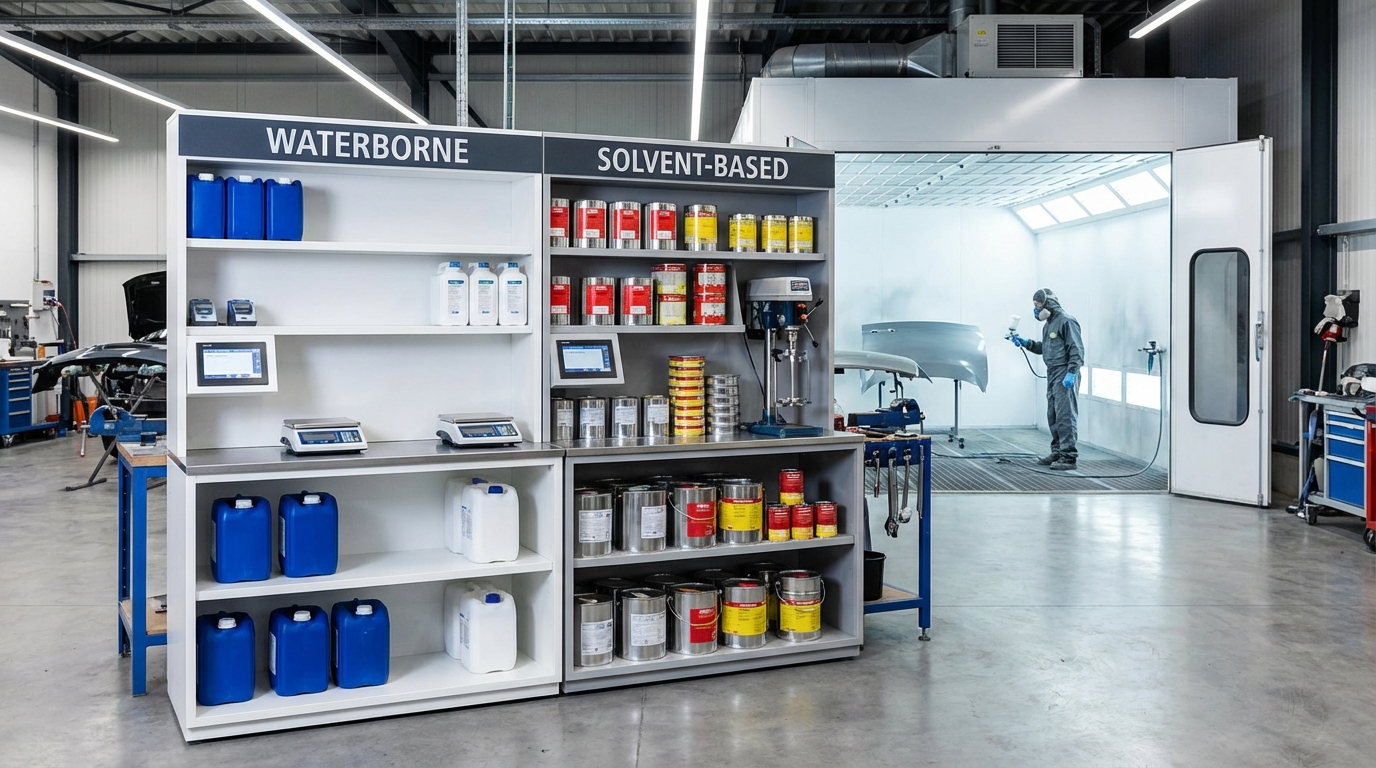
Waterborne vs Solvent-Based Automotive Paints: What Every Car Owner Should Know

Collision Coachworks Team
Expert Panel Beaters
When your vehicle goes in for a spray paint job in Cape Town, one of the most important decisions made in the workshop is which paint system to use. Most car owners never think to ask, but the choice between waterborne and solvent-based automotive paints has a real impact on the quality, longevity, and appearance of your finish.
At Collision Coachworks in Parow Industria, we believe an informed client is a happy client. Here's everything you need to know about waterborne vs solvent paint for cars — from chemistry to cost to colour matching.
What Are Waterborne Automotive Paints?
Waterborne paints (also called water-based paints) use water as the primary carrier solvent. The pigments and resins are suspended in water rather than in organic solvents. As the paint dries, the water evaporates and the resin particles fuse to form a hard, durable film.
Modern waterborne paint systems are a far cry from older formulations. Today's products are highly engineered, offering:
- Exceptional colour accuracy — waterborne paints hold pigment more precisely, which is critical for colour matching after accident repairs
- Smoother finish — smaller particle size produces a finer, more consistent coat
- Lower VOC emissions — volatile organic compound (VOC) content is significantly reduced compared to solvent-based systems
- Better metallic and pearl flake alignment — the reduced surface tension allows metallic flakes to lay flat, improving depth and shimmer
Leading paint brands like PPG, Sikkens, Glasurit, and Standox have invested heavily in waterborne systems, and most premium panel beating workshops in Cape Town's Northern Suburbs — including Bellville, Goodwood, and Parow — have made the transition to water-based basecoats.
What Are Solvent-Based Automotive Paints?
Solvent-based (or oil-based) automotive paints use petroleum-derived organic solvents as the carrier. These solvents evaporate during the drying process, releasing VOCs into the atmosphere. Older single-stage paints and many traditional workshop finishes fall into this category.
Solvent-based paints have been the industry standard for decades and still have genuine strengths:
- Self-sealing properties — they adhere well to a wider range of surfaces without as many preparation steps
- Fast dry times in cooler or more humid conditions — some solvent formulations are more forgiving of workshop temperature variation
- Established track record — decades of use means experienced painters know exactly how these products behave
- Lower upfront equipment cost — older spray equipment designed for solvent systems doesn't need immediate replacement
However, the downsides are significant: higher VOC emissions, stricter environmental regulations, and increasingly limited availability as manufacturers phase out solvent-based basecoats globally.
Waterborne vs Solvent Paint: Head-to-Head Comparison
Colour Matching Accuracy
This is where waterborne paints genuinely excel. If you've had a panel replaced on your Toyota Hilux or VW Polo and want a seamless match with the rest of the vehicle, waterborne technology delivers a more precise colour reproduction. The way waterborne paints carry pigment — and the way metallic and pearlescent flakes align during application — makes it much easier for skilled painters to achieve an invisible repair.
For solvent systems, colour matching is achievable but slightly more challenging, particularly for complex modern automotive finishes that include fine metallic particles, tri-coat pearls, or special-effect pigments.
Finish Quality and Gloss
Both systems can produce an excellent finish in the hands of a skilled painter using proper technique. However, waterborne basecoats paired with a high-quality clearcoat typically produce a deeper, richer gloss. The finer particle size in waterborne formulations contributes to a smoother surface before clearcoating, which translates to a better final appearance.
Durability and Longevity
Here's something many people don't realise: the durability of an automotive paint job is largely determined by the clearcoat, not the basecoat. Both waterborne and solvent-based basecoats, when covered with a premium two-stage clearcoat, will deliver comparable long-term performance in terms of UV resistance, chip resistance, and weather protection.
In Cape Town's climate — intense summer UV, winter rain, coastal salt air — the quality of the clearcoat and the preparation work (primer, sanding, sealing) matter far more than whether the base is water or solvent-based.
Environmental Impact
Waterborne paints contain dramatically lower levels of VOCs — typically 70–80% less than solvent-based equivalents. This is not just an environmental consideration; it's increasingly a regulatory one. South Africa's environmental standards for automotive refinishing are tightening, and workshops operating in urban industrial areas like Parow Industria and Bellville need to comply with air quality regulations.
For environmentally conscious clients — and for the long-term health of workshop staff — waterborne systems are the clear winner.
Application Complexity
Waterborne paints require more controlled application conditions. They are more sensitive to:
- Temperature — optimal application is between 18°C and 25°C
- Humidity — high humidity can extend flash-off times significantly
- Air movement — proper airflow in the spray booth is critical to flash off the water carrier
This is why climate-controlled spray booths are essential for workshops using waterborne systems. At Collision Coachworks, our fully equipped spray booths maintain consistent temperature and airflow throughout the application and curing process, ensuring waterborne paints perform exactly as designed.
Solvent-based paints are generally more forgiving of variable conditions, but this flexibility comes at the environmental cost mentioned above.
Cost
Waterborne paint products themselves often cost slightly more per litre than comparable solvent-based products. However, several factors offset this:
- Better first-pass colour accuracy means less re-work
- Fewer coats may be required due to better coverage
- Reduced waste through more consistent application
- Lower ventilation compliance costs for workshops
For most panel beating and spray painting work in South Africa, the end cost to the customer is comparable between the two systems when all factors are considered. Expect a full vehicle respray using quality waterborne paints to range from R8,000 to R25,000+ depending on vehicle size, prep required, and colour complexity. Spot repairs and single-panel resprays are naturally significantly less.
Which System Does Collision Coachworks Use?
At Collision Coachworks in Parow Industria, we use a modern waterborne basecoat system paired with a premium two-stage clearcoat. This allows us to deliver:
- Precise colour matching for insurance repairs and accident damage on any vehicle make or model
- A superior finish quality that meets or exceeds manufacturer standards
- Environmentally responsible operations that protect our staff and the surrounding Parow Industria community
- Results that hold up to the demanding Cape Town climate — coastal salt air, strong UV, and winter rains included
Our investment in quality equipment — including properly maintained spray booths with temperature and humidity control — ensures our waterborne paints deliver on their full potential every time.
Common Myths About Waterborne Automotive Paints
Myth 1: "Water-based paints won't last as long"
This is perhaps the most common misconception. As we noted above, durability in a modern automotive finish is about the complete paint system — primer, basecoat, and clearcoat — not the basecoat chemistry alone. Quality waterborne basecoats, properly applied and clearcoated, will last just as long as solvent-based equivalents.
Myth 2: "Waterborne paints are harder to touch up later"
Touch-up work requires careful colour matching regardless of the paint system used. With computerised colour matching technology — which we use at Collision Coachworks — touching up a waterborne-painted panel is no more difficult than with a solvent system.
Myth 3: "Waterborne is only for new vehicles, not repairs"
Not true at all. Waterborne paints are used extensively for collision repair and respray work across the Northern Suburbs of Cape Town. Vehicles from Durbanville, Brackenfell, Goodwood, Bellville, and all surrounding areas come through our workshop regularly for waterborne-finish repairs.
Myth 4: "Solvent paints produce a deeper, richer colour"
This may have been partially true of older waterborne formulations, but modern water-based paints — particularly from premium brands — match or exceed solvent systems for depth and richness of colour. The technology has advanced dramatically over the past decade.
What This Means for Your Repair
If your vehicle is coming in for panel beating and spray painting work — whether it's accident damage, hail repair, a full respray, or a colour change — here's what you should ask your panel beater:
- What paint system do you use? — A reputable workshop should be able to tell you the brand and type.
- Do you have a climate-controlled spray booth? — Essential for waterborne systems and for quality results in general.
- How do you colour match? — Computerised spectrophotometer-based matching is the standard for quality work.
- What clearcoat do you use? — The clearcoat is what protects your paint from UV, scratches, and the elements. Ask about the grade and brand.
At Collision Coachworks, we're happy to walk any client through our process and the products we use. Transparency builds trust, and trust is built on quality work that speaks for itself.
The Future: Where Automotive Paint Technology Is Heading
The global automotive refinishing industry is firmly moving toward waterborne systems. Major vehicle manufacturers increasingly specify waterborne products for warranty-compliant repairs. Environmental legislation in South Africa and globally will continue to restrict high-VOC solvent-based products.
Emerging technologies include:
- UV-curable waterborne paints — extremely fast cure times using UV light rather than heat
- Self-healing clearcoats — microscopic scratch resistance built into the clearcoat chemistry
- Colour-shifting and special-effect pigments — increasingly achievable with waterborne systems
- Reduced-application-step systems — combined primer-surfacers and integrated colour coats
Staying current with these technologies is part of what sets premium panel beaters apart from budget operators.
Get a Professional Finish at Collision Coachworks
Whether your vehicle needs a single dented panel repaired and resprayed, or a complete colour change, the quality of the paint system matters. At Collision Coachworks, located at 9 Assegaai Road, Parow Industria, Cape Town, we use industry-leading waterborne paint technology to deliver finishes that look factory-fresh and last for years.
We serve clients across Cape Town — from Parow and Bellville to Goodwood, Brackenfell, Durbanville, and beyond. If you have questions about our paint systems, repair process, or want to get a quote, contact us today. We're here to help you get the best possible outcome for your vehicle.
Share Article
Need Expert Advice?
Get personalized consultation from our master technicians.
Related Articles
Electric Vehicle Body Repair: New Challenges for Panel Beaters (2026 Update)
Electric vehicle body repair panel beating brings high-voltage safety, aluminium structures, and specialised adhesives that traditional workshops must master. Here is what Cape Town EV owners should know in 2026.
How Long Does Panel Beating Take? Repair Timeline Guide
Find out how long panel beating takes in Cape Town, from minor dents to major collision repair, with realistic timelines, process stages, and local factors that affect turnaround.
Third-Party vs Comprehensive Insurance for Panel Beating: A Cape Town Driver's 2026 Guide
Third-party or comprehensive cover? We break down exactly what each policy pays for when your car needs panel beating, using real Cape Town repair scenarios and 2026 ZAR figures.