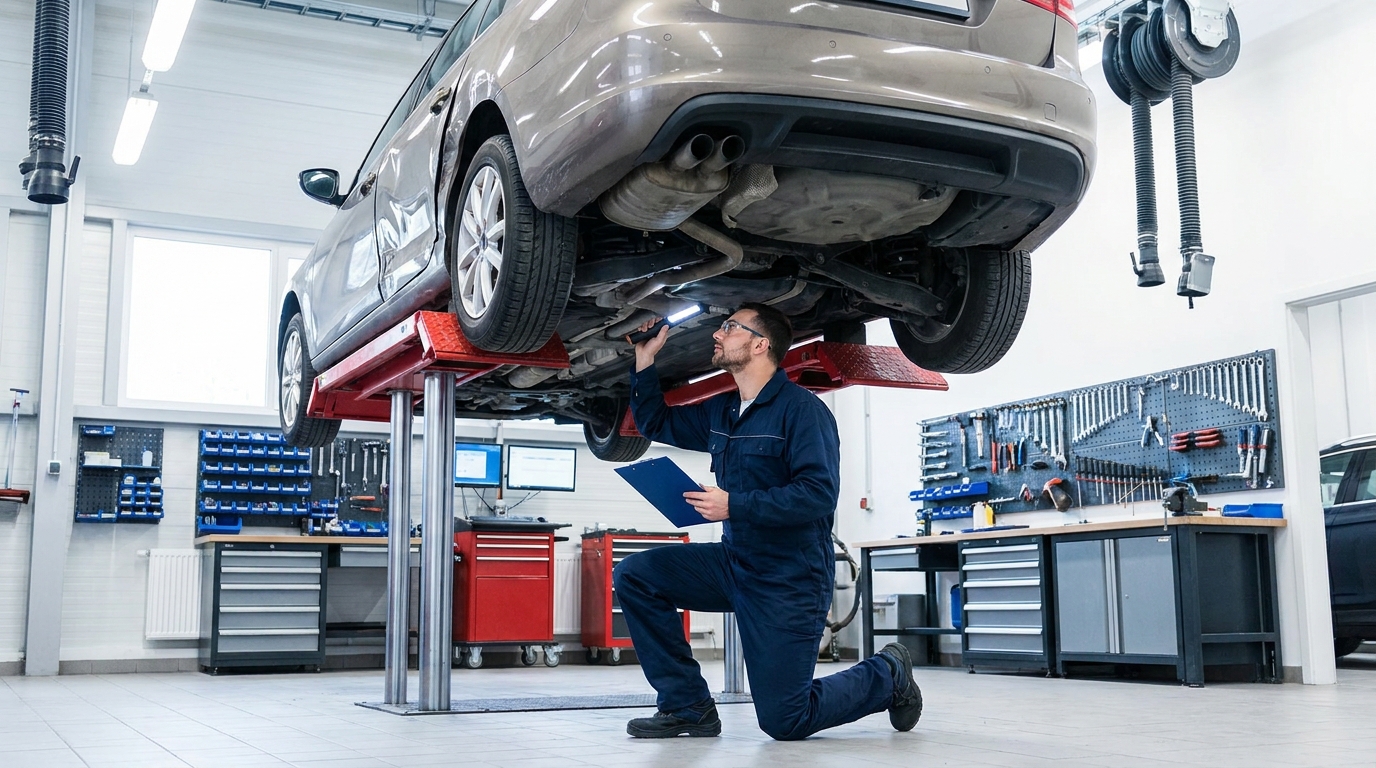
What Happens During a Professional Vehicle Assessment

Collision Coachworks Team
Expert Panel Beaters
When you bring your vehicle to a panel beater after an accident or collision, one of the first things that happens is a thorough vehicle damage assessment. This process is often misunderstood — many car owners assume it is simply a mechanic having a quick look before quoting a price. In reality, a professional vehicle damage assessment is a detailed, systematic inspection that determines the full scope of repairs needed, informs the insurance claim (if applicable), and sets the foundation for a quality repair outcome.
At Collision Coachworks, located at 9 Assegaai Road, Parow Industria, Cape Town, our assessments follow a structured process built on years of experience with all types of vehicles — from everyday VW Polos and Toyota Hiluxes to premium BMWs and Mercedes-Benz models. Here is exactly what happens during a professional vehicle damage assessment and why each step matters.
Why a Thorough Vehicle Damage Assessment Matters
A superficial assessment might catch the obvious dents and scratches, but collision damage often goes deeper than what the eye can see. A vehicle that has taken a significant impact — even a low-speed bump — can have damage to the chassis rails, structural pillars, or safety systems that are completely invisible from the outside. Missing hidden damage during the assessment means underquoting the repair, disrupting the repair schedule, and potentially returning a car to the road that is not as safe as it should be.
This is why professional panel beaters invest in proper assessment equipment and follow a methodical checklist. In Cape Town, where road conditions range from well-maintained highways to pothole-laden suburban streets, vehicles frequently sustain complex damage that requires expert evaluation. A proper assessment protects both the vehicle owner and the repairer.
Step 1: Initial Walk-Around and Documentation
The assessment begins before a single tool is touched. The assessor — typically an experienced panel beater or estimator — will perform a full walk-around of the vehicle in good lighting conditions. This involves:
- Photographing all damage from multiple angles, including wide shots and close-ups
- Noting pre-existing damage that predates the incident being assessed
- Recording the vehicle's make, model, year, VIN, and odometer reading
- Checking panel gaps — the spacing between doors, bonnets, and wings — for signs of misalignment
- Identifying paint transfer from the other vehicle or object involved in the collision
Documentation is critical, especially when an insurance claim is involved. Insurance assessors and insurers rely on detailed photos and written records to approve repair work. At Collision Coachworks we document thoroughly from the start to avoid disputes later in the process.
Step 2: Panel-by-Panel Structural Inspection
Once the walk-around is complete, the assessor moves panel by panel through the damaged areas. This is not just about identifying which panels are dented — it is about understanding the direction and energy of the impact and tracing how that force moved through the vehicle structure.
For a front-end collision on a Ford Ranger or Toyota Hilux, for example, the assessor will inspect the bumper fascia, front grille, headlamp assemblies, bonnet, front wings, radiator support, slam panel, and front rails. Even if only the bumper looks damaged, the rails behind it may have crumpled, and the bonnet may have shifted enough to require realignment even if it looks intact to the naked eye.
Common findings during this phase include:
- Creased or folded metal that will need to be cut and replaced rather than beaten out
- Stress cracks in surrounding panels that indicate the impact was absorbed by adjacent bodywork
- Damaged seams and welds at panel join points
- Deformed door sills or rocker panels in side-impact accidents
- Damaged A, B, or C pillars — structural elements that support the roof and protect occupants
Step 3: Mechanical and Safety System Checks
Panel beating is not purely cosmetic — a significant collision often affects mechanical and safety components that need to be inspected alongside the body panels. During the assessment, the assessor will flag any components that require a mechanical workshop to evaluate, including:
- Airbag modules and sensors — a front impact may have triggered or pre-tensioned the airbag system, requiring replacement of the module and sensors even if the airbags did not deploy
- Cooling system components — the radiator, fans, and associated plumbing are often damaged in front-end collisions and can cause overheating if not replaced
- Suspension geometry — even a moderate impact can bend control arms, tie rods, or wheel hubs, affecting wheel alignment and safety
- Lights and electrical systems — headlamps, indicators, and reversing cameras built into bumpers are commonly damaged and expensive to replace on modern vehicles
- Fuel, brake, and exhaust system integrity — in rear-end collisions especially
We work closely with trusted mechanical partners in the Parow Industria area to ensure that any mechanical concerns identified during our assessment are directed to the right specialists. This collaboration ensures the vehicle is returned to the road in fully roadworthy condition — not just cosmetically repaired.
Step 4: Chassis and Alignment Measurement
For any collision of moderate or greater severity, the chassis alignment must be measured using a dedicated measuring system. A vehicle chassis operates within tight tolerances — even a few millimetres of deviation in key measurement points can cause uneven tyre wear, pulling to one side, poor handling, and compromised crash protection.
At Collision Coachworks we use chassis measuring equipment to take precise measurements of critical points across the vehicle platform. These measurements are compared against the manufacturer's specifications for that exact vehicle model. If the chassis is out of specification, we use hydraulic straightening equipment on our vehicle bench to restore the correct geometry before panel repairs begin.
This step is often skipped by lower-quality panel shops — particularly those trying to complete jobs quickly or cut costs. The result is a vehicle that looks repaired but drives poorly and offers reduced protection in a future accident. This is one of the most important reasons to choose a reputable panel beater for any significant collision repair in Cape Town.
Step 5: Parts Assessment and Repair vs Replace Decision
Once the physical damage is fully documented, the assessor makes repair-or-replace decisions for each component. This involves weighing several factors:
- Extent of the damage — minor creases can often be beaten out and refinished; major folds or tears require panel replacement
- Parts availability — for some vehicles, panels are difficult to source in South Africa, affecting turnaround time and cost
- Cost-effectiveness — sometimes the labour cost to repair a panel exceeds the cost of a replacement part
- Insurance requirements — some insurers specify OEM (original equipment manufacturer) parts; others accept quality aftermarket alternatives
- Structural integrity requirements — certain structural components must always be replaced with OEM parts to maintain the vehicle's engineered safety standards
For popular vehicles in the Northern Suburbs like the VW Polo, Ford Ranger, and Toyota Hilux, parts availability is generally good and turnaround times are predictable. For European luxury vehicles — BMW, Audi, Mercedes-Benz — parts can take longer to source, particularly for less common variants.
Step 6: Compiling the Repair Estimate
With all inspection data in hand, the assessor compiles a detailed repair estimate. A professional estimate is not a rough figure scribbled on paper — it is an itemised document that lists:
- Each panel or component to be repaired or replaced, with individual labour hours and parts costs
- Paint and materials costs, including any blending required for adjacent panels to achieve a seamless colour match
- Mechanical sublet costs if applicable
- Estimated completion time
- Any flagged items that may change once the vehicle is stripped and deeper damage becomes visible (these are typically noted as supplementary items)
In Cape Town, labour rates at reputable panel shops currently range from approximately R550 to R850 per hour, depending on the facility and the complexity of the work involved. An accurate estimate prevents unpleasant surprises mid-repair and gives you and your insurer a clear picture of the total scope and cost of work.
What to Expect After the Assessment
Once the assessment is complete, one of three things typically happens:
- Direct repair approval — if you are paying privately and accept the quote, the job is booked into the repair schedule
- Insurance assessment — the estimate and supporting photos are submitted to your insurer. An independent insurance assessor may visit to verify the damage and quote before authorising repairs. Collision Coachworks is experienced in working with all major South African insurers and can guide you through this process
- Write-off assessment — in cases of severe damage, the insurer may determine that the cost of repair exceeds a set percentage of the vehicle's value, resulting in a write-off declaration
At Collision Coachworks, we communicate clearly with our clients throughout. You will receive a copy of your assessment and estimate, an explanation of what was found, and realistic timelines for your repair. We cover Parow Industria, Goodwood, Bellville, Brackenfell, Durbanville, and surrounding areas and are conveniently located for clients throughout the Cape Town Northern Suburbs.
Questions to Ask Your Panel Beater During the Assessment
A professional assessment is also an opportunity for you as the vehicle owner to ask important questions. Consider asking:
- Was any hidden or structural damage found that wasn't visible from the outside?
- Are all parts going to be OEM, or will aftermarket parts be used in some areas?
- What is the estimated turnaround time, and what happens if additional damage is found once the vehicle is stripped?
- Is the repair going to affect the vehicle's resale value?
- Will the paint colour match perfectly, and which panels will need blending?
A reputable panel beater will answer these questions clearly and without evasion. If an assessor is vague about the scope of work or reluctant to provide an itemised estimate, that is a warning sign worth taking seriously.
Book Your Vehicle Damage Assessment at Collision Coachworks
Understanding what happens during a vehicle damage assessment helps you make better decisions after an accident — whether you are paying privately or going through insurance. A thorough, professional assessment is the foundation of a quality repair, and it is something Collision Coachworks takes seriously on every vehicle that comes through our doors.
Located at 9 Assegaai Road, Parow Industria, Cape Town, we serve vehicle owners across Goodwood, Bellville, Brackenfell, Durbanville, Milnerton, and the broader Northern Suburbs. Whether your vehicle has been in a minor fender bender or a serious collision, contact us to arrange a professional assessment and repair estimate. We work with all major insurers and pride ourselves on honest, expert advice.
Share Article
Need Expert Advice?
Get personalized consultation from our master technicians.
Related Articles
Electric Vehicle Body Repair: New Challenges for Panel Beaters (2026 Update)
Electric vehicle body repair panel beating brings high-voltage safety, aluminium structures, and specialised adhesives that traditional workshops must master. Here is what Cape Town EV owners should know in 2026.
How Long Does Panel Beating Take? Repair Timeline Guide
Find out how long panel beating takes in Cape Town, from minor dents to major collision repair, with realistic timelines, process stages, and local factors that affect turnaround.
Third-Party vs Comprehensive Insurance for Panel Beating: A Cape Town Driver's 2026 Guide
Third-party or comprehensive cover? We break down exactly what each policy pays for when your car needs panel beating, using real Cape Town repair scenarios and 2026 ZAR figures.